The 2026 Sveriges Riksbank Prize in Economic Sciences was awarded jointly to Robert E. Hall (Stanford) and Michael Woodford (Columbia) "for microeconomic foundations of macroeconomic stabilisation." Their work solved the central intellectual crisis of 1970s macroeconomics and gave the world's central banks the theoretical framework they still rely on today.
Pioneer of intertemporal consumption theory. His 1978 random walk hypothesis showed that rational consumers already incorporate all available income expectations into current spending — making future consumption changes inherently unpredictable.
Architect of the New Keynesian model. His 2003 treatise Interest and Prices synthesized a complete three-equation framework showing central banks can stabilise economies through interest rate management alone — without targeting money supply.
1. The Crisis That Made This Prize Necessary
For nearly four decades after the Great Depression, macroeconomic policy was dominated by traditional Keynesian frameworks — the IS-LM and AS-AD models formalised by John Hicks. These theories assumed governments could predictably tune output and employment by adjusting fiscal spending or money supply, exploiting a stable empirical tradeoff between inflation and unemployment known as the Phillips Curve.
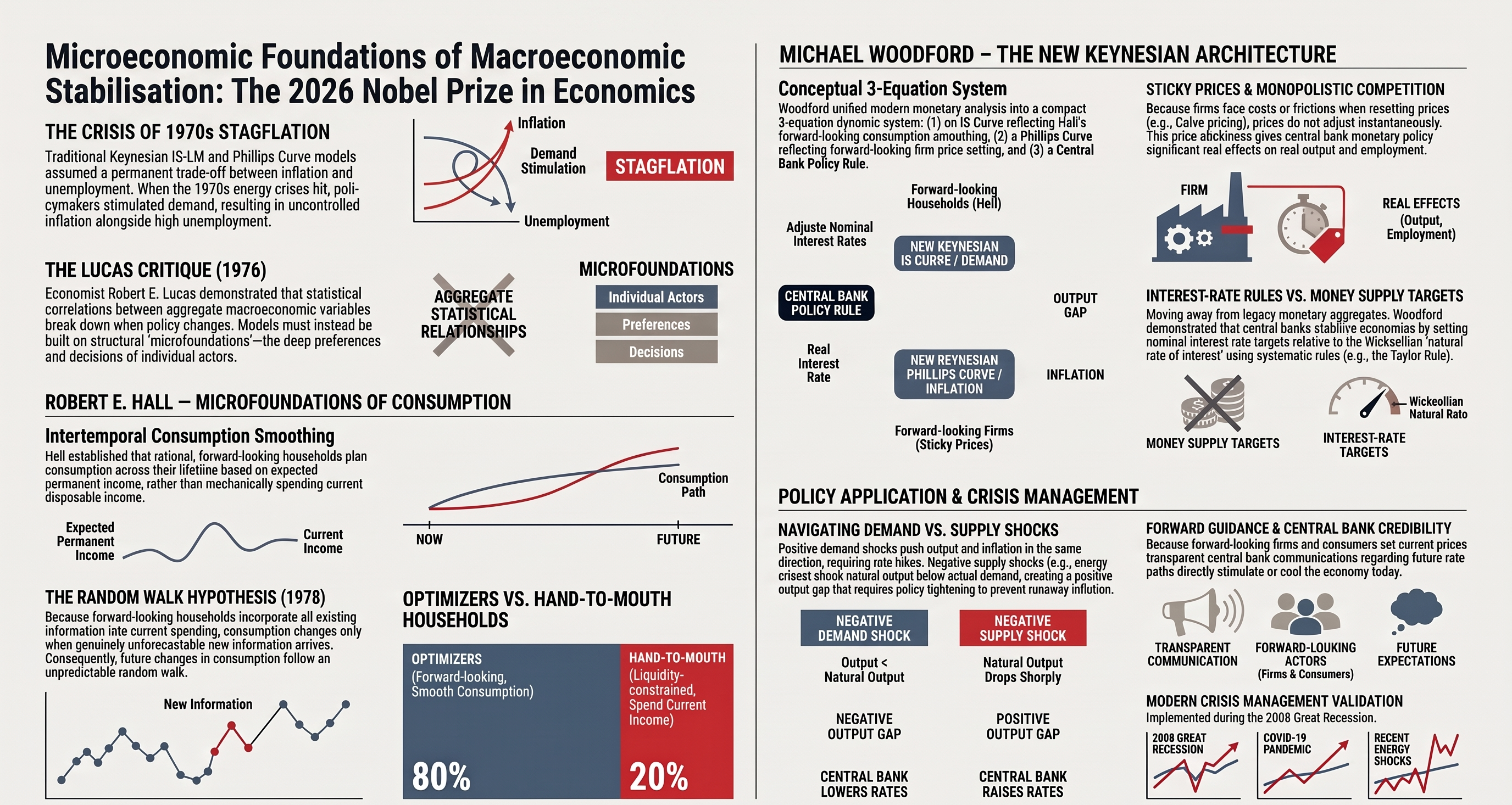
Then came the 1970s. Oil shocks triggered severe stagflation across Western economies — simultaneous stagnant growth, high unemployment, and soaring inflation. Government stimulus designed to reduce unemployment failed to boost production and instead accelerated price rises. The standard models had no coherent explanation.
Nobel laureate Robert E. Lucas Jr. formalised the theoretical reason for this failure: traditional Keynesian models relied on reduced-form statistical correlations between aggregate variables rather than fundamental behavioural parameters. When policymakers attempt to exploit such correlations, rational individuals and firms adjust their expectations, altering the underlying relationships and causing policy to fail. A model derived from individual behaviour — robust to changes in the policy environment — was urgently needed.
This was the intellectual void that Hall and Woodford independently filled over the following three decades.
2. Robert E. Hall: The Random Walk of Consumption
Hall's crucial insight was to take Milton Friedman's Permanent Income Hypothesis seriously at an empirical level. Prior to his work, consumption theory acknowledged that consumers are forward-looking, but treated the unobservable expectations of future income as practically untestable.
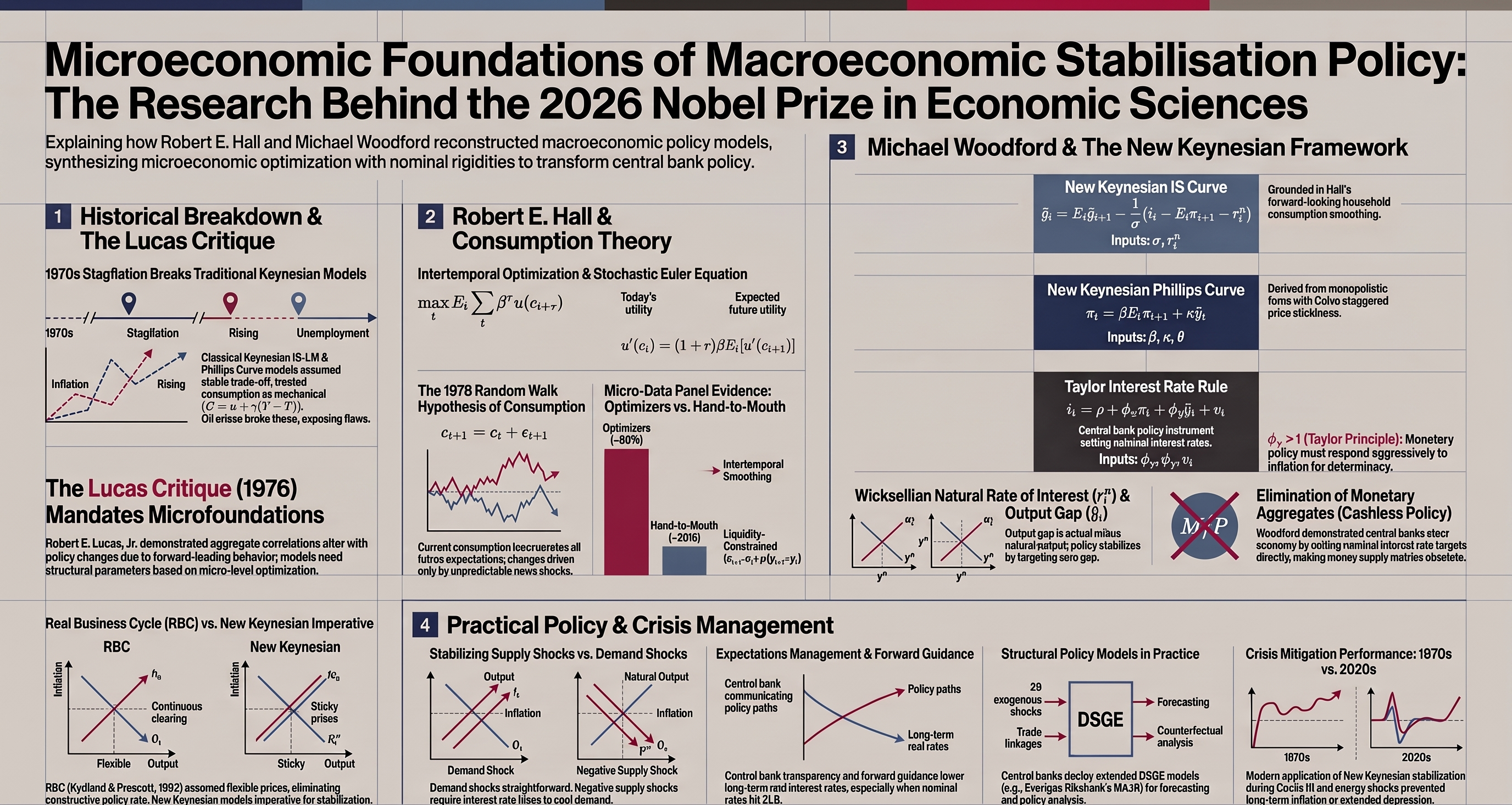
In a seminal 1978 paper, Hall derived the intertemporal stochastic Euler equation for optimising households. He showed that if consumers are fully rational and use financial markets to smooth consumption over time, then current consumption already incorporates all available information about past, present, and expected future income.
where ε is unpredictable — only new information drives consumption changes
The implication was radical: consumption follows a random walk. Changes in consumption from one period to the next are driven only by genuinely new, unpredictable information or unanticipated economic shocks. Past income levels should have no predictive power for future consumption changes once current consumption is controlled for. Hall verified this against aggregate US data — and it held.
The 80/20 Split: Optimisers and Hand-to-Mouth Consumers
In 1982, Hall and Fredric Mishkin expanded the framework using panel data from individual households in the Panel Study of Income Dynamics (PSID). They found a structural heterogeneity that has become central to modern macroeconomic modelling:
- ~80% of households behave as rational, forward-looking optimisers who smooth consumption intertemporally through savings and borrowing
- ~20% of households face binding borrowing constraints or lack financial savings, consuming strictly out of current income (hand-to-mouth behaviour)
This dual structure explains why fiscal transfers and tax cuts can have real short-run demand effects even when Ricardian equivalence might suggest otherwise — the hand-to-mouth segment spends immediately. It is now a standard building block in Dynamic Stochastic General Equilibrium (DSGE) models used by central banks worldwide.
3. Michael Woodford: Building the New Keynesian Architecture
Building directly upon Hall's consumption theory and incorporating nominal price-setting frictions, Woodford became the principal architect of the New Keynesian model. In a series of seminal papers in the 1990s and his monumental 2003 treatise Interest and Prices: Foundations of a Theory of Monetary Policy, Woodford synthesised a complete macroeconomic framework grounded in explicit microfoundations.
The Three-Equation Model
Woodford's core framework replaced the old IS-LM apparatus with a compact, dynamic three-equation system:
The Wicksellian Revival: The Natural Rate of Interest
Woodford revitalised the 19th-century insights of Swedish economist Knut Wicksell by defining the natural rate of interest — the real interest rate consistent with aggregate demand equalling natural output and stable prices. He proved that central banks do not need to control monetary aggregates (M1, M2) to stabilise prices. Instead, monetary policy operates by setting nominal interest rates relative to the natural rate — and this works even in a fully cashless financial system.
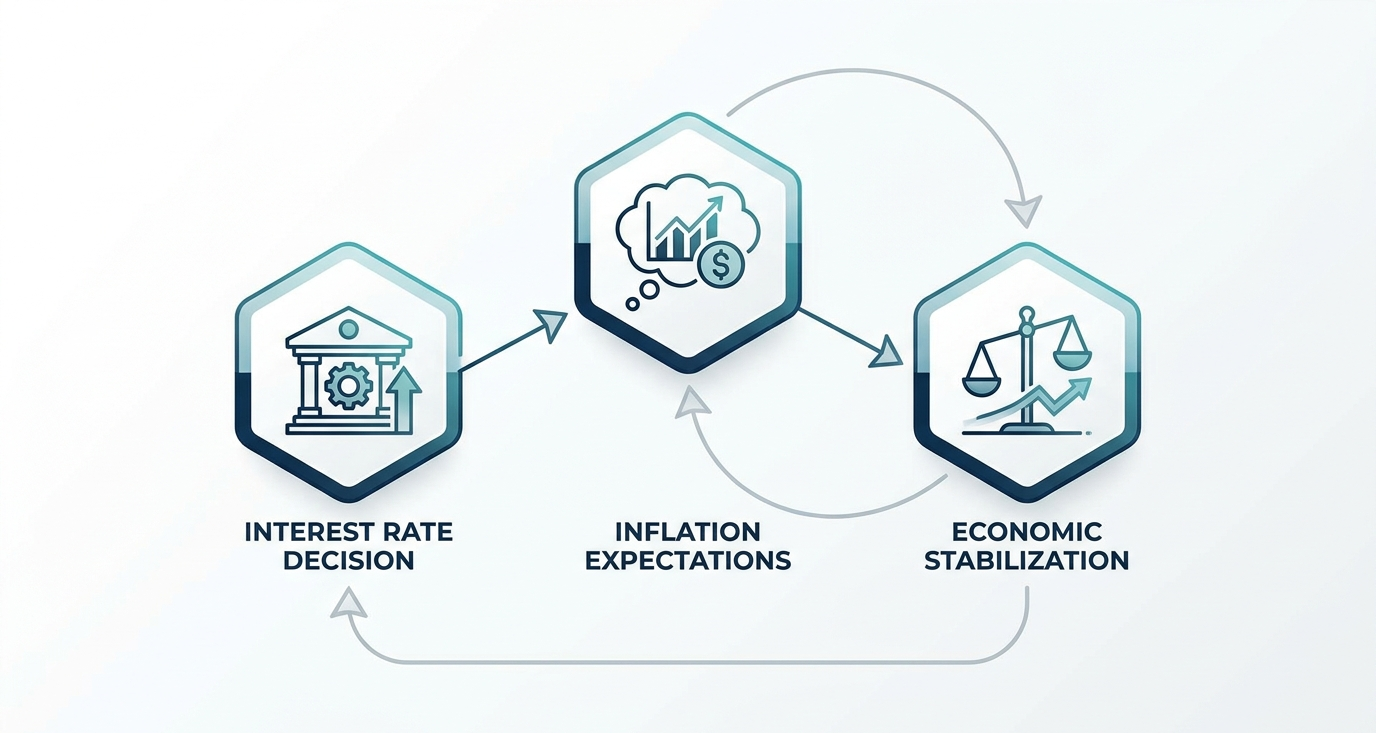
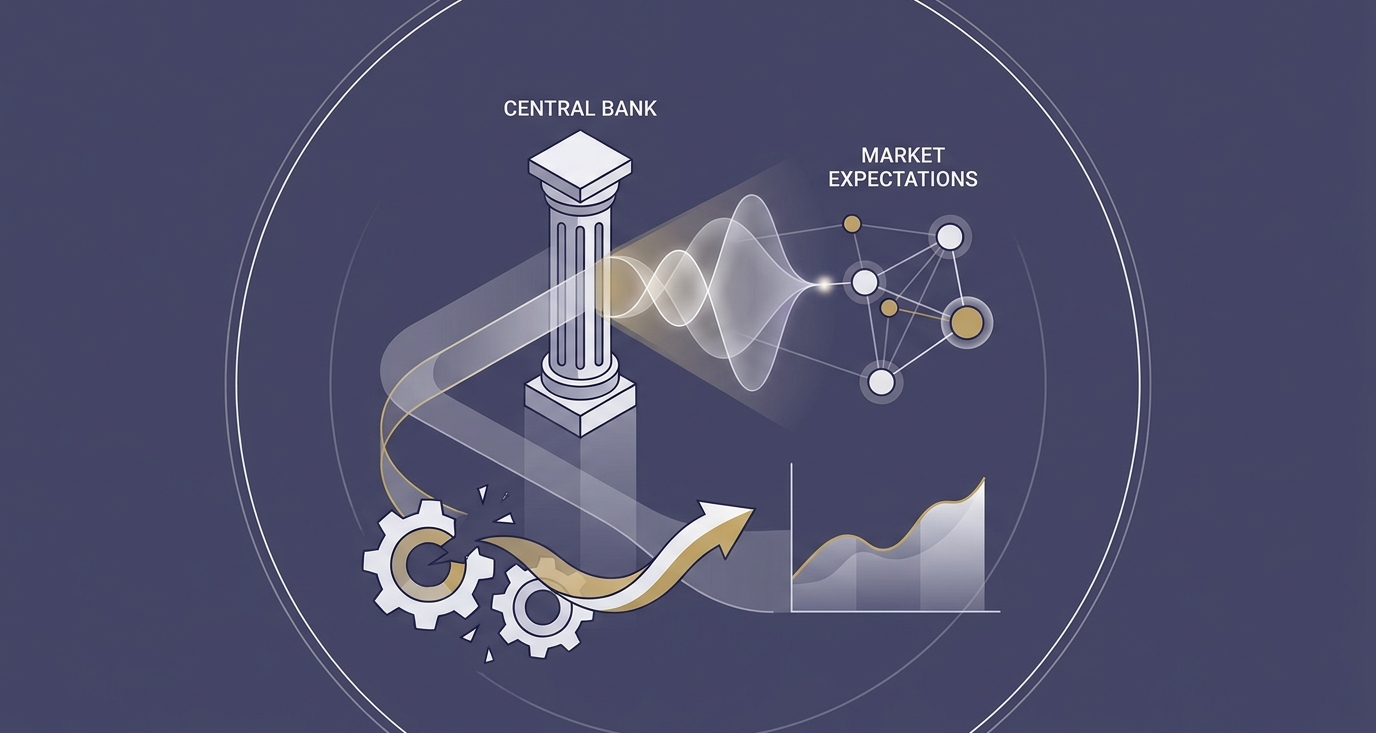
Woodford demonstrated that expectations management is monetary policy. Because firms and households are forward-looking, what matters is not just the current interest rate, but the entire anticipated path of future interest rates. A central bank's credibility and communication strategy are therefore first-order policy instruments — not ancillary concerns.
4. Policy Application: Forward Guidance and Crisis Management
The theoretical framework translates directly into central bank practice. The most consequential application emerged in response to the Zero Lower Bound (ZLB) — the constraint that nominal interest rates cannot be cut below zero (or very slightly below).
During deep recessions such as the 2008 Global Financial Crisis and the COVID-19 pandemic, central banks exhausted conventional rate-cutting space. Woodford's model showed the solution: forward guidance. By explicitly committing to keep future interest rates low even after recovery begins, central banks lower expected future real interest rates, boosting current consumption and investment through the New Keynesian IS Curve mechanism.
Diagnosing Shocks: Supply vs. Demand
A second major policy application is the framework's ability to distinguish between types of economic shocks — a distinction with radically different policy implications:
- Demand shocks push output and inflation in the same direction. A central bank can address both simultaneously without trade-offs — cutting rates boosts output and raises inflation back to target when demand collapses.
- Supply shocks push output and inflation in opposite directions. When a negative supply shock (such as an oil embargo or supply chain disruption) reduces natural output while driving up costs, the central bank faces a painful trade-off. Woodford's model prescribes raising rates to cool aggregate demand to the new, lower natural level — preventing inflation from becoming unanchored, even at the cost of short-run output contraction.
The 2022–23 global inflation surge — driven primarily by pandemic supply disruptions and the energy price shock from the Ukraine war — was a textbook supply shock in the New Keynesian framework. Central banks worldwide raised rates aggressively. Unlike the 1970s stagflation, inflation was brought back under control without triggering a prolonged recession. This outcome was not accidental: it was the framework working as designed.
5. A Timeline of the Ideas
Keynes publishes The General Theory. IS-LM formalisation follows. Demand management becomes the dominant policy paradigm for 40 years.
Oil shocks expose the limits of traditional Keynesian models. Simultaneous high inflation and unemployment breaks the assumed stable Phillips Curve trade-off.
Lucas argues that policies based on historical correlations will fail when agents adjust expectations. Macroeconomics requires microfoundations.
Hall derives the stochastic Euler equation and shows consumption follows a random walk under rational expectations — a cornerstone of modern macro.
Using PSID microdata: ~80% forward-looking optimisers, ~20% hand-to-mouth consumers. The dual-agent structure enters the modelling toolkit.
Woodford (and contemporaries Clarida, Galí, Gertler) develop the three-equation New Keynesian model. Central bank practice begins to align with theory.
The definitive synthesis: a complete, rigorous New Keynesian framework showing that interest rates alone can stabilise economies, even without controlling money supply.
The framework's prescriptions guide central bank responses. Forward guidance deployed for the first time at the ZLB. Recovery — though slow — vindicates the model.
Post-pandemic supply disruptions and energy shocks test the framework's supply shock diagnostics. Central banks raise rates; inflation is contained without prolonged stagnation.
Hall and Woodford receive the Sveriges Riksbank Prize for building modern macroeconomic policy on rigorous microeconomic foundations.
6. Why This Matters for Investors
The Hall-Woodford framework is not academic abstraction — it is the operating system of every major central bank. Understanding it changes how you interpret monetary policy communications and anticipate market moves.
7. A Lasting Legacy
The microeconomic foundations developed by Hall and Woodford restored credibility and effectiveness to macroeconomic stabilisation policy. The contrast with the 1970s is stark: modern economies have experienced severe shocks — the 2008 financial crash, COVID-19, the energy price spiral — yet managed to recover far more rapidly and avoid the sustained inflationary spirals of the stagflation era.
That outcome did not happen by accident. It happened because central banks had a theoretically coherent, empirically grounded framework telling them what to do, how to communicate it, and why it would work. That framework rests on the intellectual architecture of Robert E. Hall and Michael Woodford.
For retail investors, the practical implication is that central bank communications are now substantive policy instruments, not institutional noise. When the ECB or the Federal Reserve says it expects to hold rates at a certain level, it is deliberately shaping the expectations of every household and firm — and through that channel, current economic activity. Knowing the mechanism makes the message legible.