OKX is the world's second-largest crypto exchange by derivatives volume — and its fee architecture is significantly more nuanced than its headline rate of 0.08% maker / 0.10% taker suggests. Two hidden traps systematically cost users far more than they realize: the "Convert" spread that can run 12× the cost of a limit order, and an EU regulatory fork that penalizes EEA users who haven't activated a specific account type. This is the complete structural diagnostic — two decks, one blueprint.
The Convert trap: OKX's most expensive feature
OKX markets its "Convert" function as zero fees, zero slippage — instant crypto swaps at no cost to the user. The reality is structurally different. Convert routes all orders to market makers who embed a hidden spread of up to 1.00% into the execution price. The fee doesn't disappear; it's baked into the rate you receive.
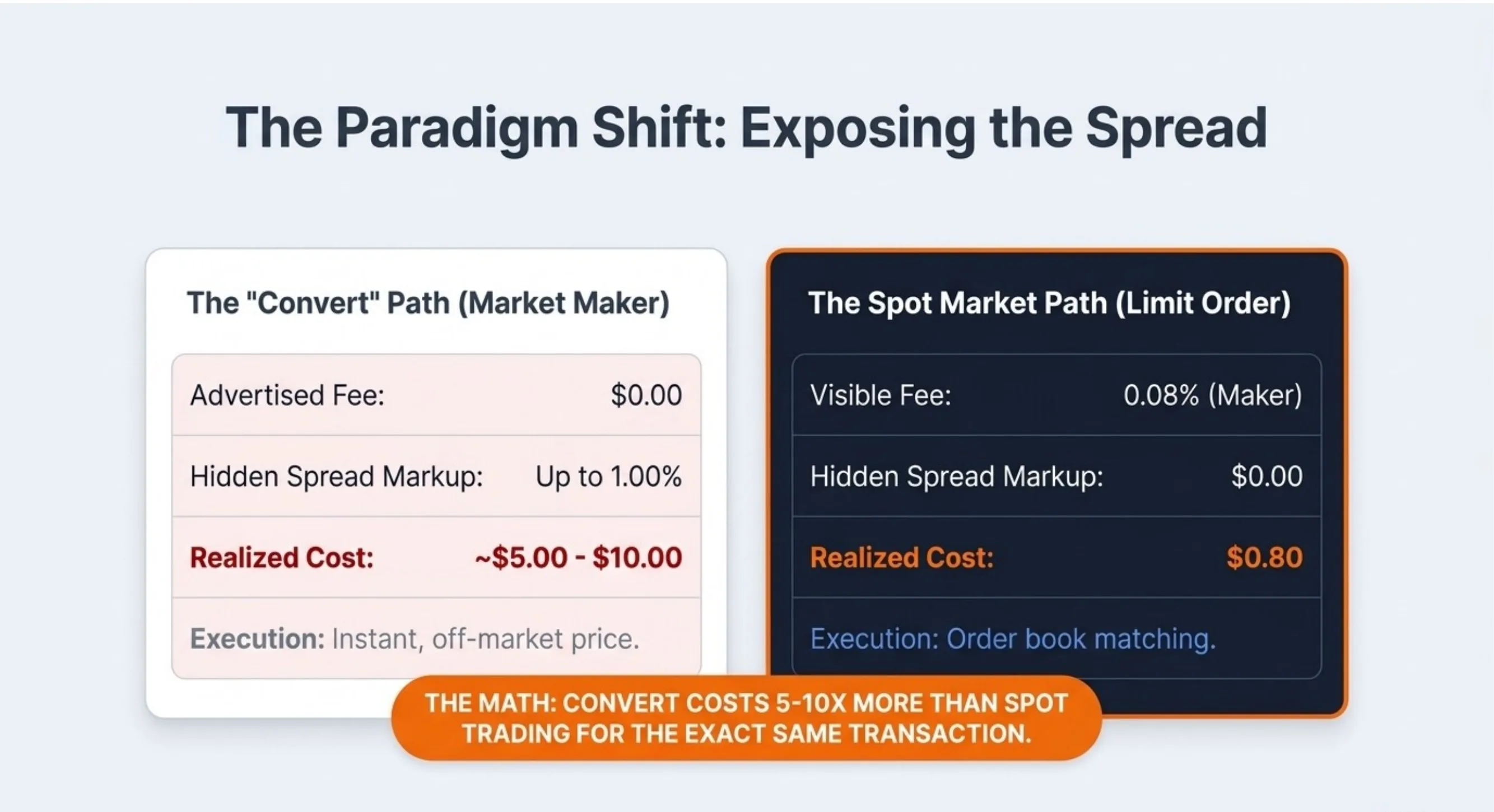
On a $1,000 trade: Convert costs ~$5.00–$10.00 in realized terms vs $0.80 for a Spot Market limit order. The advertised "zero fee" is offset entirely by the embedded spread.
The math is unambiguous. For any transaction above $100, using the Spot Market order book — specifically a limit (maker) order — is mathematically superior in every scenario. Convert should be reserved only for very small amounts where the convenience of instant execution is worth a few cents.
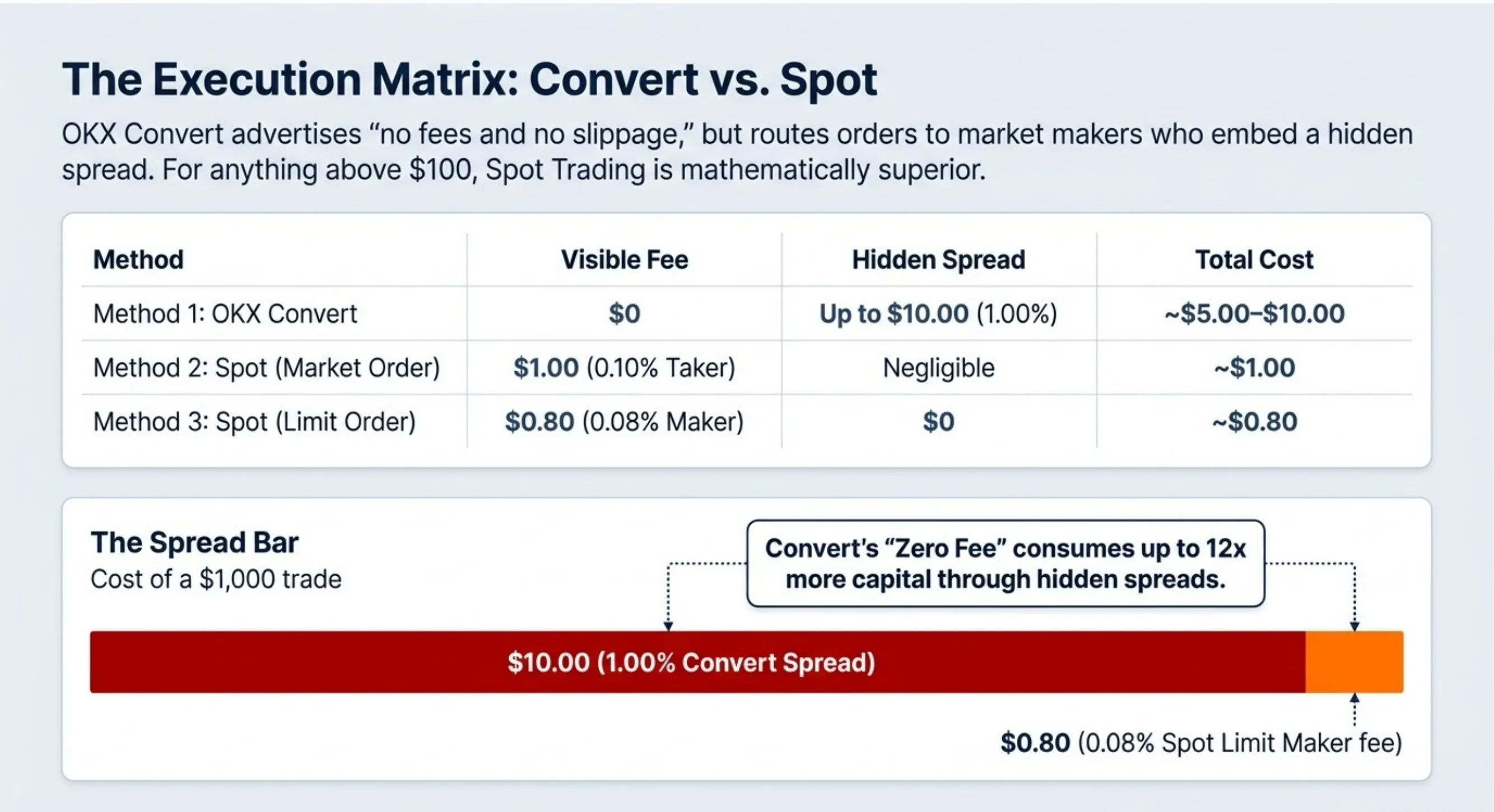
The spread bar makes the math visceral: Convert's "zero fee" can consume up to 12× more capital than a Spot Limit (Maker) order on the same transaction. OKX Convert advertises "no fees and no slippage" — but routes orders to market makers who embed the cost in the execution price.
⚠️
Never use OKX Convert for any transaction above $100. The hidden spread embedded by market makers systematically costs 5–12× more than placing the same trade via the Spot Market with a limit order. The "zero fee" label is accurate for the visible fee — not for the realized cost of execution.
Why makers pay less: the order book mechanics
OKX's fee asymmetry — 0.08% maker vs 0.10% taker at the regular tier — is not arbitrary. It reflects a fundamental economic function in central limit order book (CLOB) markets. Understanding the distinction is the foundation of every fee optimization strategy on the platform.
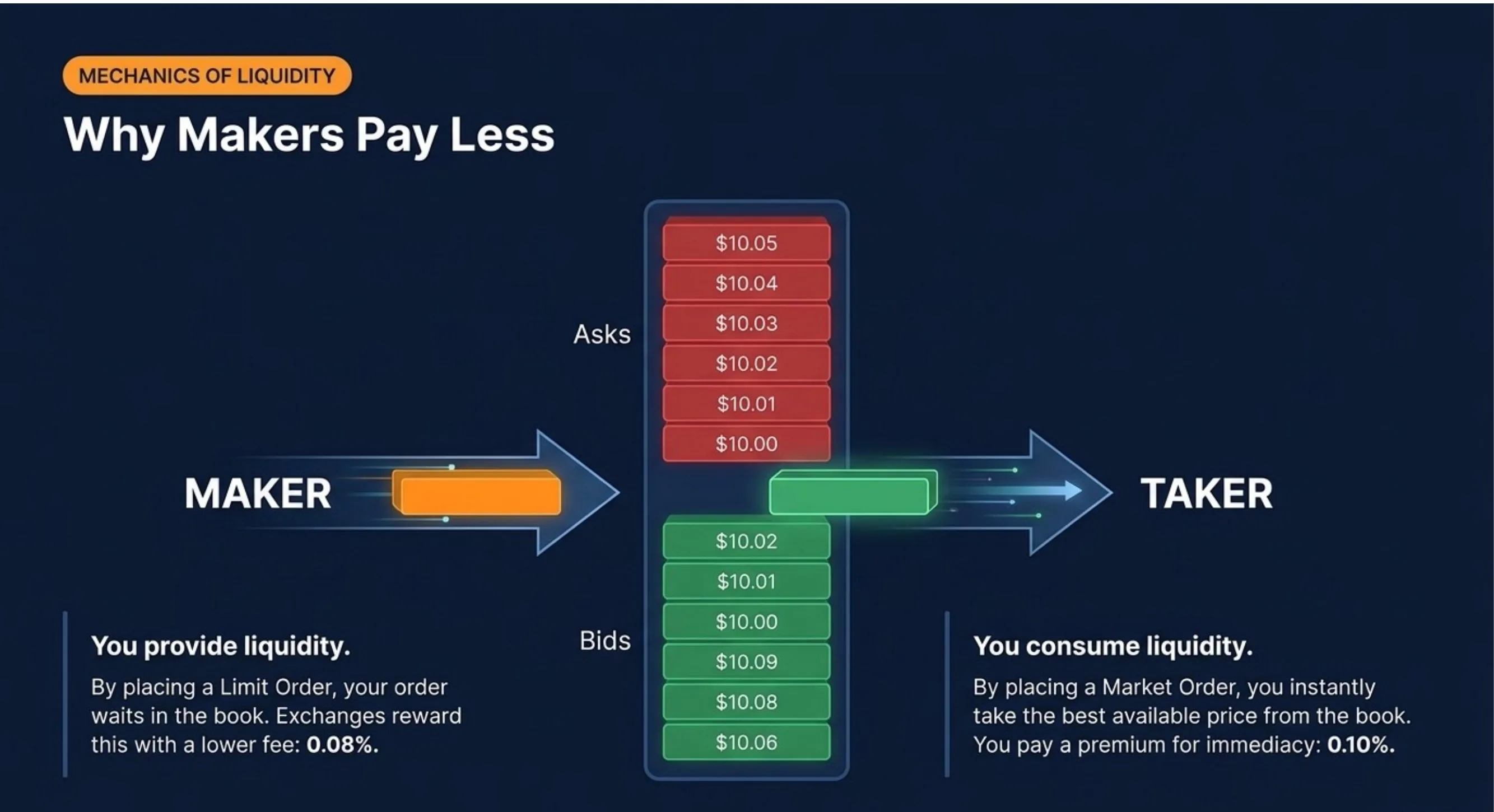
Maker: you post a limit order that waits in the book, adding liquidity. Taker: you execute a market order that instantly fills against existing orders, removing liquidity. Exchanges reward provision; they charge for consumption.
Placing a limit order — even a limit order that executes immediately at the best available price — qualifies for the maker rate if it enters the order book first. This distinction is worth 0.02% per trade (20% less than the taker rate), which compounds materially for active traders. Every optimization strategy on OKX starts from this principle: always use limit orders, not market orders.
Key takeaway: Switching from market orders (taker, 0.10%) to limit orders (maker, 0.08%) saves 20% on every spot trade, requires no additional capital, no token holdings, and no VIP status. It is the single most accessible fee reduction on OKX — available to every user from day one.
The EEA regulatory fee anomaly: the X-Perps fork
EU and EEA users face a structural fee disadvantage that most European OKX traders are entirely unaware of. Due to MiCA regulatory compliance requirements, OKX applies different base spot fees depending on whether a user has activated an X-Perps (Derivatives) account — even if they never intend to trade derivatives.
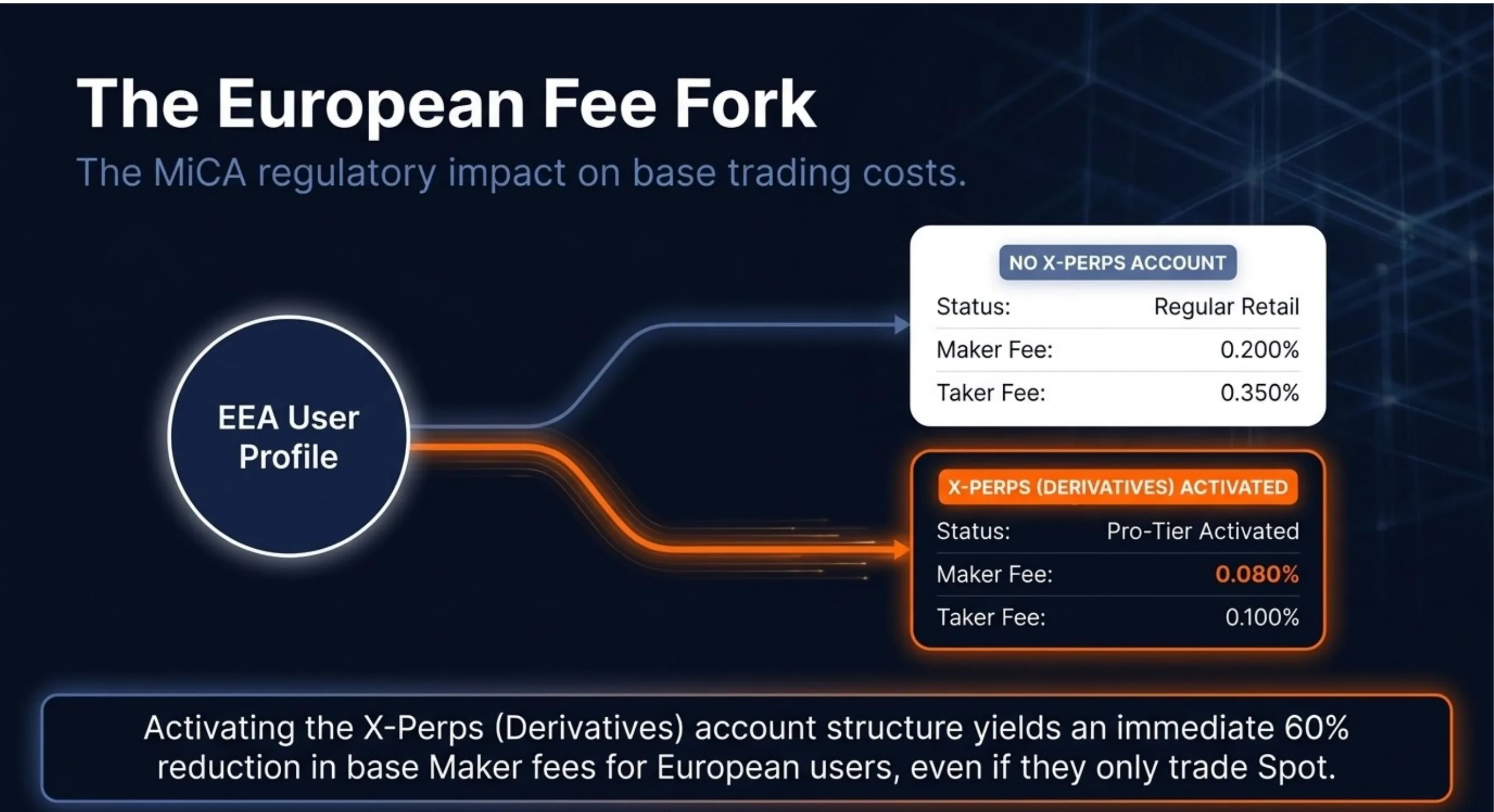
The fee fork is structural, not tiered: activating the X-Perps account drops base Maker fees from 0.200% to 0.080% — a 60% reduction — regardless of trading volume or asset balance.
The impact is severe: EEA users without an X-Perps account pay 0.200% maker / 0.350% taker — 2.5× more expensive than the global base rate of 0.08% / 0.10%. This represents a 250% increase in base trading costs for what is effectively a configuration omission, not a tier difference.
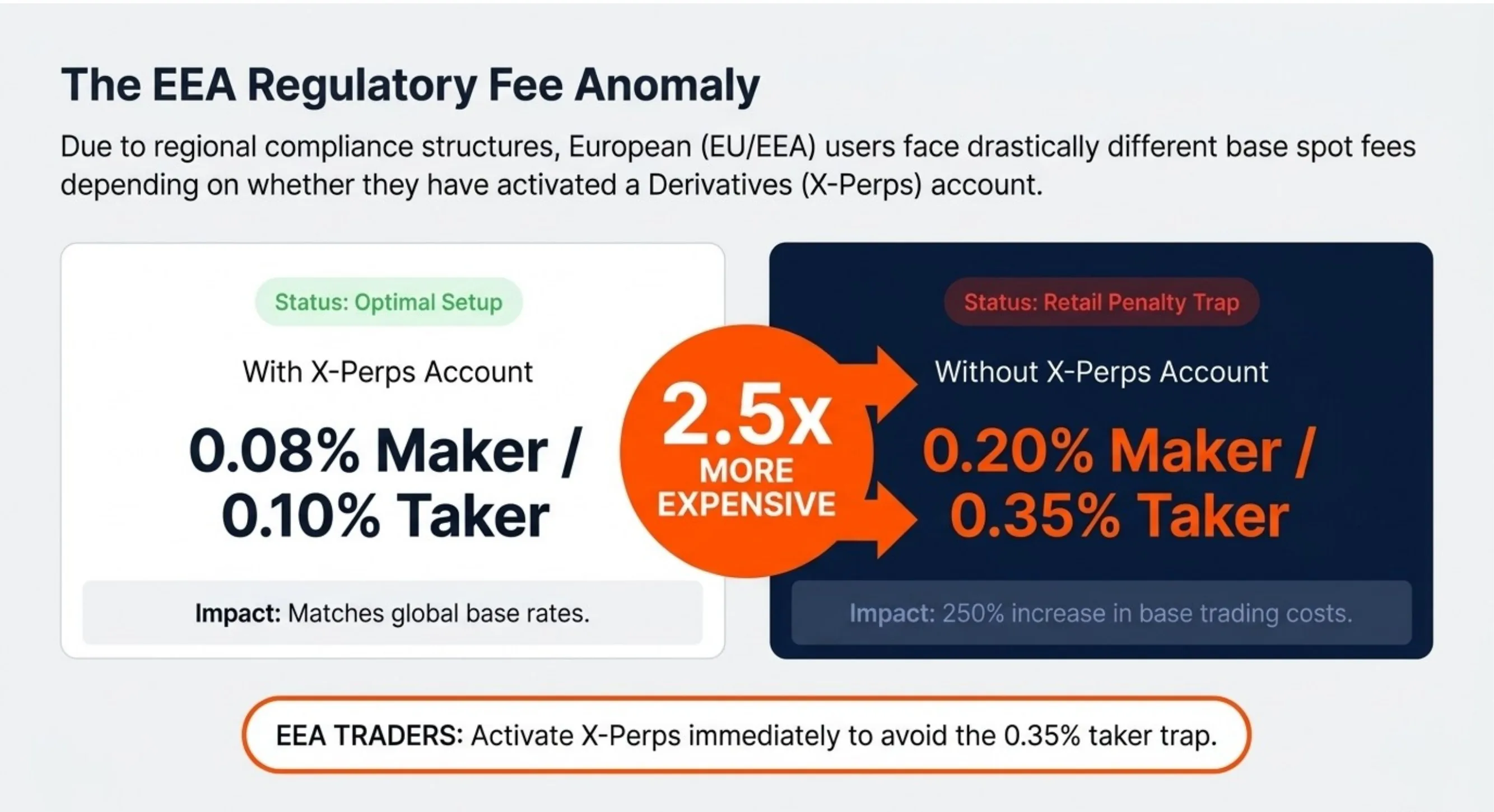
Without X-Perps: EEA users pay the "Retail Penalty Trap" — 0.20% maker / 0.35% taker. With X-Perps activated: standard global rates of 0.08% / 0.10% apply. The fix takes minutes and requires no additional capital.
✅
Action for all EU/EEA users: Navigate to your OKX account settings and activate the X-Perps (Derivatives) account immediately — even if you never trade derivatives. This single action drops your base Maker fee from 0.200% to 0.080% and your Taker fee from 0.350% to 0.100%. It costs nothing and takes under two minutes.
The VIP fee ladder: one metric, not two
OKX's VIP tier system has a critical structural difference from Binance: you only need to satisfy one of two thresholds — either total asset balance OR 30-day trading volume. Binance requires both simultaneously. This makes OKX's tier structure significantly more accessible for traders who hold assets but trade infrequently, and vice versa.
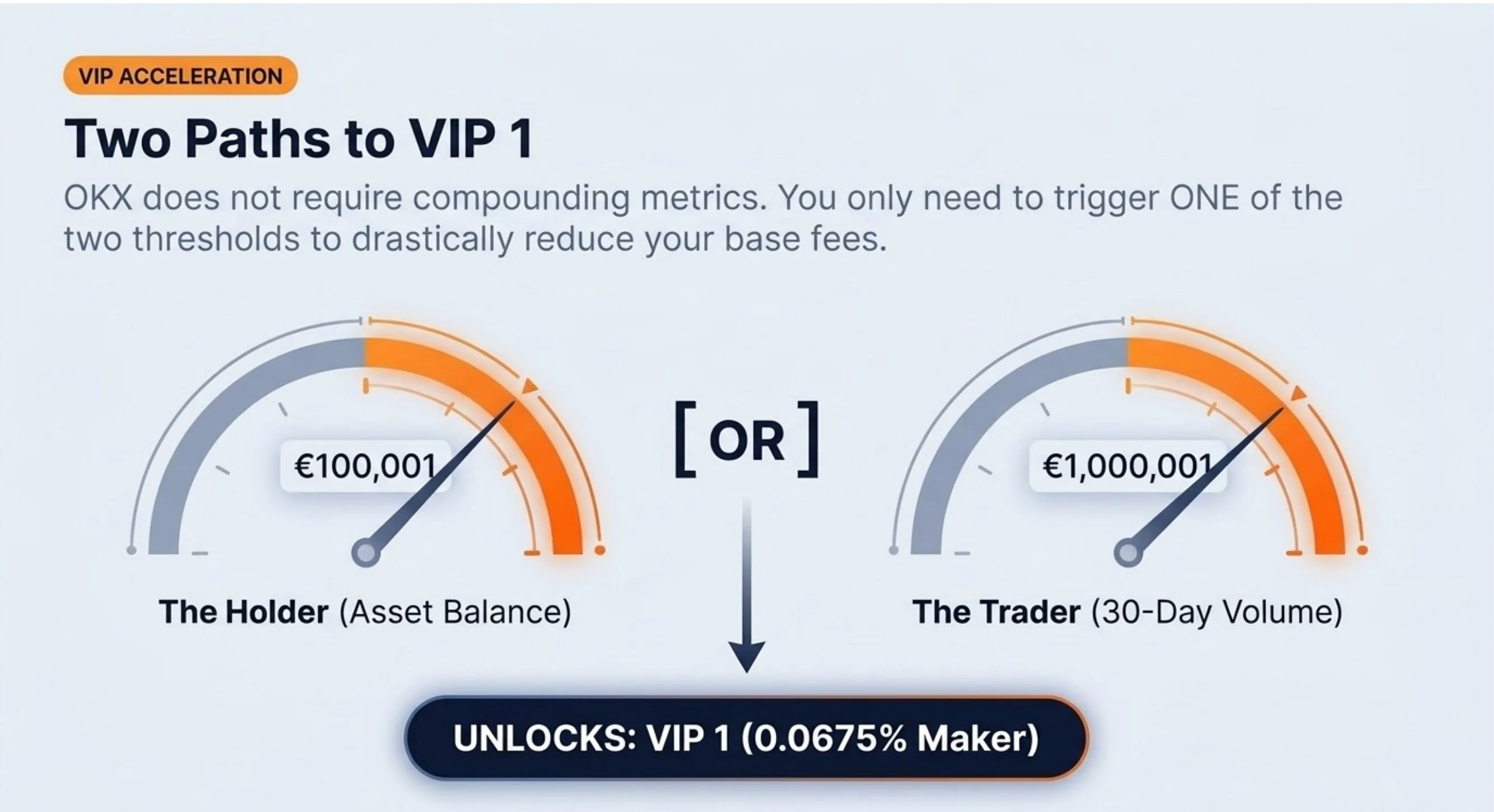
OKX does not require compounding metrics. You only need to trigger ONE threshold: hold €100k+ in assets (without trading), or generate €1M+ in 30-day volume. Either path unlocks VIP 1.
The tier structure itself scales from Regular through VIP 5 (Platinum). The gap between top and bottom is significant — but not as extreme as Binance's ladder, which extends to VIP 9 and requires locked token holdings at every step.
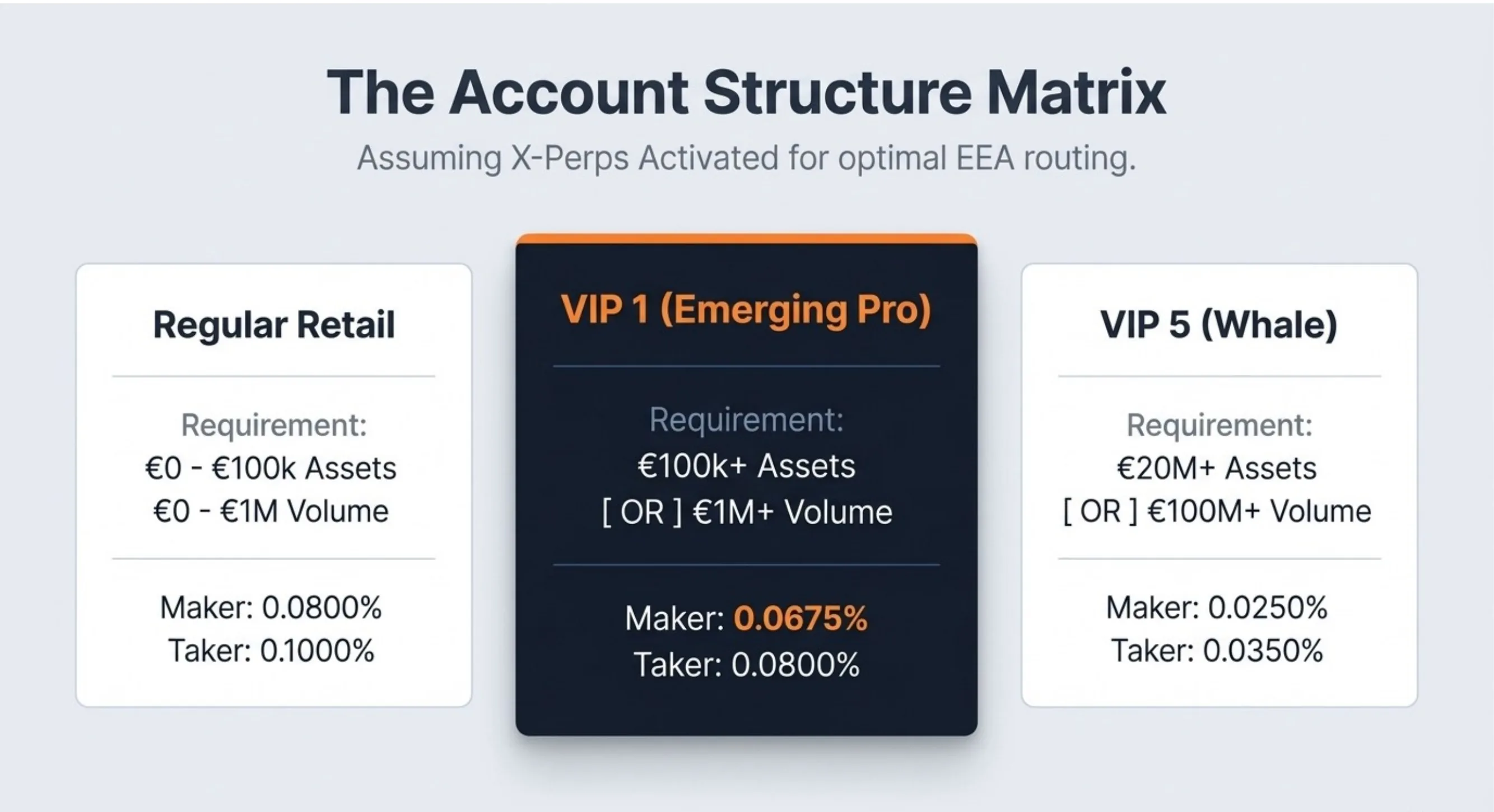
Three representative tiers: Regular (0.0800% maker), VIP 1 Emerging Pro (0.0675% maker, accessible with just €100k in assets), VIP 5 Platinum/Whale (0.0250% maker). All figures assume X-Perps activated for EEA routing.
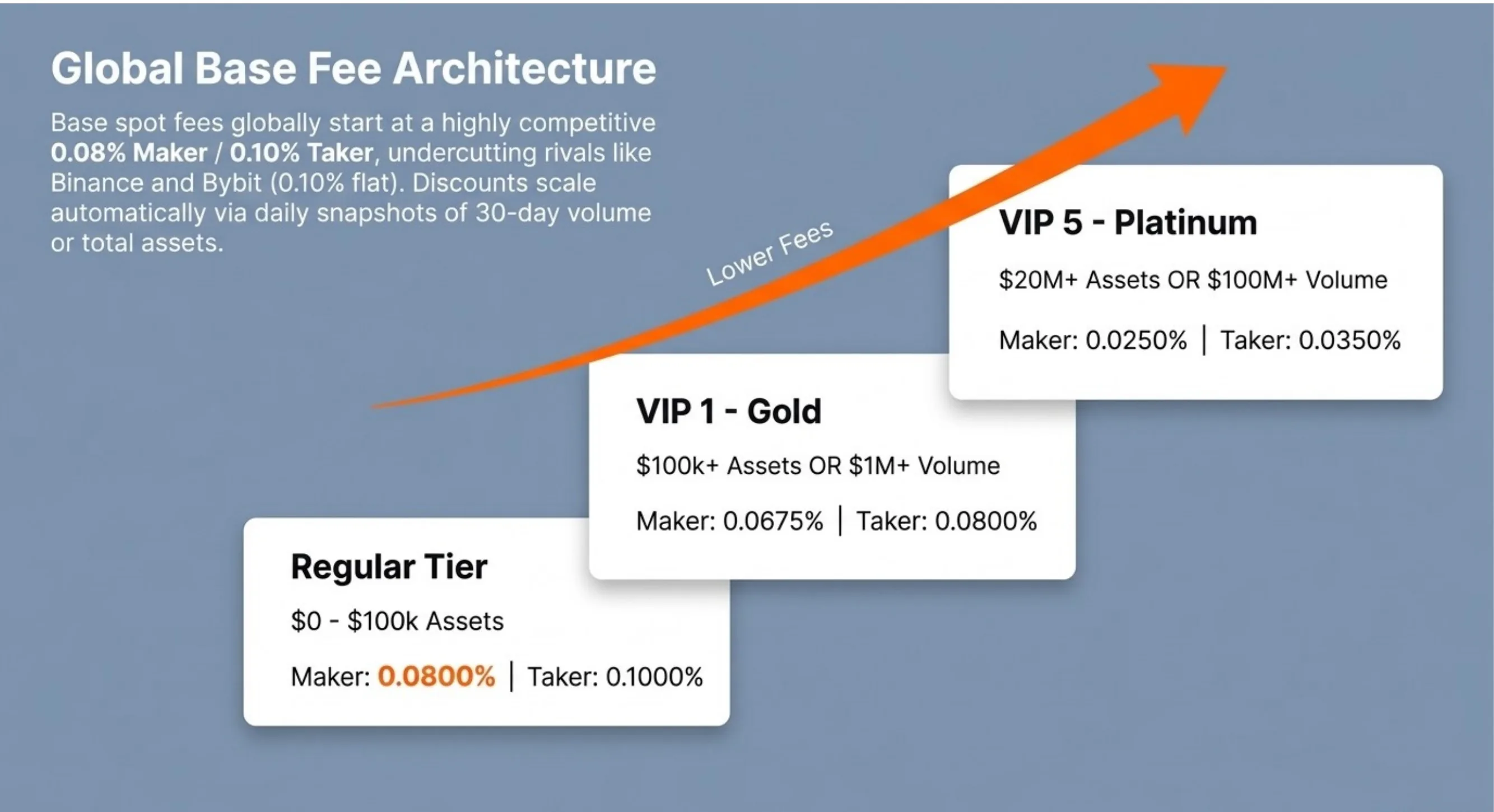
Unlike Binance's daily manual threshold checks and locked BNB requirement, OKX recalculates tiers automatically via daily snapshots — no action required when you cross a threshold.
Key takeaway: A trader holding €100,001 in OKX assets immediately qualifies for VIP 1 (0.0675% maker) — no trading volume needed. A trader generating €1M+ in 30-day volume qualifies regardless of account balance. OKX's single-threshold design eliminates the "capital lockup" dynamic that defines Binance's BNB-linked tier structure.
KYC gates and account access tiers
OKX enforces identity verification at three levels that gate both withdrawal limits and product access. The default state for unverified users is browse-only — no trading, no deposits are possible. Advancing to Level 2 is the practical requirement for any active trader.
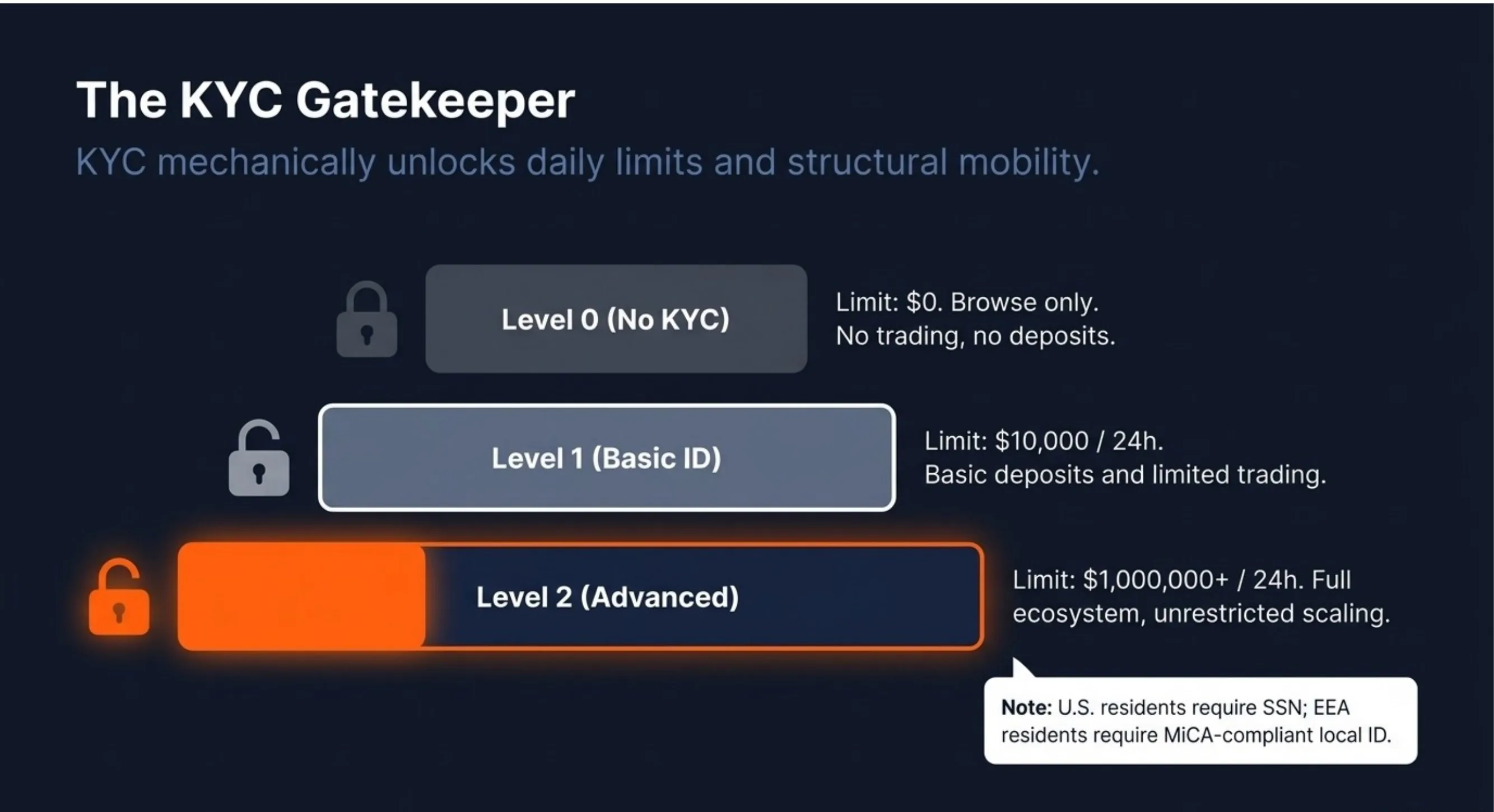
Level 2 is the operational floor for any serious trader: it unlocks the full $1M+/24h withdrawal limit, staking, NFT access, and all exchange products. US residents must provide SSN for Level 1; EEA users face enhanced source-of-funds checks at high volumes.
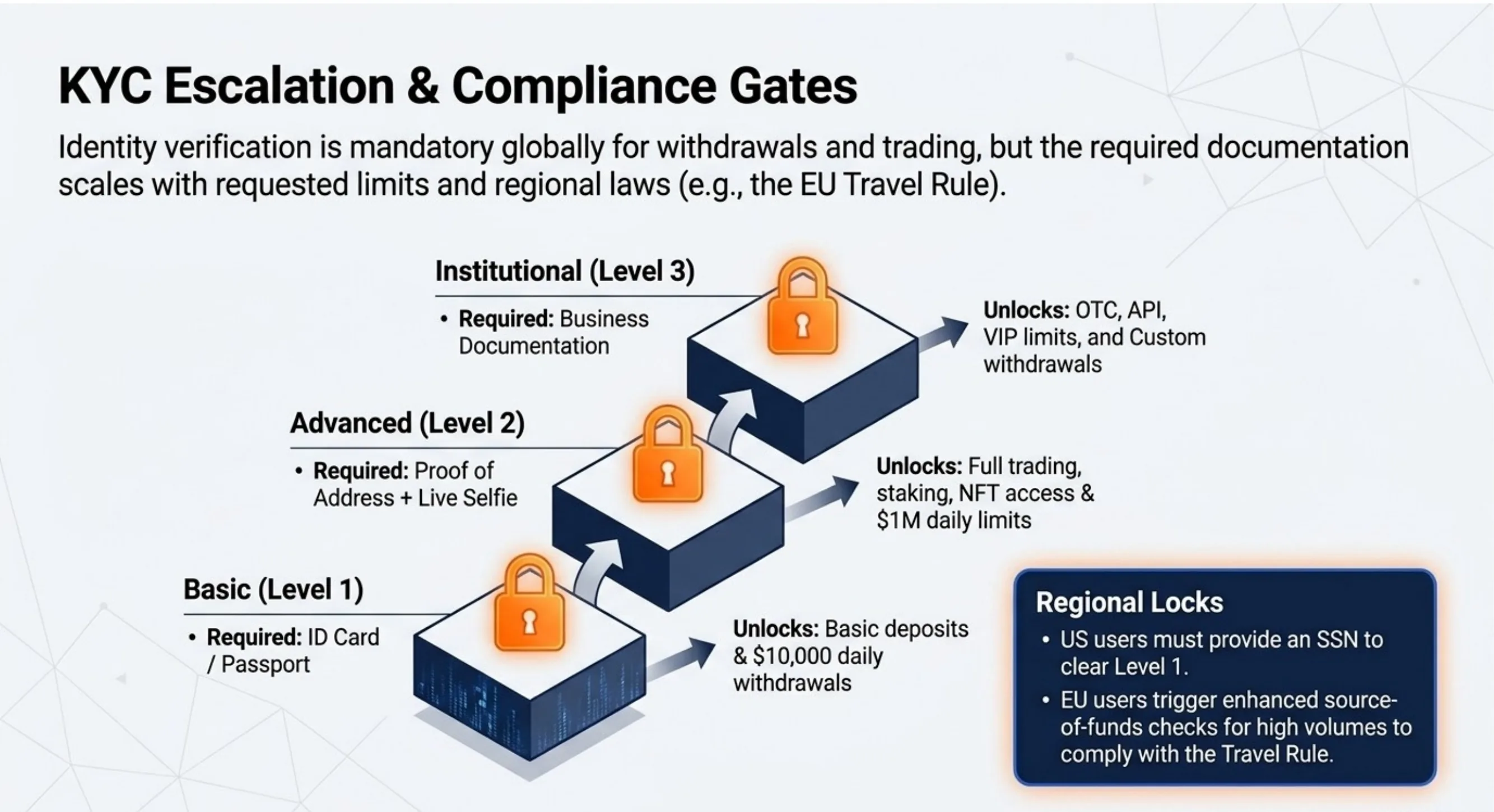
The three-tier KYC escalation governs what you can do, not just how much you can withdraw. Level 3 (Institutional) is required for OTC access, API trading with custom limits, and full VIP tier activation.
- Level 0 (No KYC): Browse only. No trading, no deposits, no withdrawals.
- Level 1 (Basic ID — passport or national ID): Basic deposits and $10,000/24h withdrawal limit. Sufficient for initial exploration but insufficient for active trading.
- Level 2 (Advanced — proof of address + live selfie): Full trading access, staking, NFT access, and $1,000,000/24h withdrawal limits. The practical minimum for any active trader.
- Level 3 (Institutional — business documentation): OTC desk access, API with custom limits, full VIP tier activation. Required for institutional use cases.
- Regional notes: US users must provide an SSN to clear Level 1. EU/EEA users trigger enhanced source-of-funds checks for high transaction volumes under the EU Travel Rule.
MiCA regulation, capital security & global access
OKX's regulatory footprint is one of the most advanced among major crypto exchanges — and for European users, it matters more than at any time in the exchange's history. As unregulated exchanges exit the EU ahead of the MiCA July 2026 deadline, OKX holds the CASP authorization that makes it the natural destination for displaced users.
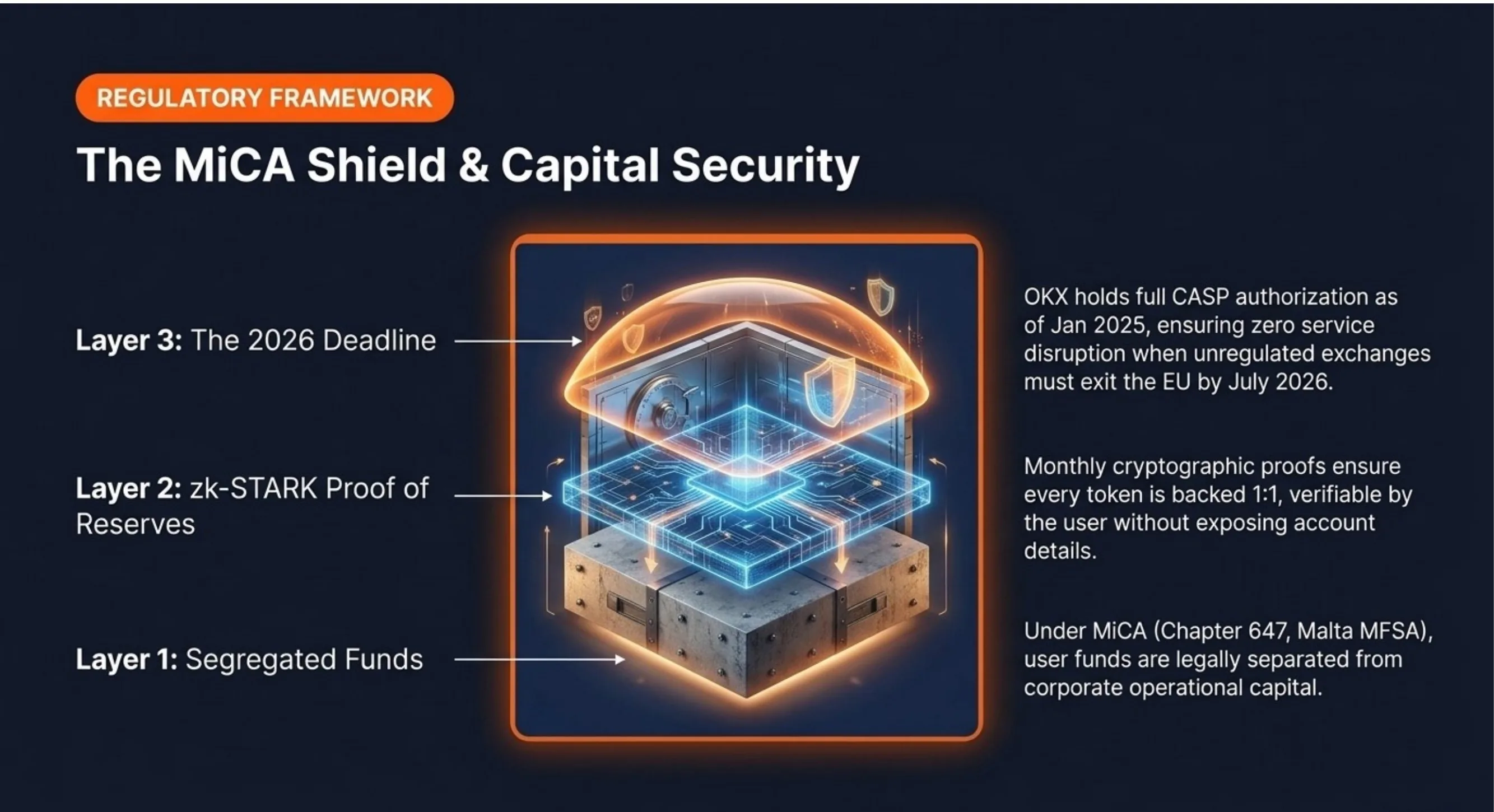
Three layers of capital protection: legal fund segregation under MiCA, monthly cryptographic reserve proofs (zk-STARK), and CASP authorization that predates the July 2026 compliance deadline by 18 months.
One Malta MFSA license passports OKX Europe Limited across all 30 EEA member states. This single authorization provides six legally enforceable protections that unregulated exchanges cannot offer:
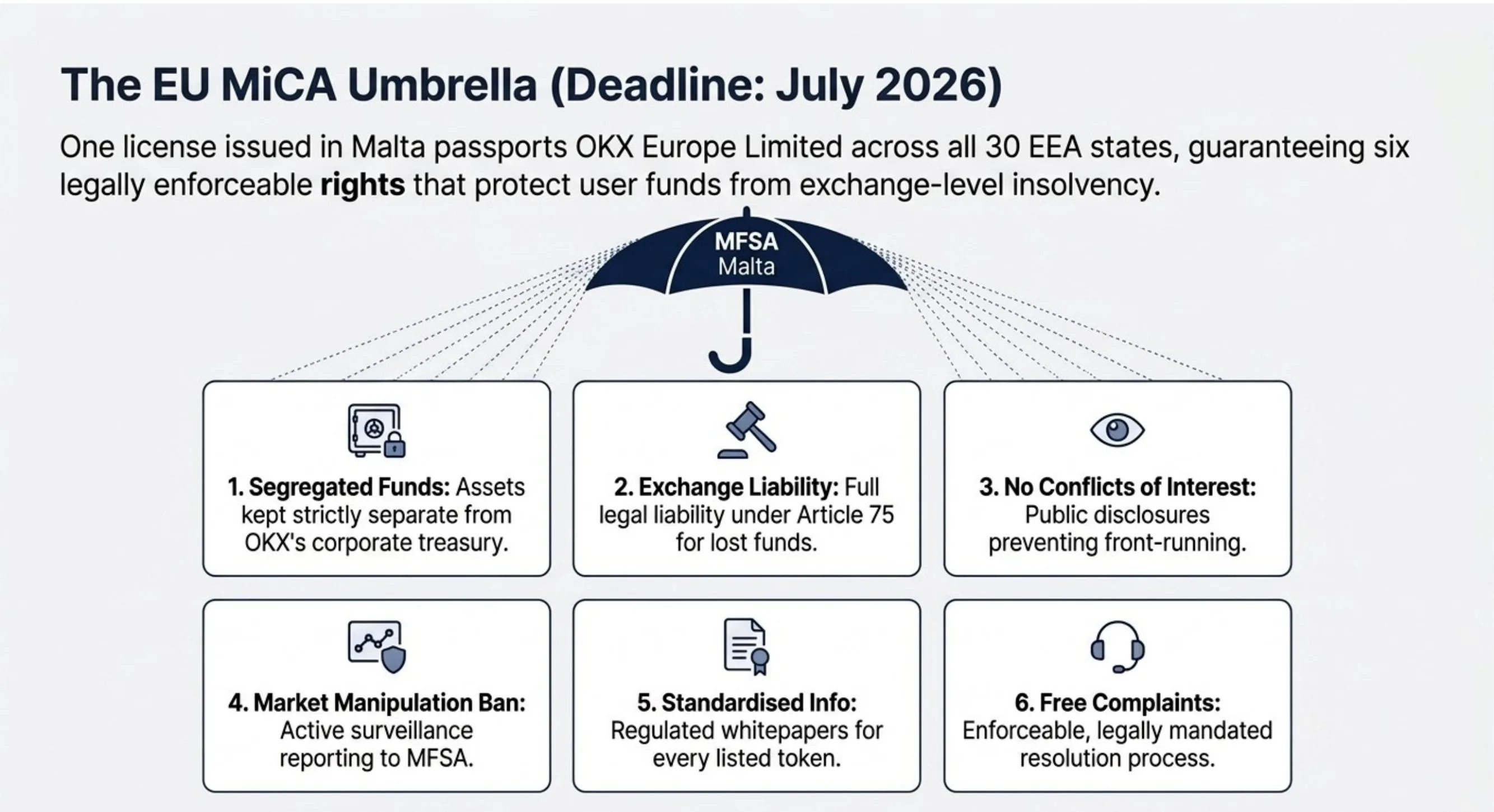
The six MiCA protections are legally mandated, not optional. Article 75 Exchange Liability means OKX bears full legal responsibility for lost funds — a protection unavailable on any unregulated exchange.
OKX's regulatory presence spans three major jurisdictions, each with distinct product sets and user access levels:
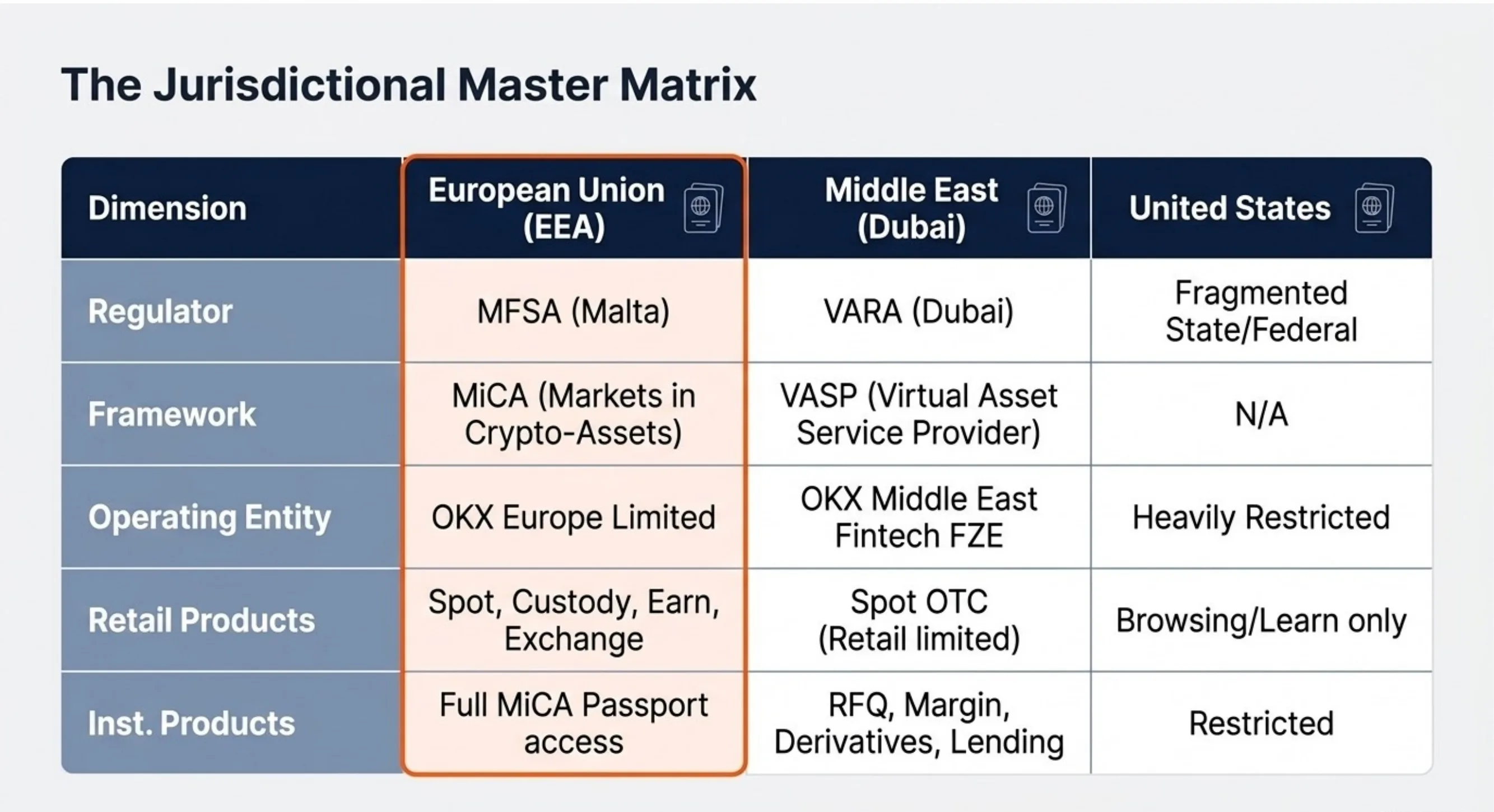
Three distinct regulatory frameworks: EU/EEA under MiCA (full retail access), Dubai under VARA (institutional-focused), and the US (restricted — browse only). Each jurisdiction operates through a separate legal entity with distinct product availability.
The Dubai VARA framework operates differently from the EU model — it segments users by capital qualification rather than providing broad retail access:
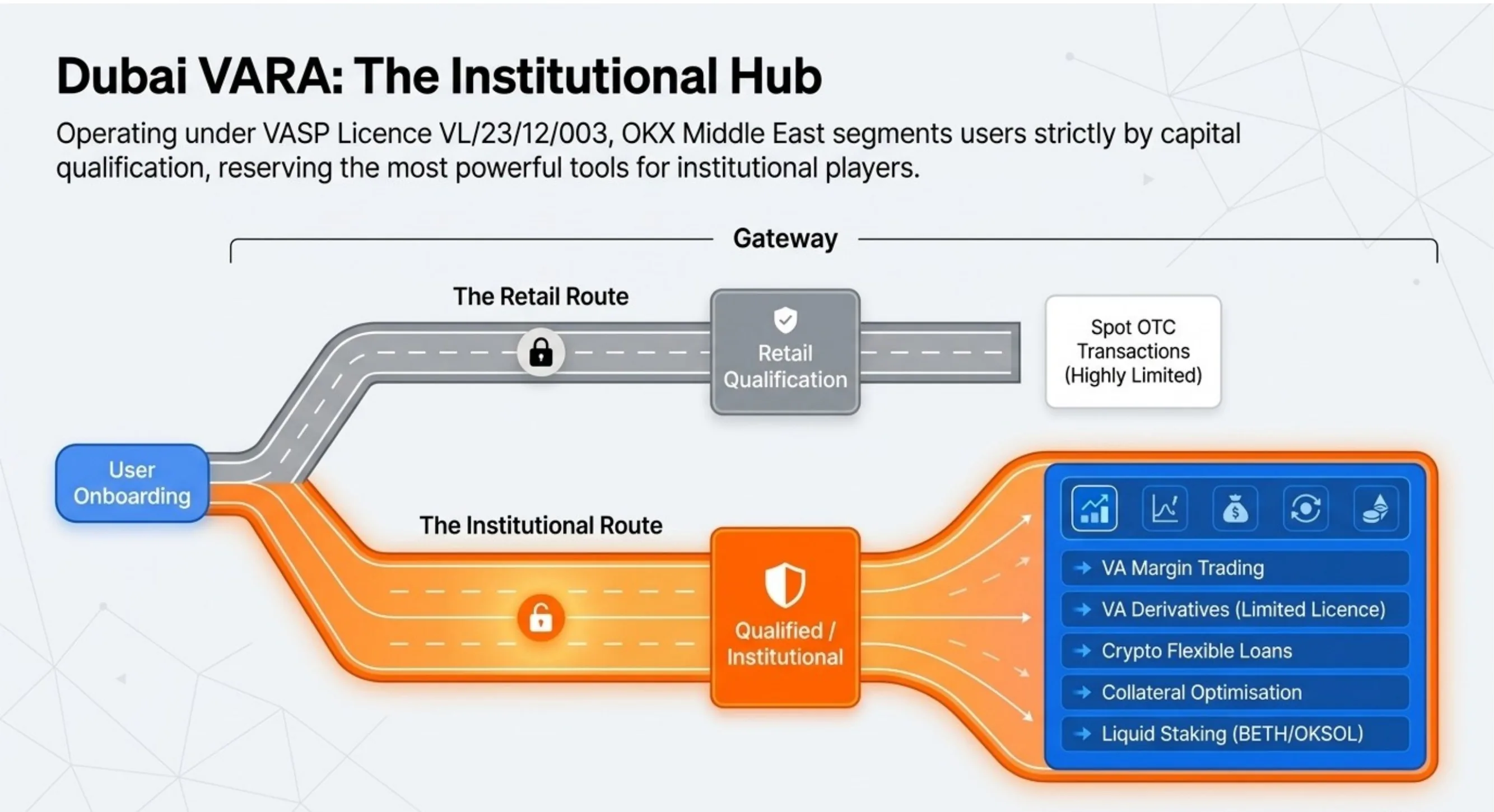
In Dubai, OKX is primarily an institutional platform. Retail users accessing OKX Middle East Fintech FZE are limited to spot OTC. Institutional clients unlock margin, derivatives, lending, and liquid staking.
ℹ️
US users: OKX.com offers browsing and educational content only for US residents as of 2026. No trading, deposits, or withdrawals are available. Regulated US alternatives include Coinbase, Kraken, and Gemini — all CFTC/FinCEN registered with comparable or broader crypto spot coverage.
OKX vs. the competition: the spot market benchmark
OKX's structural advantage over Binance and Bybit is visible at the base retail tier — before any VIP acceleration, before any token discounts, and available to any user who places limit orders. The comparison uses non-discounted base rates at the regular tier:
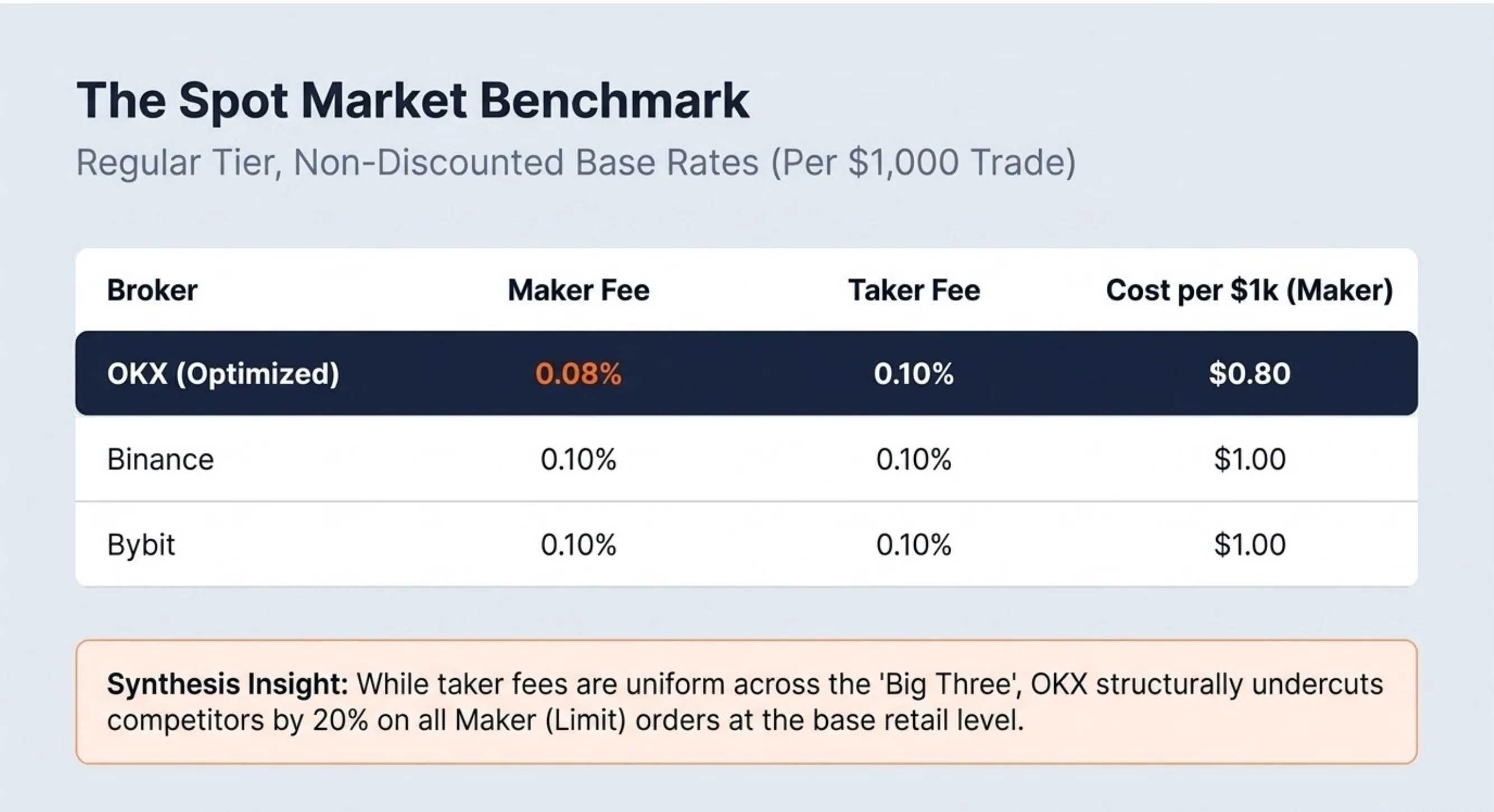
Taker fees are uniform across the Big Three at 0.10%. The structural differentiation is entirely on the maker side: OKX charges 0.08% vs Binance and Bybit's 0.10% — a 20% cost advantage on every limit order, at no additional cost or requirement.
The maker fee advantage (0.08% vs 0.10%) is modest in absolute terms but meaningful in practice. On $100,000 in monthly limit-order volume, it represents a $20 saving — purely from choosing OKX over Binance or Bybit at the base tier and using limit orders. The gap widens at VIP 1 (0.0675% on OKX vs 0.0900% on Binance VIP 1 standard), and narrows at the very top of each ladder.
Synthesis: the optimal OKX configuration
Both research decks converge on the same four-step configuration that any OKX user — regardless of volume or geography — should implement immediately. Each step is independent; each adds value on its own:
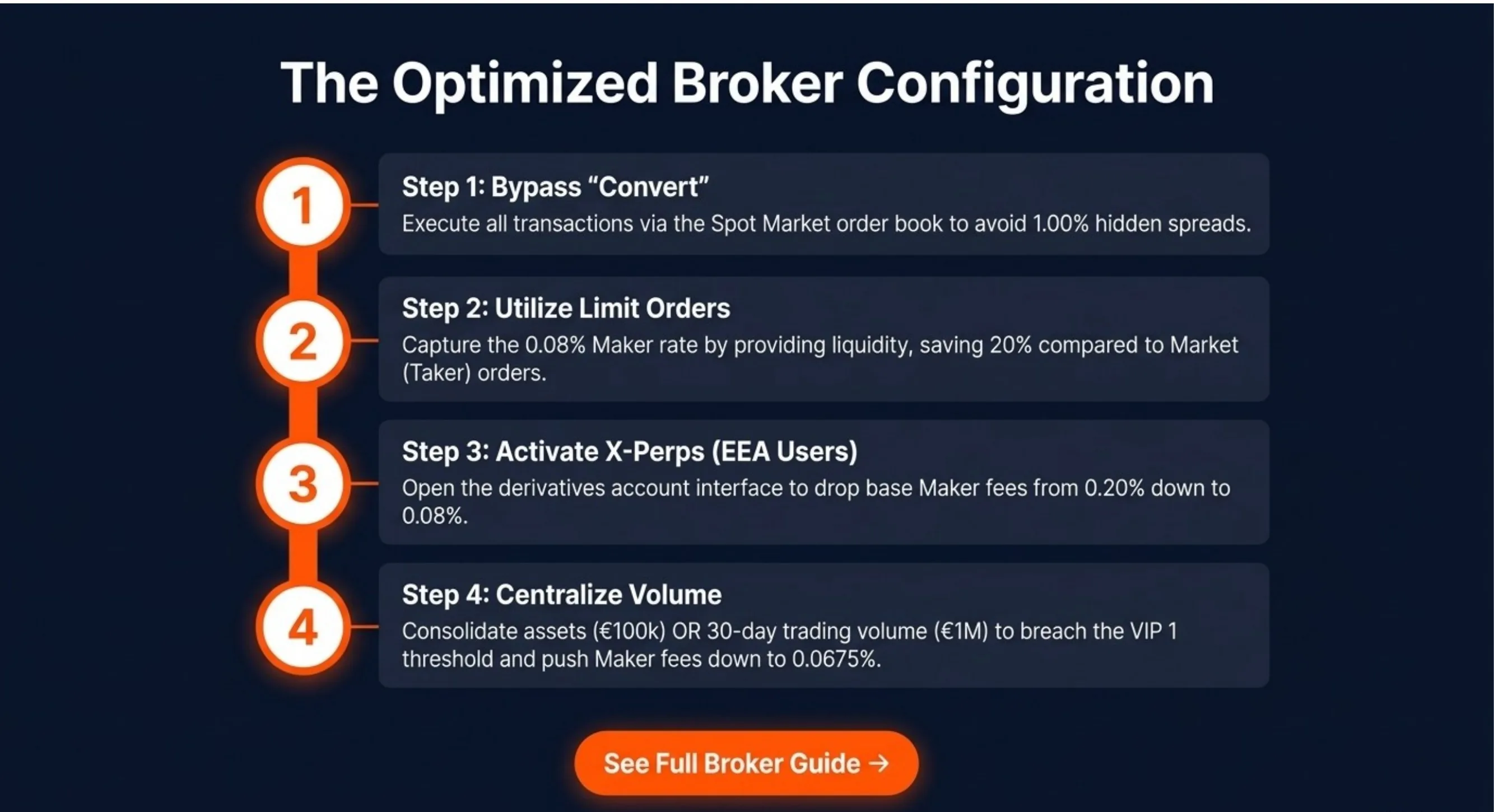
The four-step blueprint: (1) never use Convert above $100, (2) always use limit orders, (3) activate X-Perps if EEA-based, (4) consolidate to hit €100k assets or €1M volume for VIP 1. Each step is independent and additive.
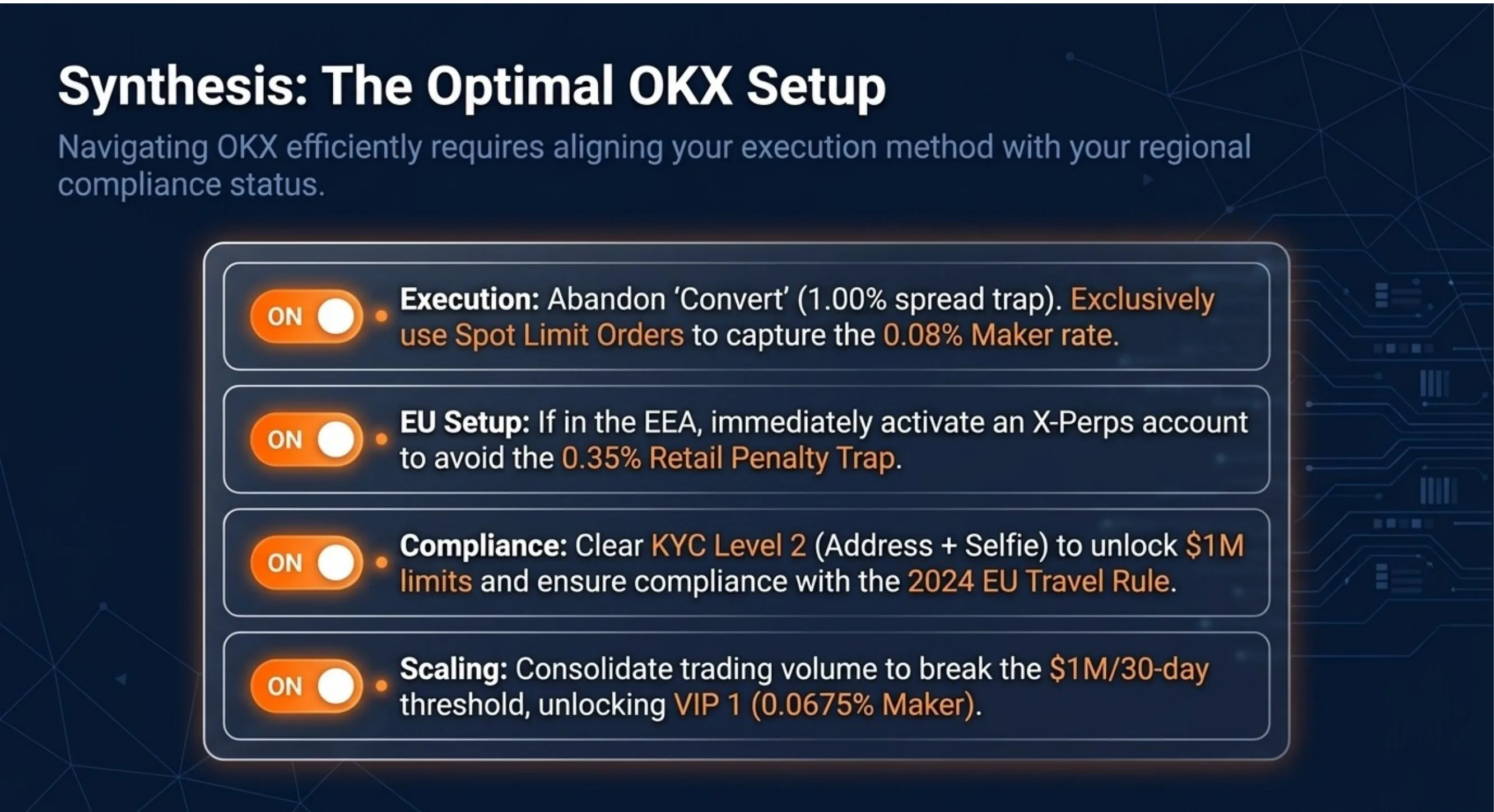
The synthesis checklist from the Global Operating Model Teardown: four toggles, each one independently switching a cost reduction ON. Together, they move a regular EEA user from 0.35% taker to a potential 0.0675% maker.
Maximum fee reduction pathway for an EEA user: Start at 0.35% taker (no X-Perps, no limit orders) → Activate X-Perps → drop to 0.10% taker / 0.08% maker → switch to limit orders → 0.08% maker → hit €100k assets or €1M volume → VIP 1 → 0.0675% maker. Total reduction: from 0.35% to 0.0675% — an 81% fee reduction — with no capital lockup required and no proprietary tokens to hold.
📈 Who should use OKX — and who shouldn't
OKX's fee architecture rewards sophistication: users who know how to configure the platform correctly pay among the lowest fees in the market. Those who don't can pay 2.5–12× more than necessary.
EU/EEA Traders
Strong fit — if configured
MiCA-regulated, full product access, CASP-authorized since Jan 2025. Activate X-Perps immediately — without it you pay the Retail Penalty Trap (0.35% taker). With it, you get the best base rates of any MiCA-compliant exchange.
Active Spot Traders
Best-in-class maker rates
0.08% maker at base tier beats Binance and Bybit's 0.10% flat. VIP 1 (0.0675%) requires only €100k in assets OR €1M volume — not both. For limit-order-first strategies, OKX is the structurally cheapest of the Big Three.
Casual / Retail Users
Good — but mind the traps
Casual users who default to Convert and market orders can pay 5–12× more than necessary. The platform rewards configuration. Read this guide, activate X-Perps if EEA-based, and always use limit orders.
US Residents
Not available
OKX.com is restricted for US users — browse only, no trading or deposits. Consider Coinbase (CFTC-registered, broad spot coverage), Kraken (US-regulated, futures available), or Gemini (SOC 2 certified, US-regulated).
Dubai / MENA Institutional
Best institutional hub
OKX Middle East Fintech FZE under VARA licence VL/23/12/003 offers VA margin, derivatives, crypto flexible loans, collateral optimisation, and liquid staking (BETH/OKSOL) for qualified/institutional clients.
High-Volume Traders
Single-threshold VIP advantage
VIP 5 Platinum (0.0250% maker / 0.0350% taker) requires $20M assets OR $100M volume. Compared to Binance's VIP 9 requiring $4B+ volume AND 5,500 BNB simultaneously, OKX's single-threshold model is dramatically more capital-efficient to climb.
Frequently asked questions
What is the standard OKX spot trading fee? +
Regular-tier OKX users pay 0.08% maker / 0.10% taker on spot markets. This already undercuts Binance and Bybit (both 0.10% flat maker). VIP 1 (Gold) drops maker fees to 0.0675% / 0.0800% taker, and VIP 5 (Platinum) reaches 0.0250% maker / 0.0350% taker. EEA users without an X-Perps account pay a different, much higher rate — see the X-Perps FAQ below.
What is the OKX Convert hidden spread and should I use it? +
OKX Convert advertises zero fees, but routes orders through market makers who embed a spread of up to 1.00%. On a $1,000 trade, Convert's realized cost is $5–$10, versus $0.80 for a Spot Limit (Maker) order. Convert's "zero fee" is accurate for the visible line item — not for total cost of execution. For any transaction above $100, the Spot Market with a limit order is always cheaper.
What is the X-Perps anomaly and who does it affect? +
EEA (EU) users who have not activated an X-Perps (Derivatives) account are charged 0.200% maker / 0.350% taker — 2.5× more than the global base rate of 0.08%/0.10%. This is a MiCA regulatory compliance structure, not a punitive fee. Activating the X-Perps account (a simple two-minute process in account settings) immediately drops fees to global base rates. EEA users should do this before their first trade, even if they never intend to trade derivatives.
Does OKX VIP require both volume AND asset balance? +
No. Unlike Binance, OKX only requires ONE of two thresholds to unlock a VIP tier: either a total asset balance (e.g. €100k+ for VIP 1) OR a 30-day trading volume (e.g. €1M+ for VIP 1). Meeting either condition triggers automatic tier upgrades via daily snapshots. No proprietary token holdings are required at any tier.
Is OKX regulated in Europe? +
Yes. OKX holds full CASP authorization from the Malta MFSA under MiCA, issued in January 2025. One Malta license passports OKX Europe Limited across all 30 EEA states. Six legally mandated protections apply: segregated user funds, Article 75 exchange liability for lost funds, market manipulation surveillance, regulated token whitepapers, conflict-of-interest disclosures, and a free complaints resolution process. OKX's compliance timeline means zero service disruption when the MiCA July 2026 deadline forces unregulated exchanges to exit the EU.
Is OKX available in the United States? +
No. OKX.com is restricted for US residents — the platform is available for browsing and learning only; no trading or deposits are possible as of 2026. US alternatives include Coinbase (CFTC-registered), Kraken (US-regulated futures and spot), and Gemini (SOC 2 certified, NYDFS-licensed). For cross-asset access including crypto, consider Interactive Brokers (220+ countries, regulated globally).
What KYC level do I need to trade on OKX? +
Level 1 (passport or national ID) unlocks basic deposits and $10,000/24h withdrawals. Level 2 (proof of address + live selfie) is the practical minimum for any active trader — it unlocks full trading, staking, NFT access, and $1,000,000/24h limits. Level 3 (business documentation) is required for OTC desk access, API with custom limits, and full VIP tier activation. EU users at high transaction volumes trigger additional source-of-funds checks under the EU Travel Rule.