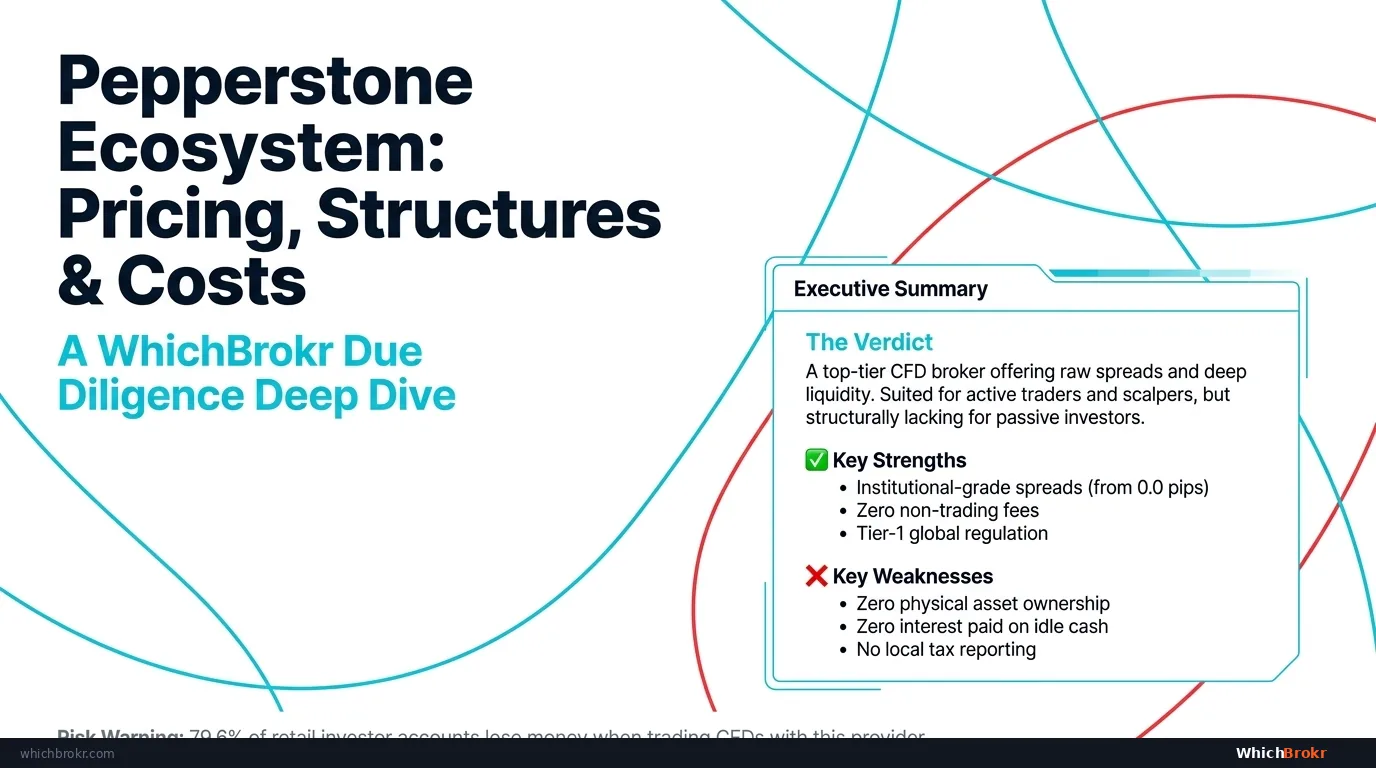
Pepperstone is one of the world's largest CFD and forex brokers, processing over $12 billion in daily volume across 900,000+ traders globally. But its pricing structure is deceptively complex: a two-account architecture with completely different cost logic, a multi-entity global footprint that directly affects your legal protections, overnight funding formulas tied to interbank benchmark rates, and a handful of silent costs that strip margin without appearing on a trade confirmation. This is the complete breakdown.
The global entity architecture
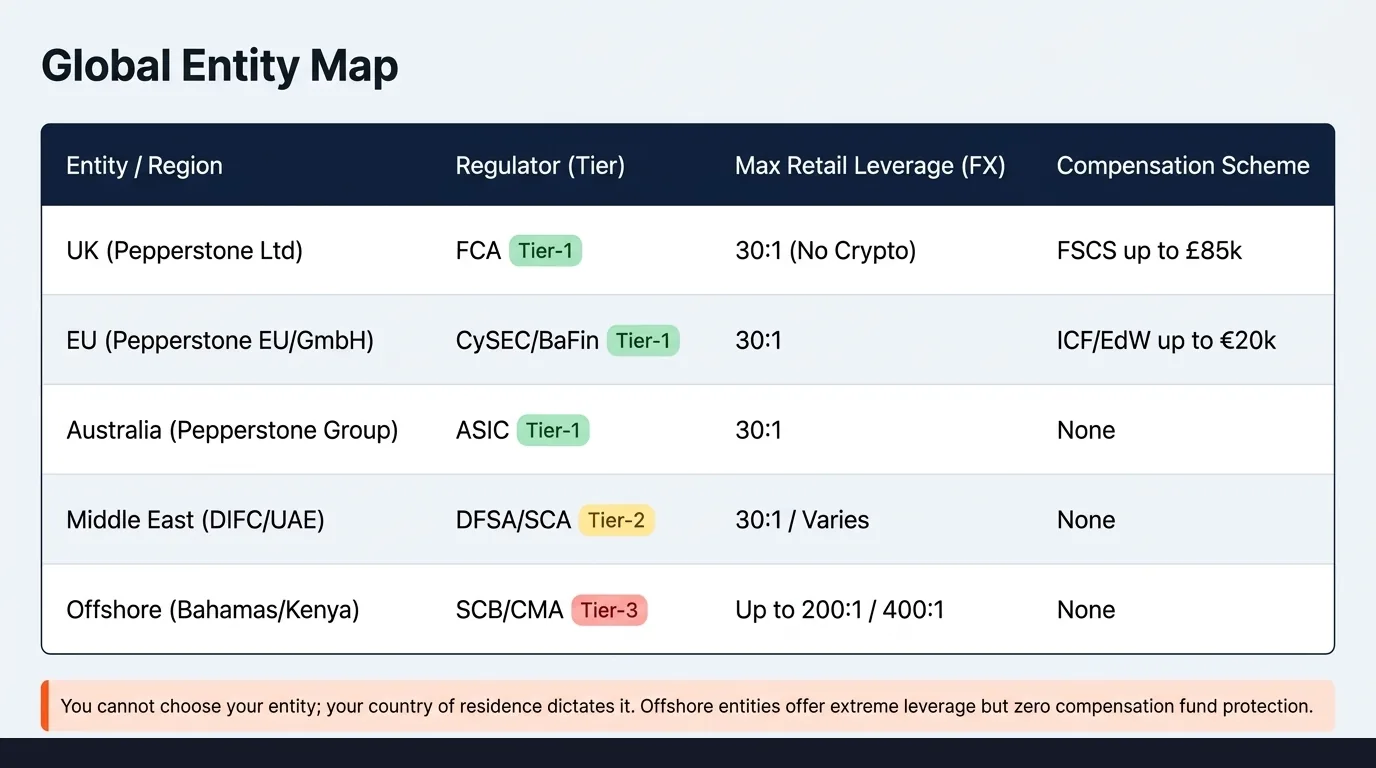
Before discussing fees, you need to understand which Pepperstone you're dealing with. The broker operates through six distinct regulated entities, each with different capital requirements, leverage limits, and — critically — different client protection levels.
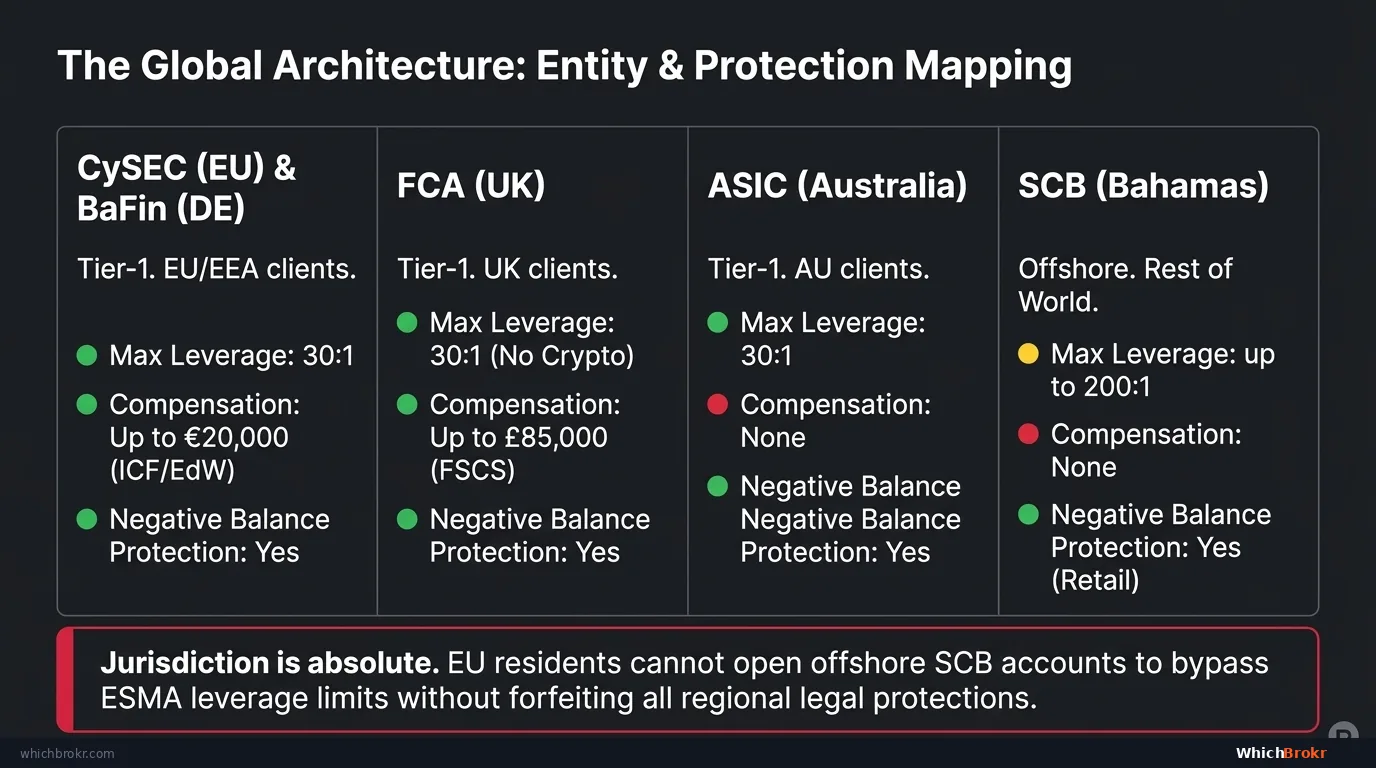
The practical differences are significant. UK clients (FCA) are covered by FSCS compensation up to £85,000 and face MiFID II leverage caps. EU clients (CySEC) are covered by the Investor Compensation Fund up to €20,000. Australian clients (ASIC) have no state-backed compensation scheme but benefit from strict segregation rules. Offshore clients (SCB Bahamas) access higher leverage but have effectively zero protection if Pepperstone fails.
Client classification and leverage limits
Pepperstone distinguishes between retail and professional clients. The classification directly controls the maximum leverage available to you, which in turn affects your margin cost and risk-of-ruin calculations.
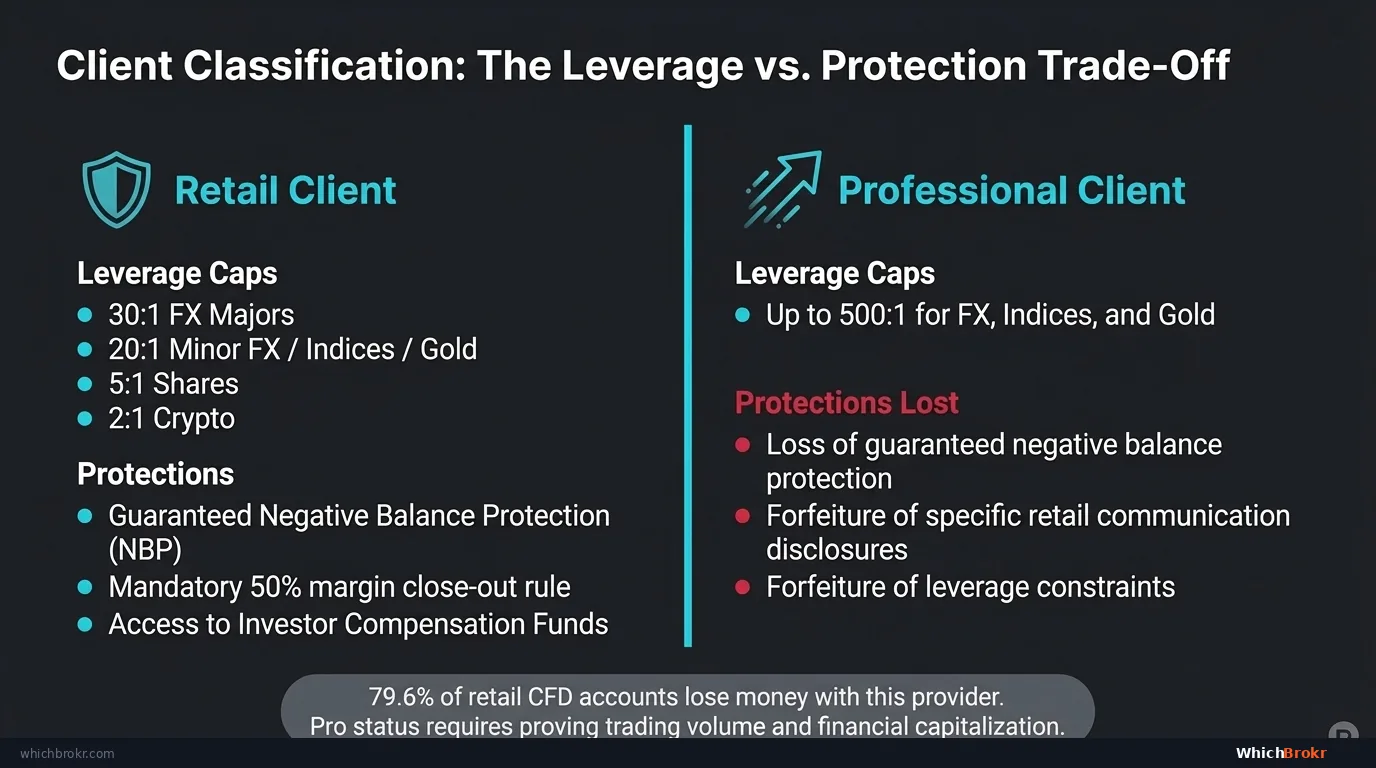
Under MiFID II (EU/UK entities), retail clients are limited to: 30:1 on major FX pairs, 20:1 on major indices, 10:1 on minor FX and gold, 5:1 on individual shares, and 2:1 on cryptocurrencies. To qualify as professional, you must meet two of three ESMA criteria: significant portfolio (€500k+), professional trading experience, or relevant financial industry experience.
Account architecture: Standard, Razor, and Swap-Free
Pepperstone offers three account types with fundamentally different pricing logic. The choice is not cosmetic — it changes whether the broker's profit comes from spread markup, commission, or periodic admin charges.
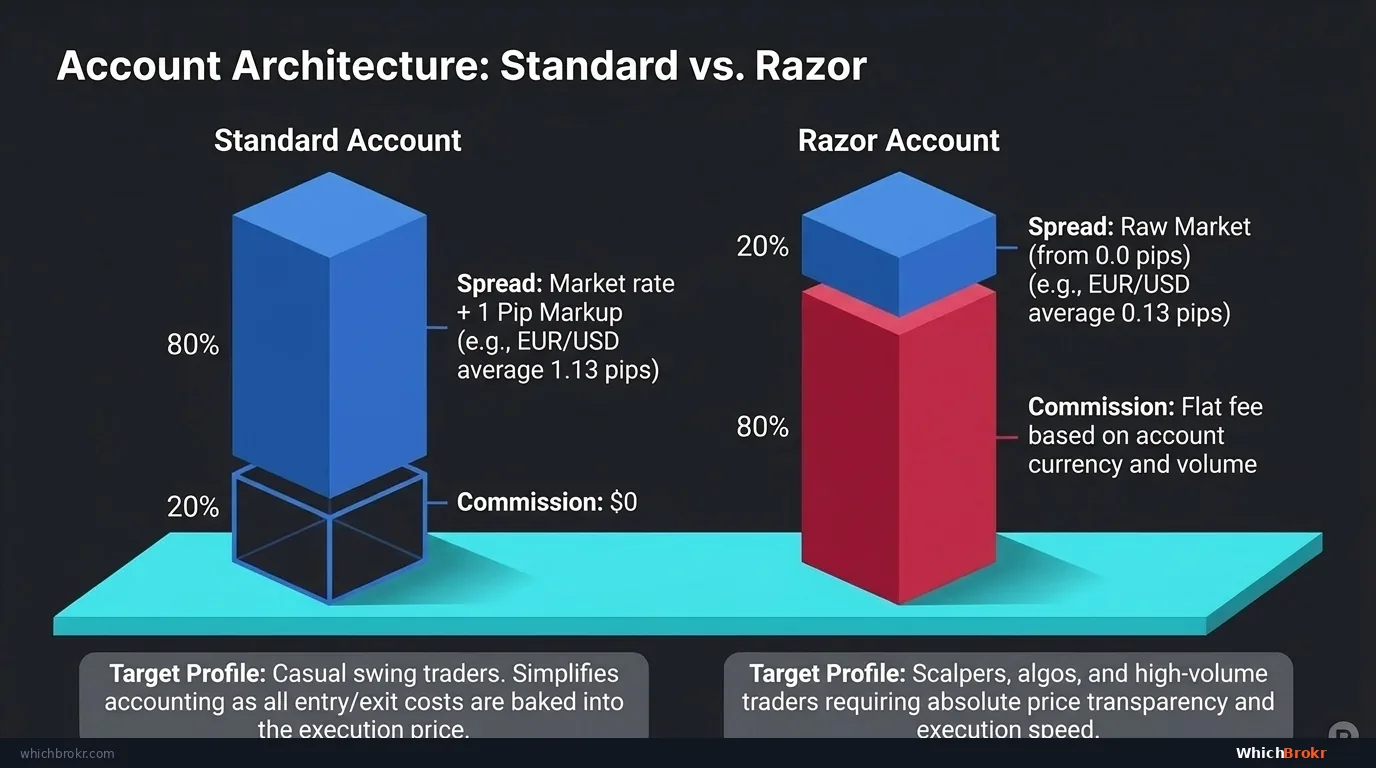
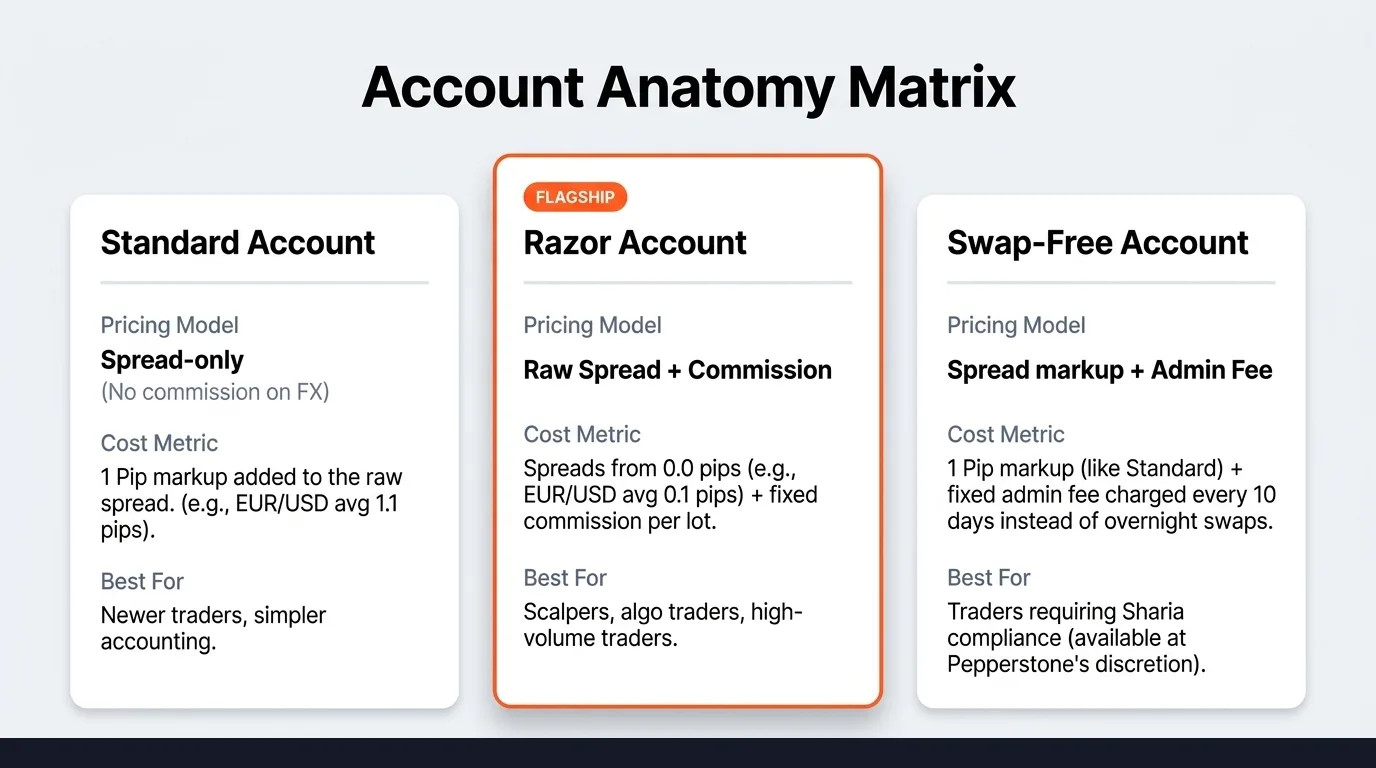
- Standard Account — All-in spread pricing. A 1 pip markup is added to the raw interbank spread. EUR/USD averages 1.1 pips. No commission per trade. Best for newer traders who want simple, predictable cost per trade.
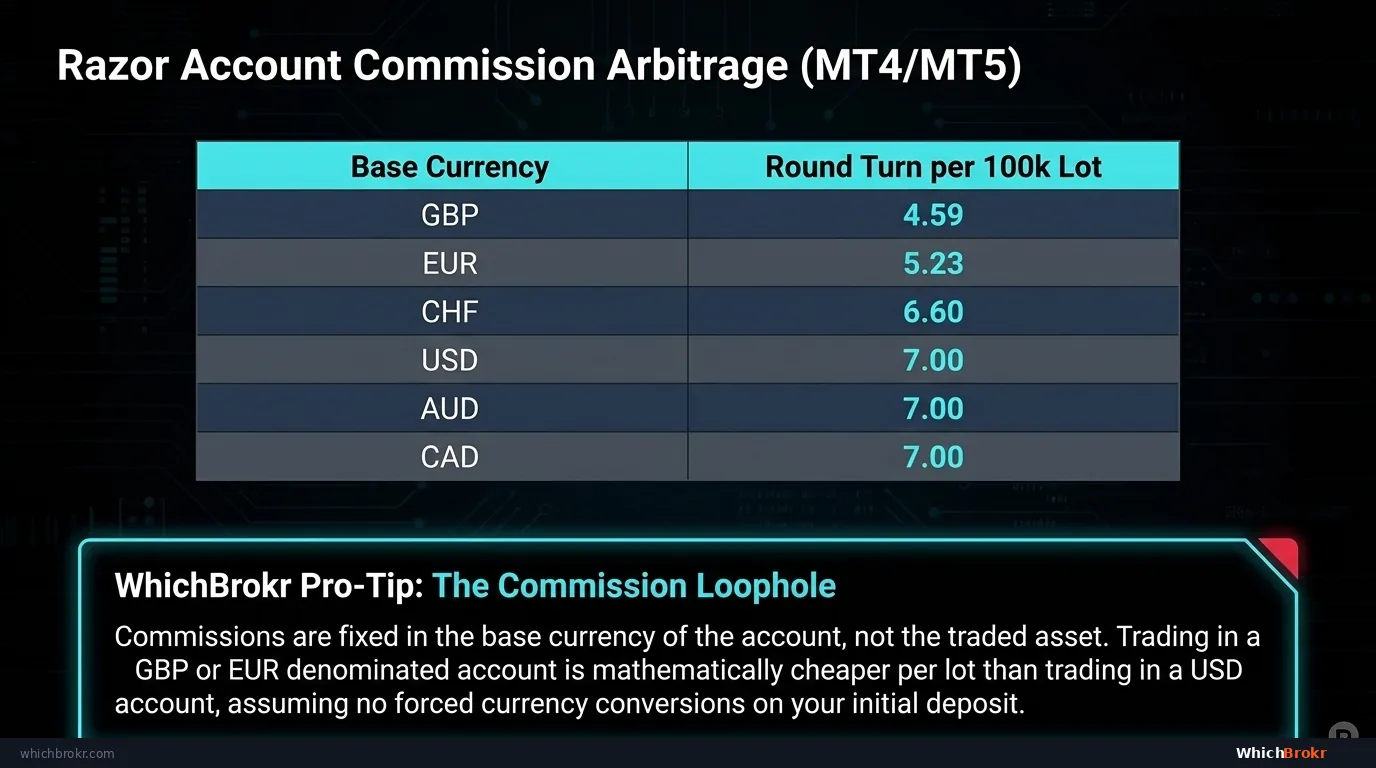
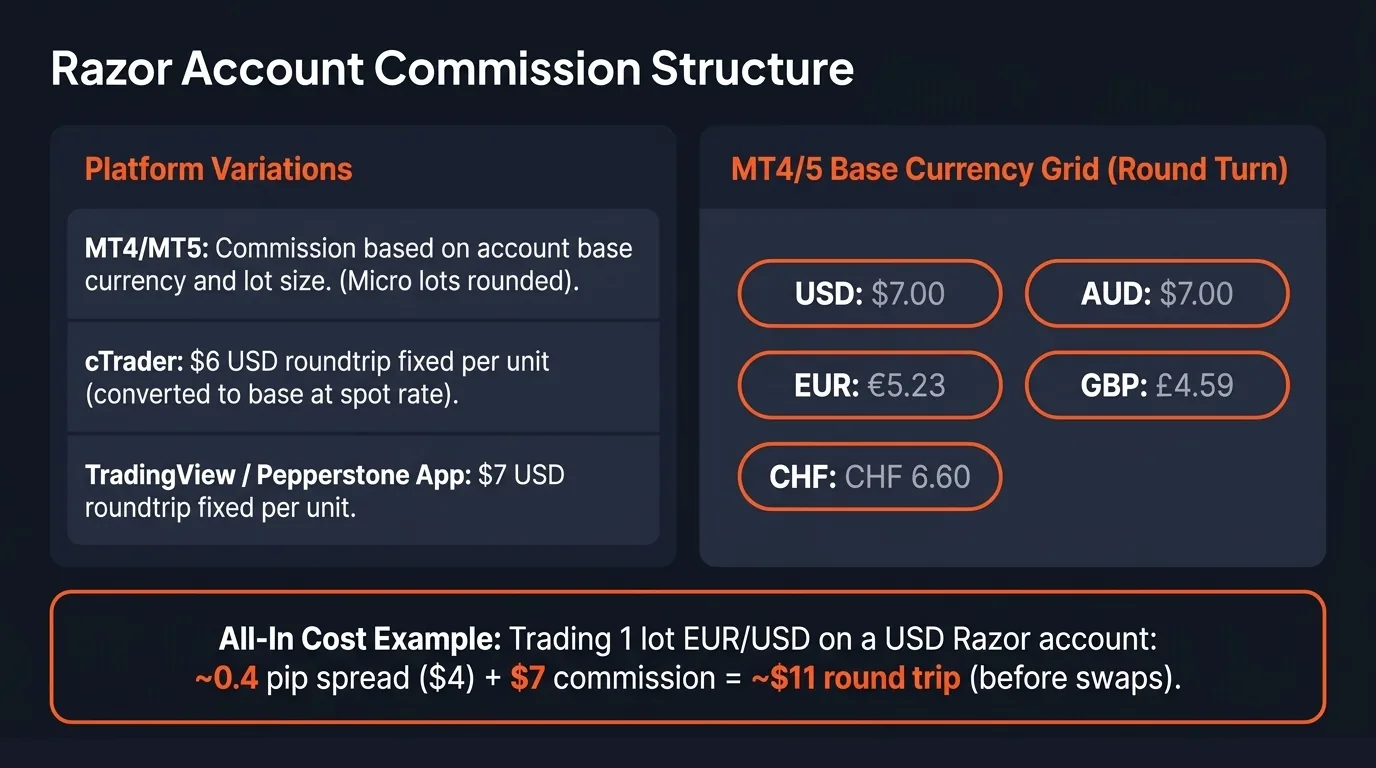
- Razor Account — Raw interbank spread (can reach 0.0 pips on EUR/USD) plus a per-lot commission. Commission varies by platform: $3.50/lot per side on MT4/MT5 ($7.00 round-trip), $3.00/lot per side on cTrader ($6.00 round-trip). Best for scalpers, algo traders, and high-volume traders.
- Swap-Free Account — Spread markup similar to Standard, plus a fixed admin fee charged every 10 days instead of nightly swap charges. Available at Pepperstone's discretion, primarily for Sharia-compliant requirements.
What you actually pay: spread reality check
Pepperstone's marketing emphasises minimum spreads — the figure that appears in best-case conditions at peak liquidity. The number that matters to most traders is the average spread across all market hours.
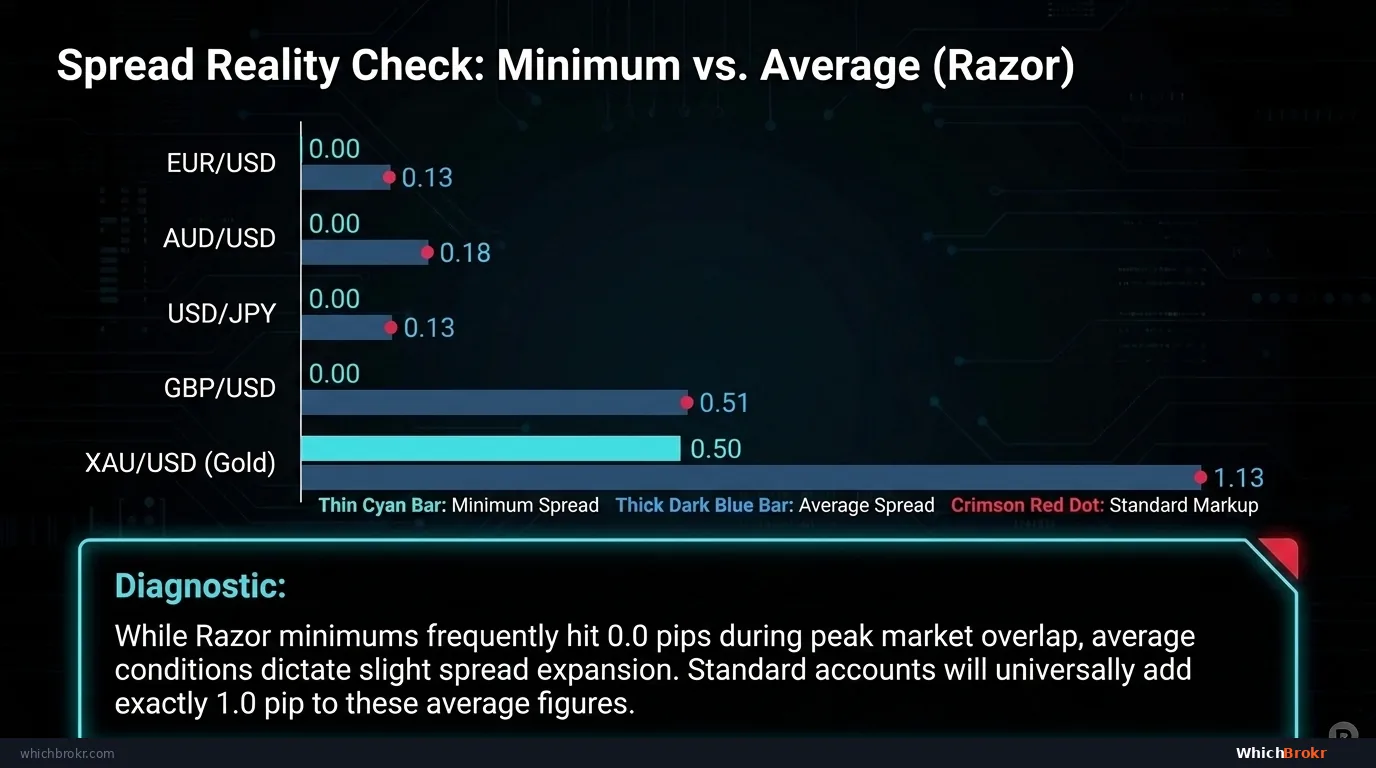
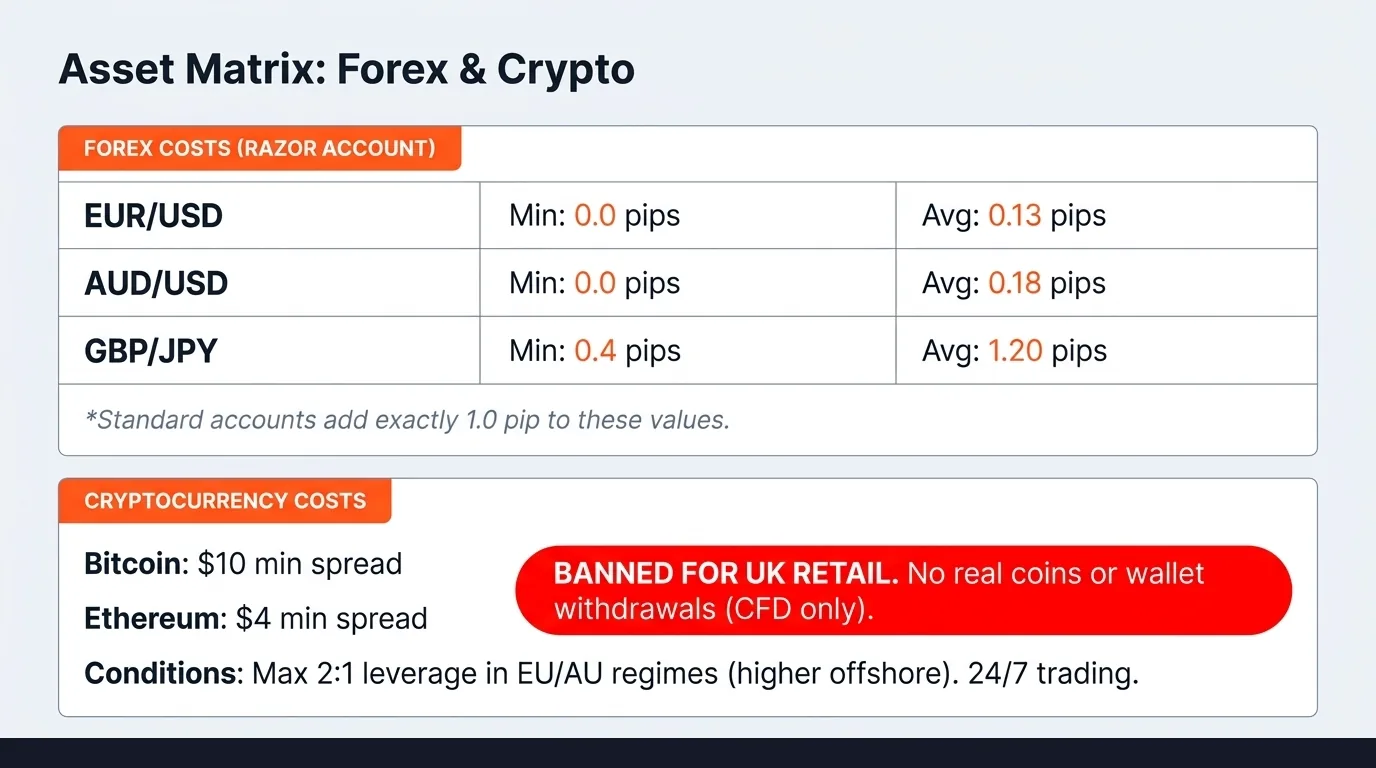
On the Razor account, EUR/USD averages 0.1 pips. Adding the $7.00 round-trip commission ($3.50 × 2), the total effective spread-equivalent is approximately 1.1 pips on a standard lot — the same as the Standard account's average. The Razor advantage emerges at scale: very large lots where the fixed commission per lot becomes a smaller percentage of total trade value, or for algorithmic strategies where ultra-low latency entry matters at the micro-pip level.
The Razor commission structure by platform
Commission on the Razor account is not uniform across all platforms. The per-lot rate varies by trading terminal, and for accounts denominated in non-USD currencies, an additional FX conversion applies to the commission itself.
Multi-asset cost matrix
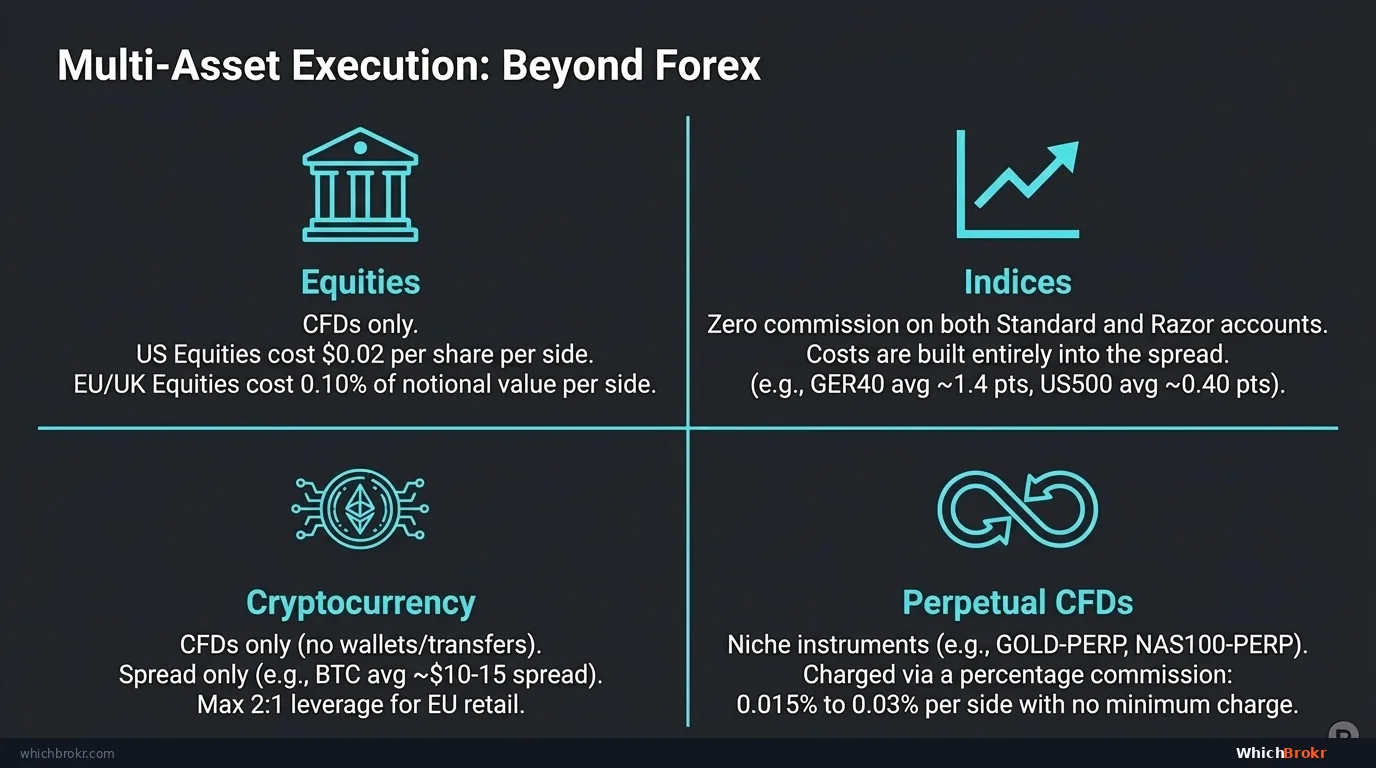
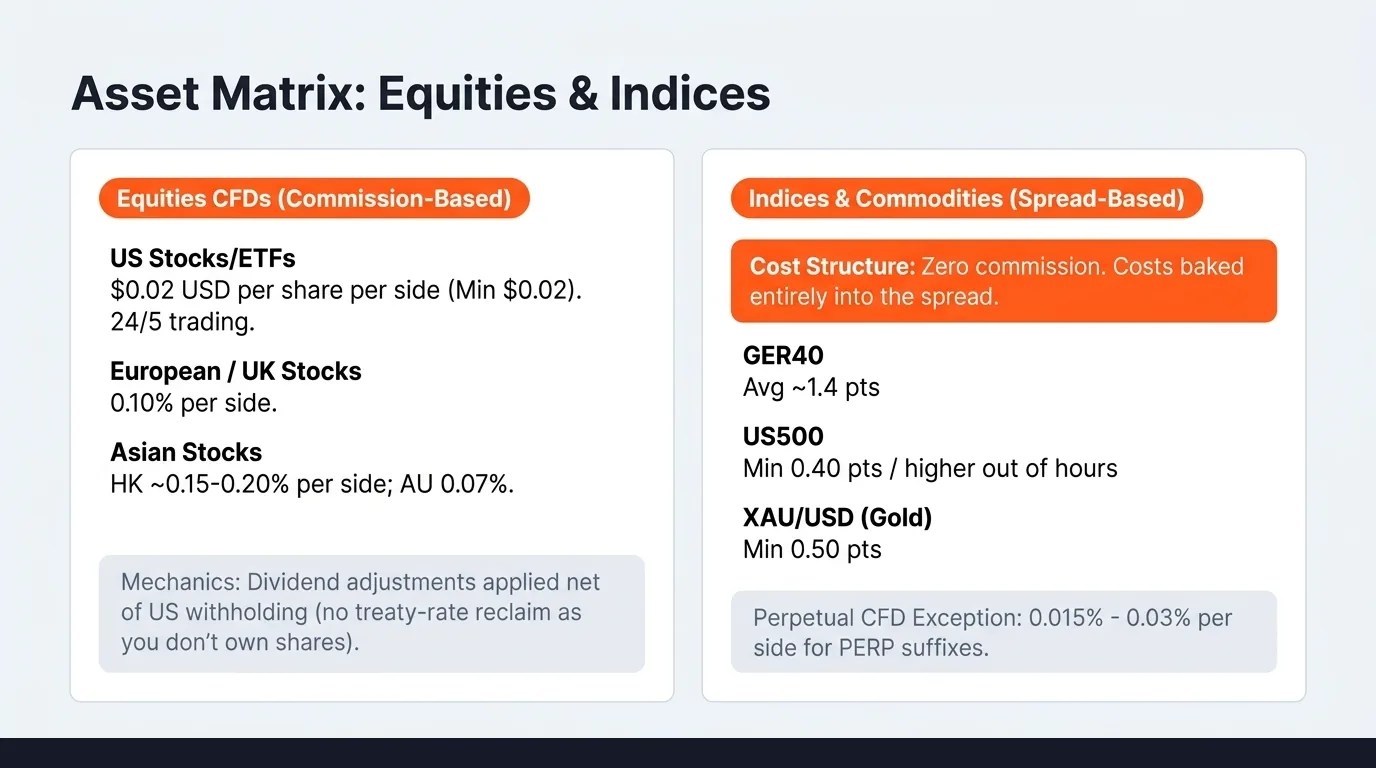
Pepperstone is not purely a forex broker. It offers CFDs across forex, metals, indices, shares, commodities, and cryptocurrency. Pricing methodology differs substantially by asset class.
What costs nothing — and where Pepperstone earns
Understanding Pepperstone's zero-fee claims requires knowing exactly which costs are genuinely absent and which simply appear elsewhere in the pricing structure.
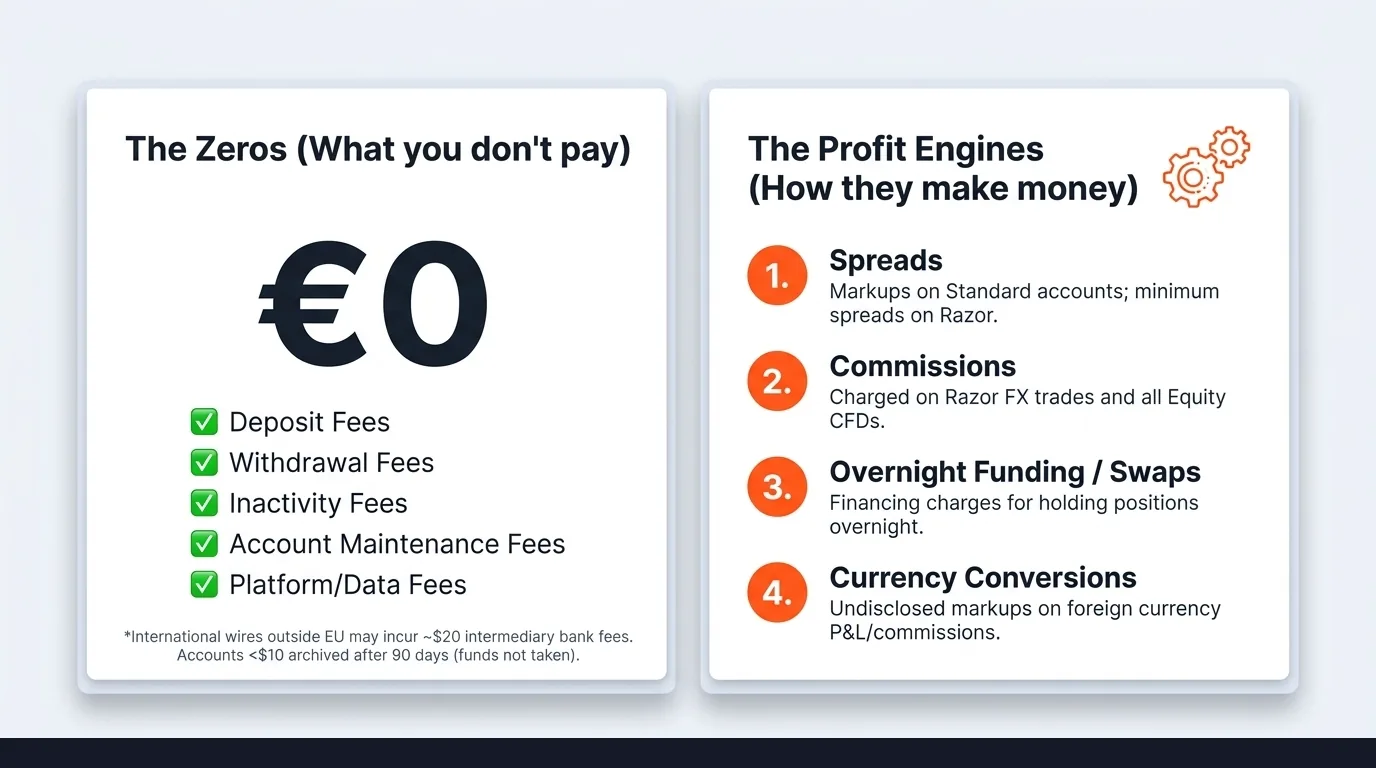
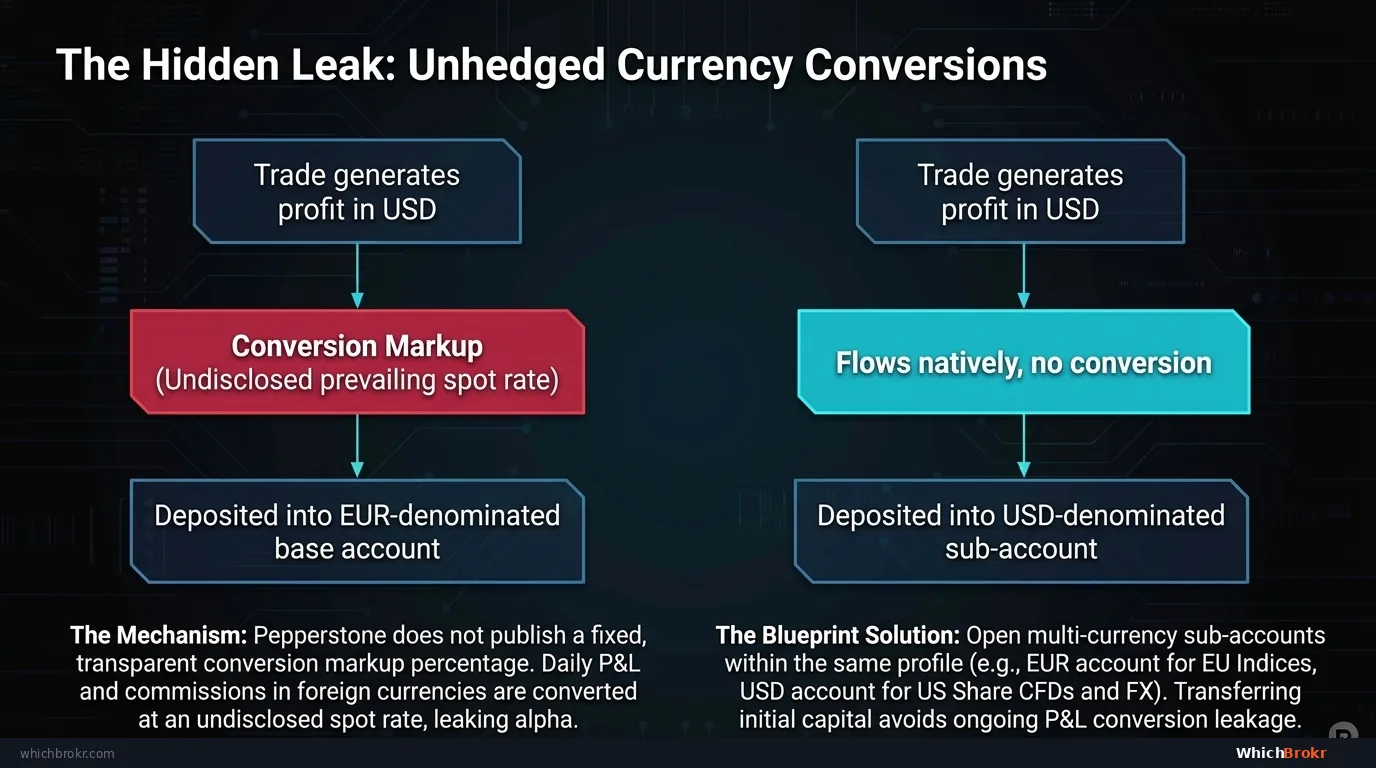
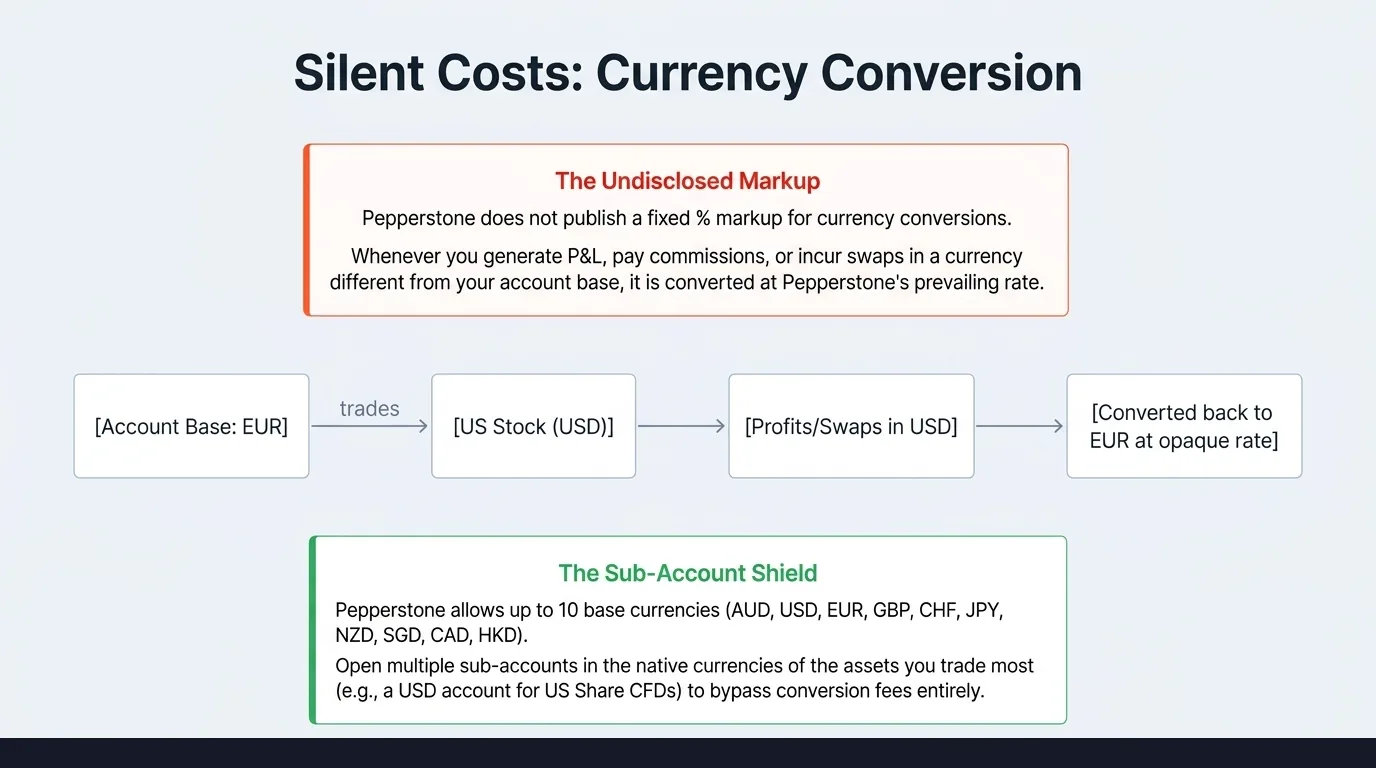
Pepperstone genuinely charges no deposit fee, no withdrawal fee, and no inactivity fee. However, the real costs come through four mechanisms: the 1 pip spread markup on Standard accounts; the $3.50–$7.00 commission per lot on Razor; the ±3% admin fee added to the overnight benchmark rate; and a 0.3–0.5% FX conversion markup on positions denominated in a currency different from your account base.
Overnight funding: the TomNext formula
Every CFD position held past the daily rollover (5pm New York time) incurs an overnight funding charge or credit. For forex and metals, Pepperstone uses the TomNext (Tomorrow/Next) interbank rate. For indices and shares, it uses the relevant short-term interest rate benchmark (ARR).
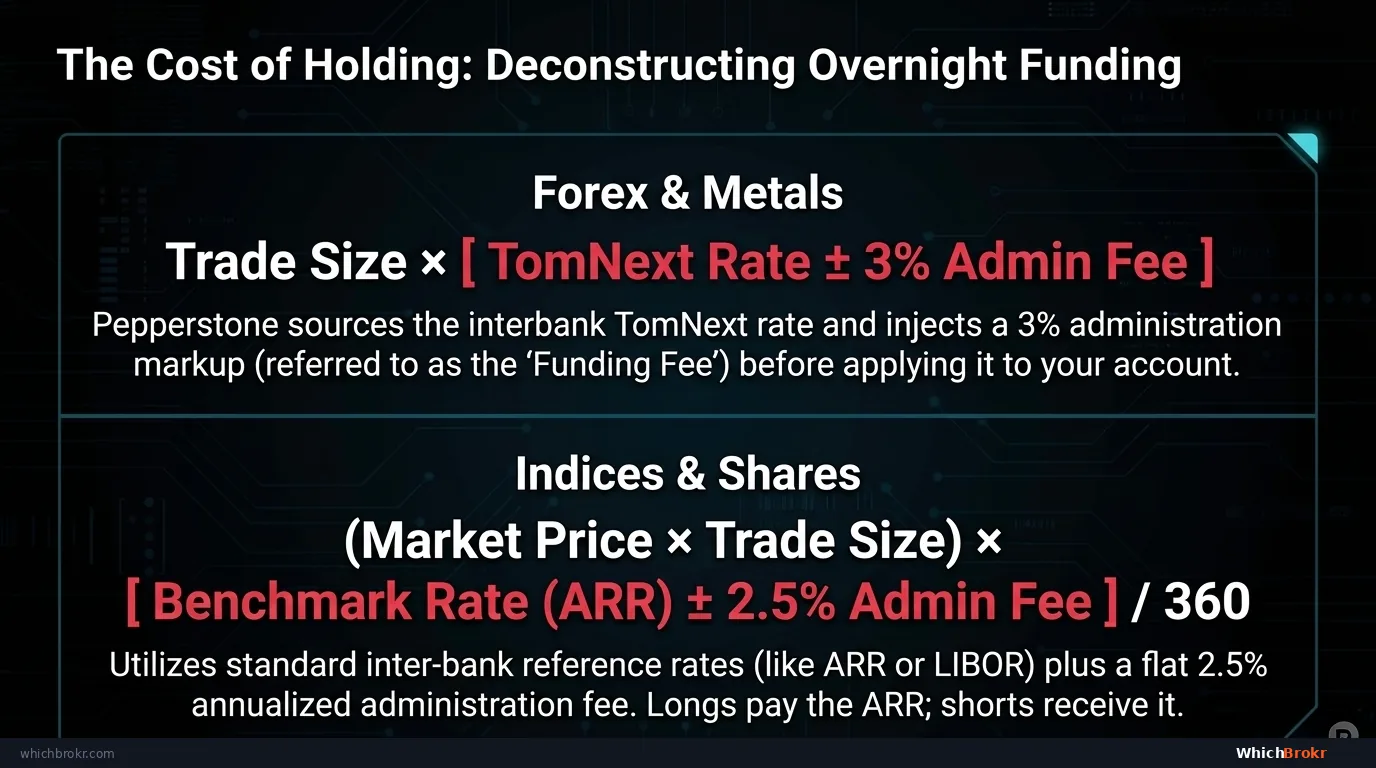
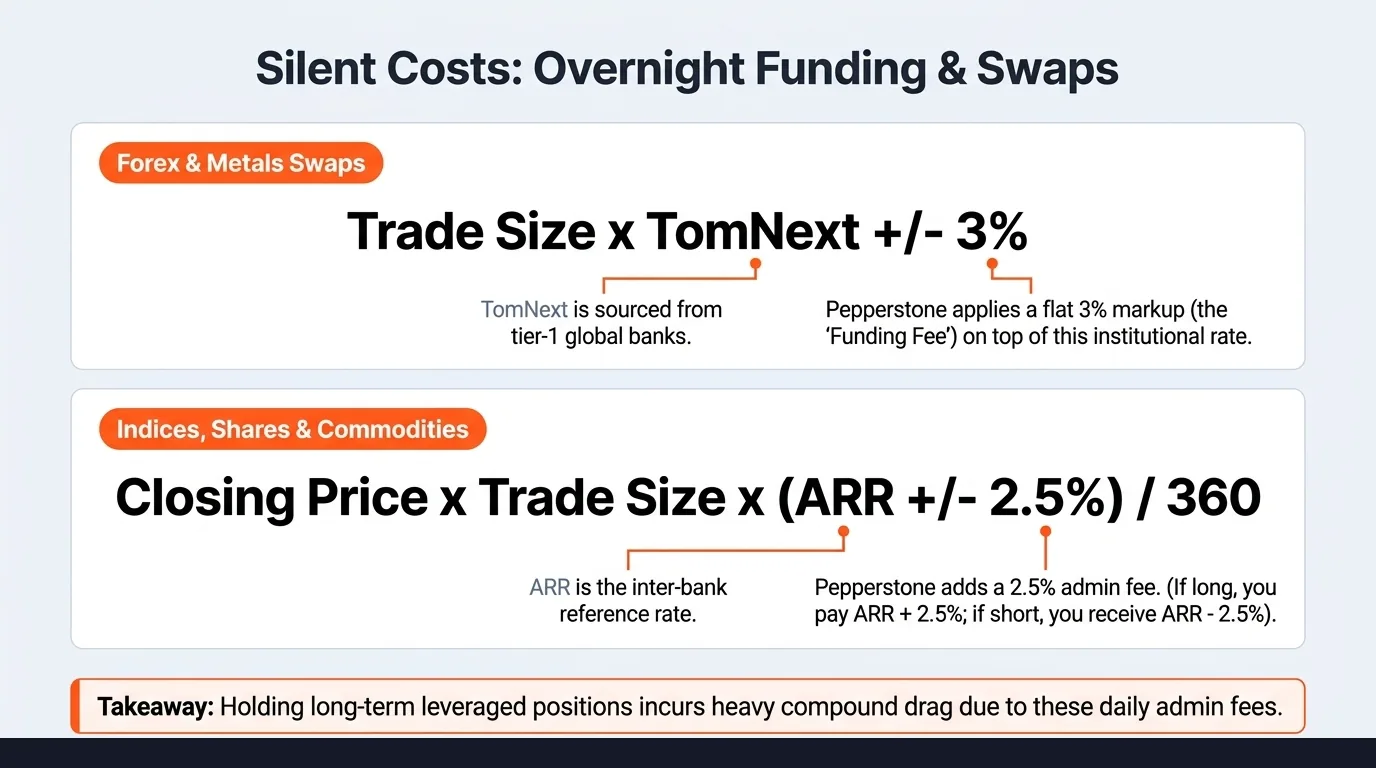
For a long USD position where the TomNext rate is positive (USD funding rate above JPY, for example), the long position may actually receive a credit. But after the 3% admin fee, most carry positions that appear positive on paper become flat or negative in practice. Short positions always pay the benchmark plus the admin fee.
The triple swap quirk: Wednesday's hidden tax
Every forex trader needs to understand the triple swap mechanism before placing their first leveraged position. It is a structural quirk of the global FX settlement system — not a Pepperstone-specific policy — but it creates a predictable weekly cost spike that catches unprepared traders.
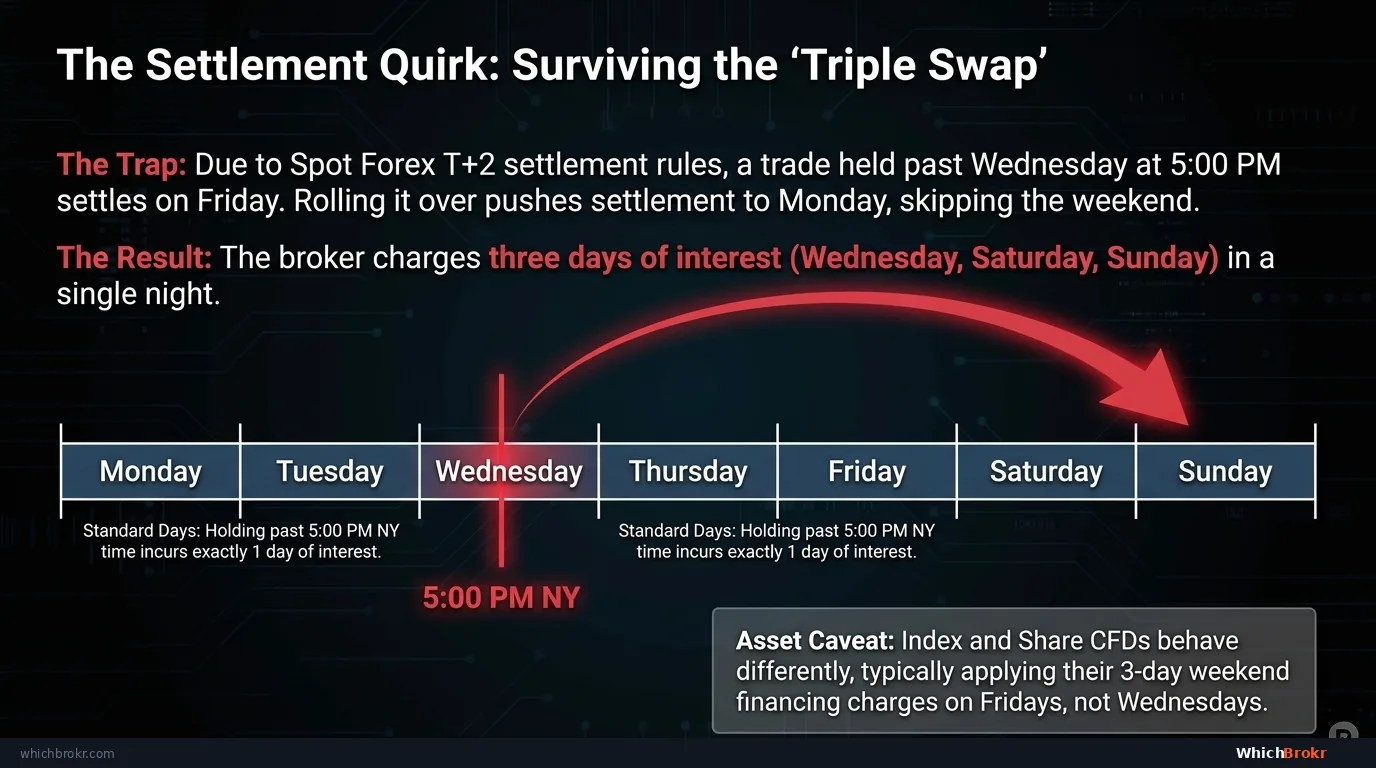
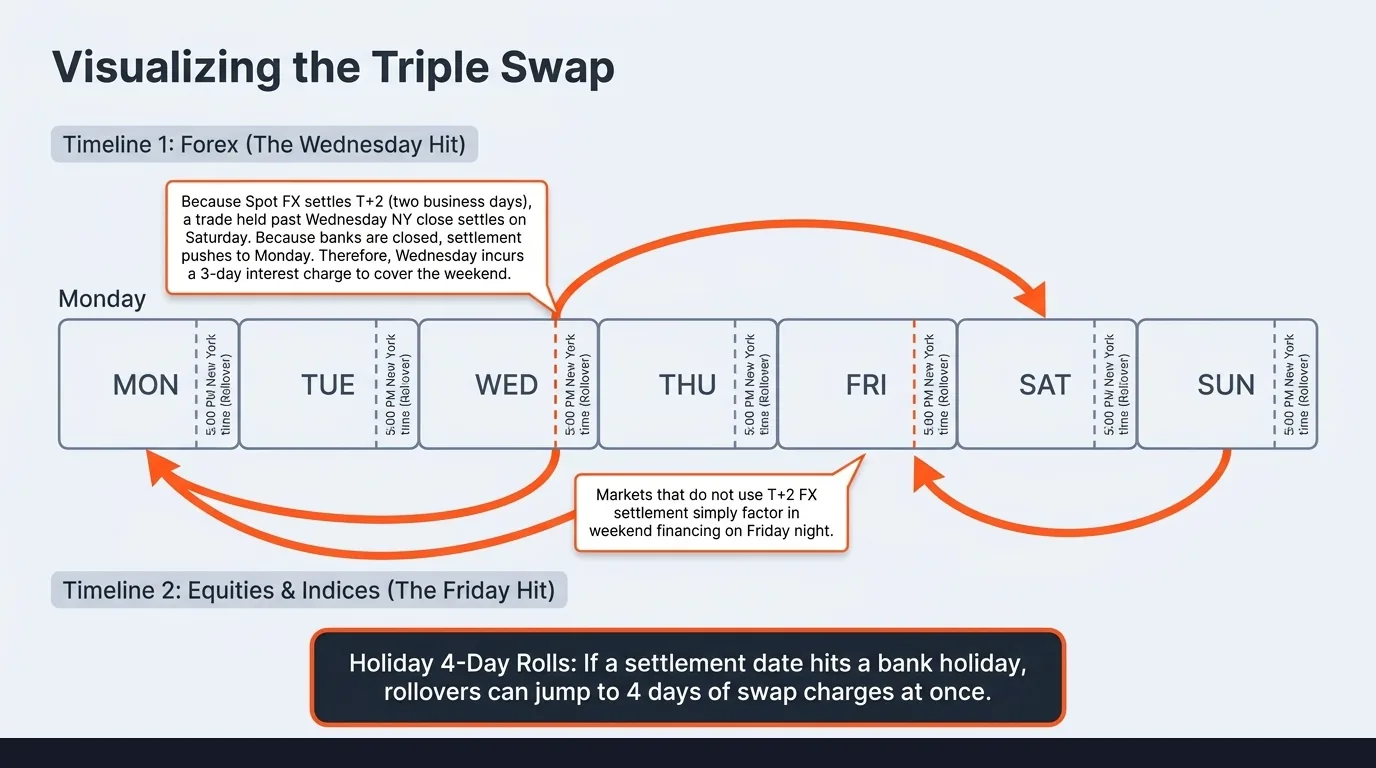
The practical implication: if you trade primarily on Thursdays, you may open a position just after the Wednesday rollover and avoid the triple charge. Conversely, holding a position into Wednesday rollover when the swap rate is negative amplifies your weekly funding cost significantly.
Swap-free accounts: what you gain and what you give up
Pepperstone's swap-free (Islamic) account is designed for traders who require Sharia compliance by eliminating interest-bearing overnight charges. The structure replaces swap with an admin fee — which changes the cost profile significantly for different holding periods.
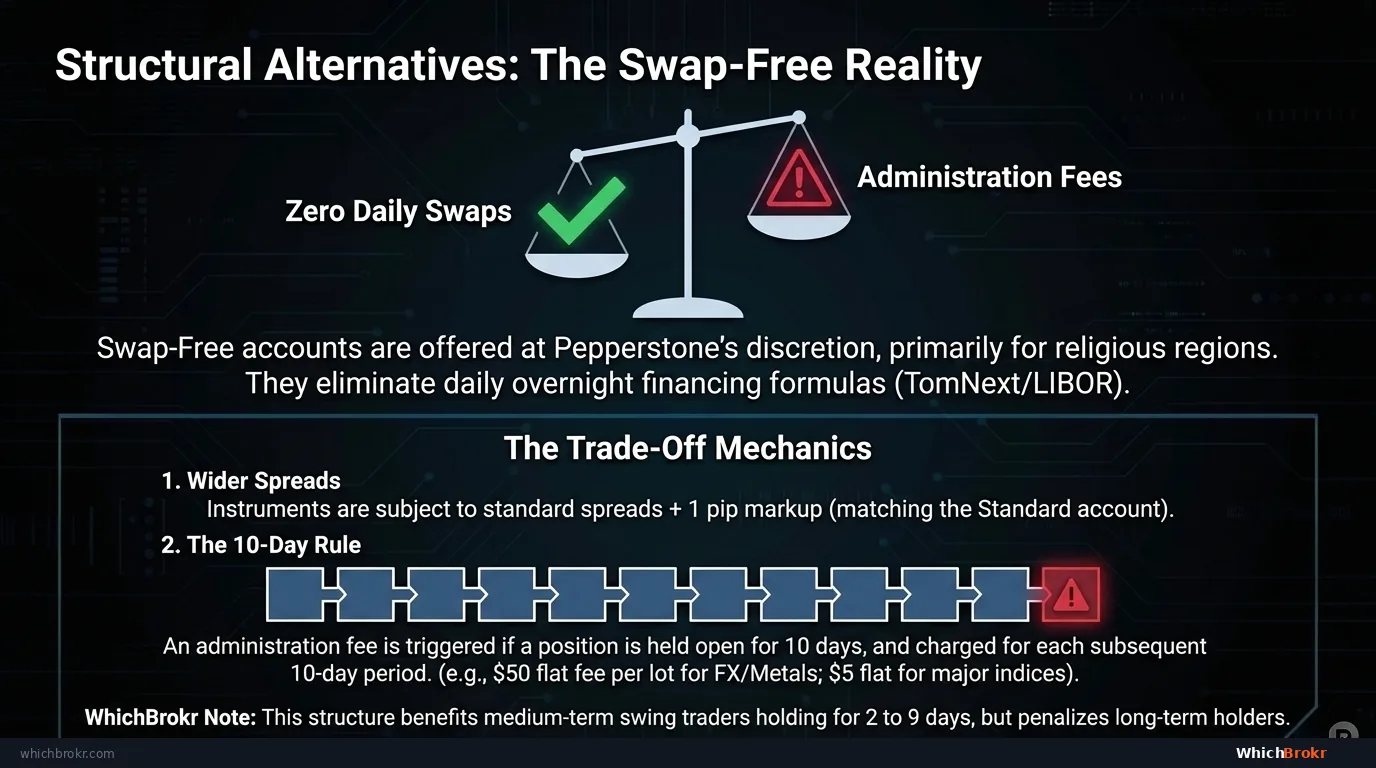
The swap-free account carries a 1 pip markup (like Standard), plus a fixed admin fee per 10 days instead of daily swap deductions. For traders holding positions for 1–3 days, the swap-free structure may actually be cheaper than a standard account with negative swap. For positions held over 2 weeks, the periodic admin fee typically exceeds what standard swap would have cost. Pepperstone approves swap-free status at its discretion.
The silent cost: currency conversion leak
One of the most consistently overlooked costs in CFD trading is the FX conversion charge. It applies any time you trade an instrument denominated in a currency different from your account base currency — which, for most traders, happens on nearly every non-domestic trade.
Cash management and non-trading fees
Pepperstone's non-trading fee profile is genuinely clean by industry standards — but one structural characteristic constitutes a real cost that is rarely discussed: the 0% interest on uninvested cash.
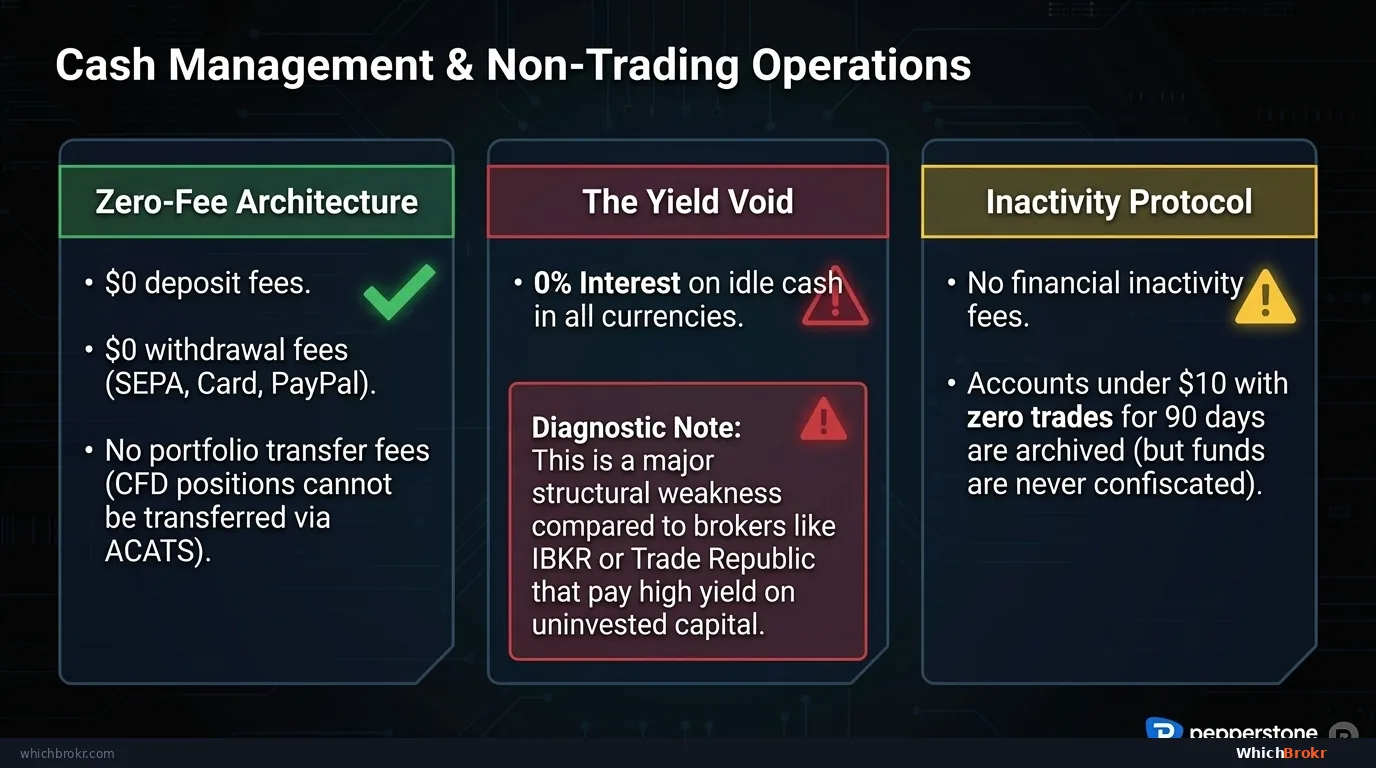
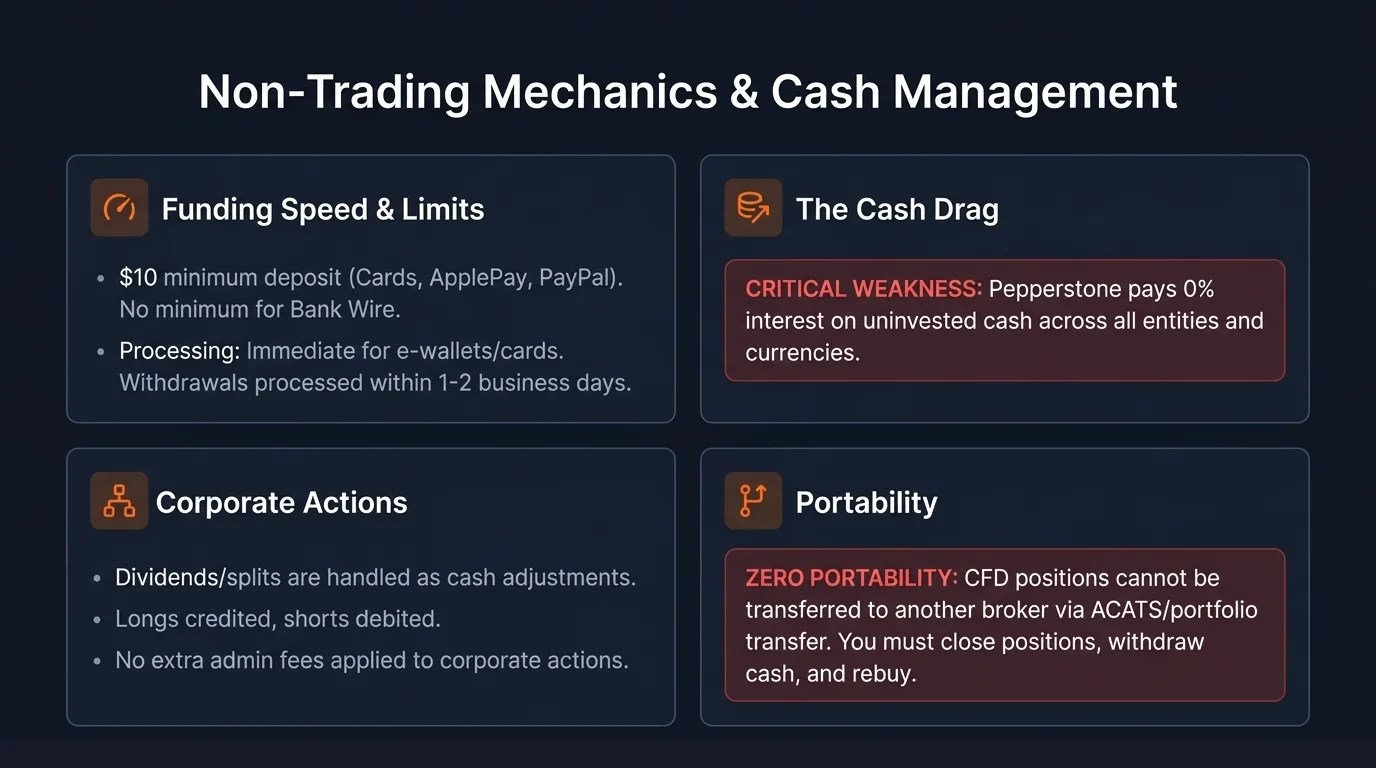
At current risk-free rates (5%+ in USD, 4%+ in EUR), a trader keeping $50,000 in a Pepperstone account earns $0 in interest. The same capital in a money market fund earns ~$2,500/year. This opportunity cost is real and compounds over time — particularly for traders who hold large cash reserves between positions.
Cost scenario: 100 lots EUR/USD full lifecycle
Abstract pricing metrics are easier to evaluate through a concrete trade scenario. The following models the full cost of a 100-lot EUR/USD round-trip held for three days — comparing Standard and Razor accounts.
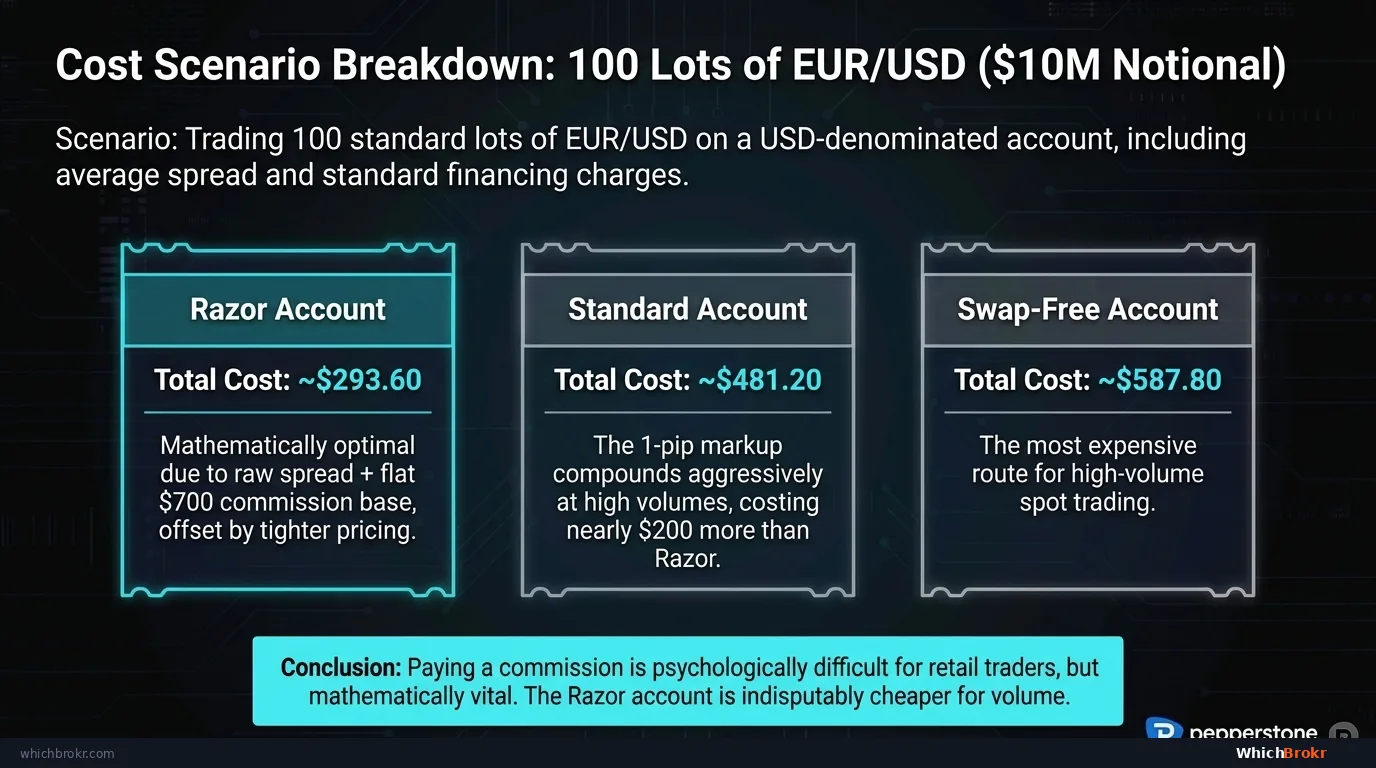
The takeaway from the scenario analysis: Razor is cheaper than Standard for positions above 20 lots, where the tighter raw spread overcomes the commission. Below 20 lots with short hold times, Standard may be marginally cheaper due to the absence of commission. The real differentiator at retail scale is whether you can absorb the commission as a visible P&L line item — many algorithmic strategies require the tighter spread to trigger correctly.
What you don't own: CFD structure and tax realities
Pepperstone offers CFDs exclusively. This matters for both your legal rights and your tax treatment — in ways that are frequently misunderstood.
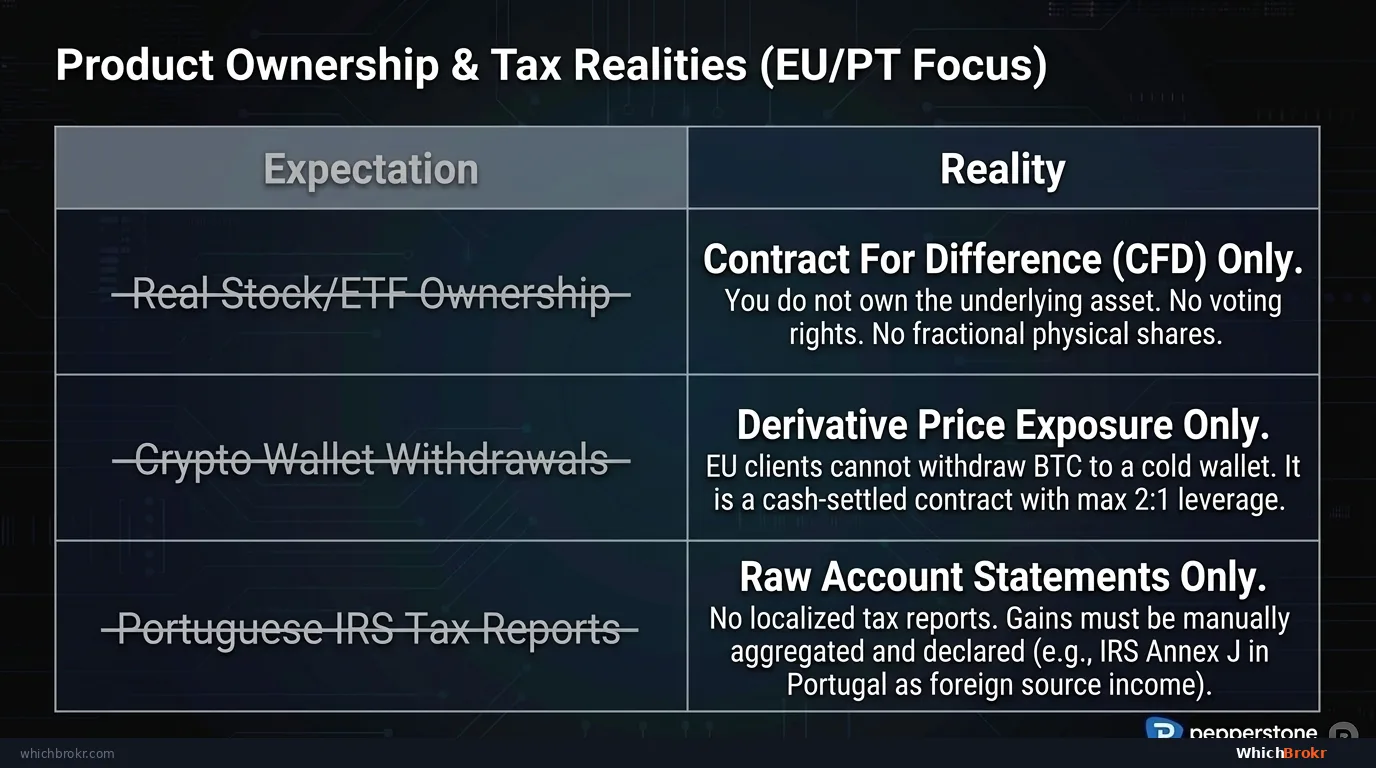
When you hold a long equity CFD over an ex-dividend date, Pepperstone credits a dividend adjustment to your account — but this is a cash adjustment, not a dividend in the tax sense. In most jurisdictions, qualifying dividend income has preferential tax treatment (lower rate or tax credits) that CFD adjustments do not qualify for. Additionally, CFD losses may or may not be offsettable against capital gains depending on your jurisdiction.
The diagnostic teardown: Pepperstone by the numbers
The following analysis is drawn from Pepperstone's publicly reported figures and regulatory filings, cross-referenced against live pricing data. It provides a second-opinion lens on the cost structure documented above.
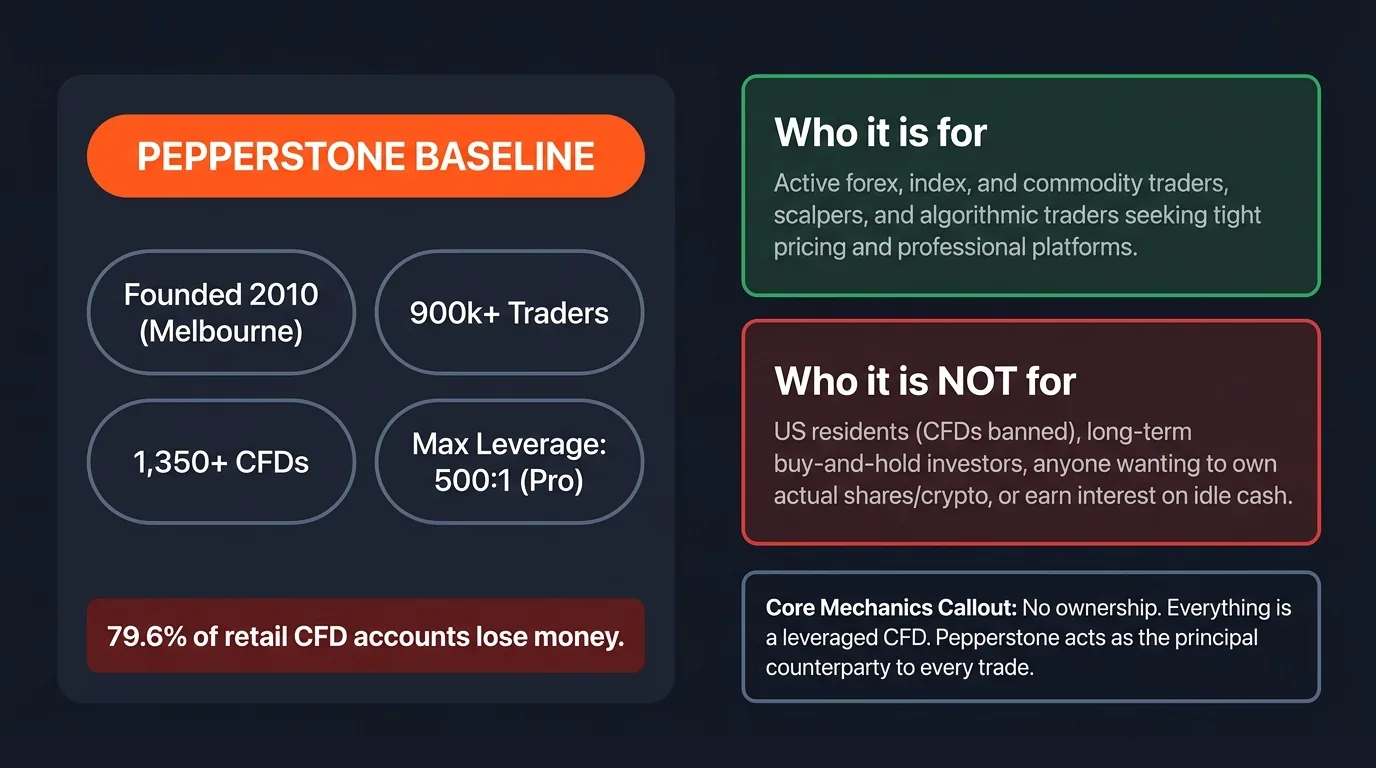
Pepperstone's scale is a genuine competitive advantage on spread pricing. With $12.5B+ in daily FX volume, it commands prime brokerage access that enables EUR/USD raw spreads at or near 0.0 pips during peak hours — something that genuinely cannot be replicated by smaller brokers without artificial subsidisation. The diagnostic confirms that the spread claims are real, but the silent costs documented above are equally real.
Synthesis: which setup for which strategy
Different trader profiles have fundamentally different cost sensitivities. The synthesis maps account choice and platform selection to strategy archetype.
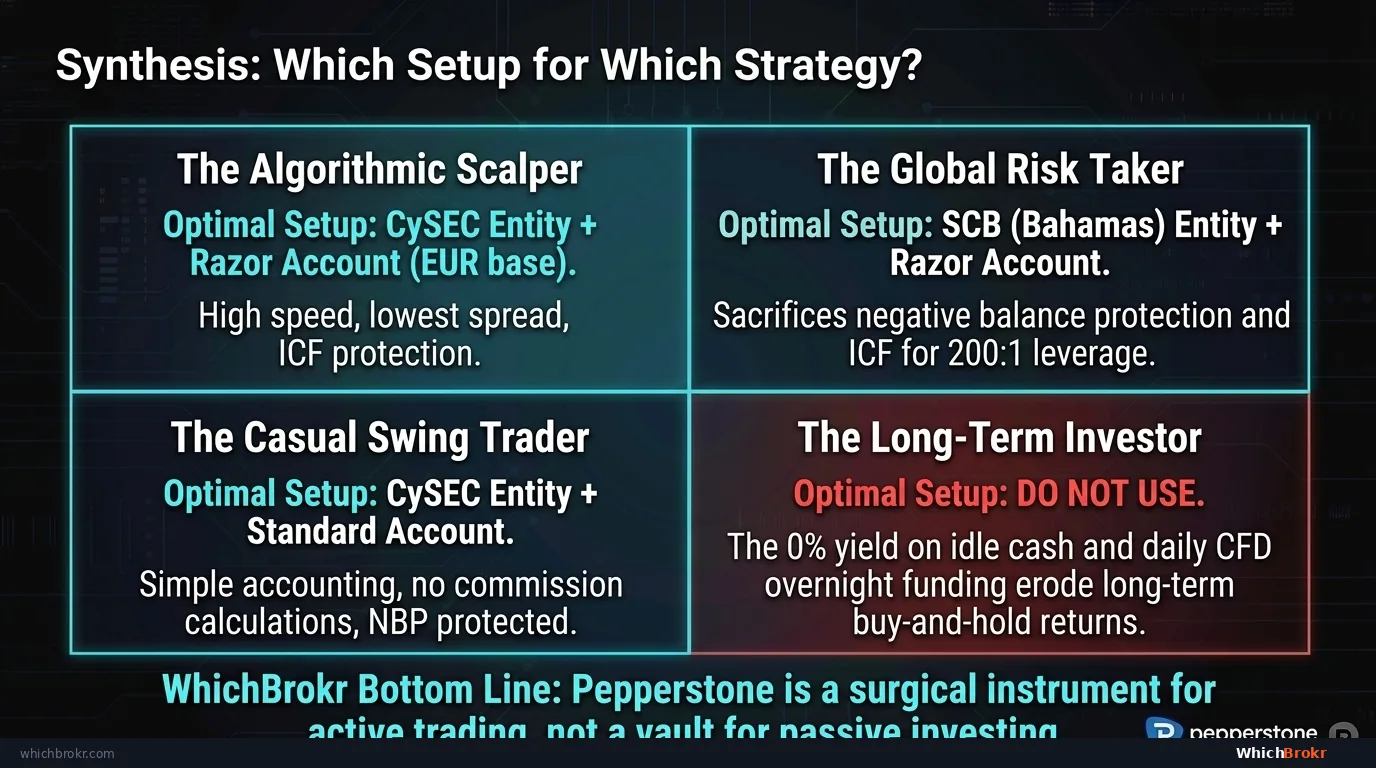
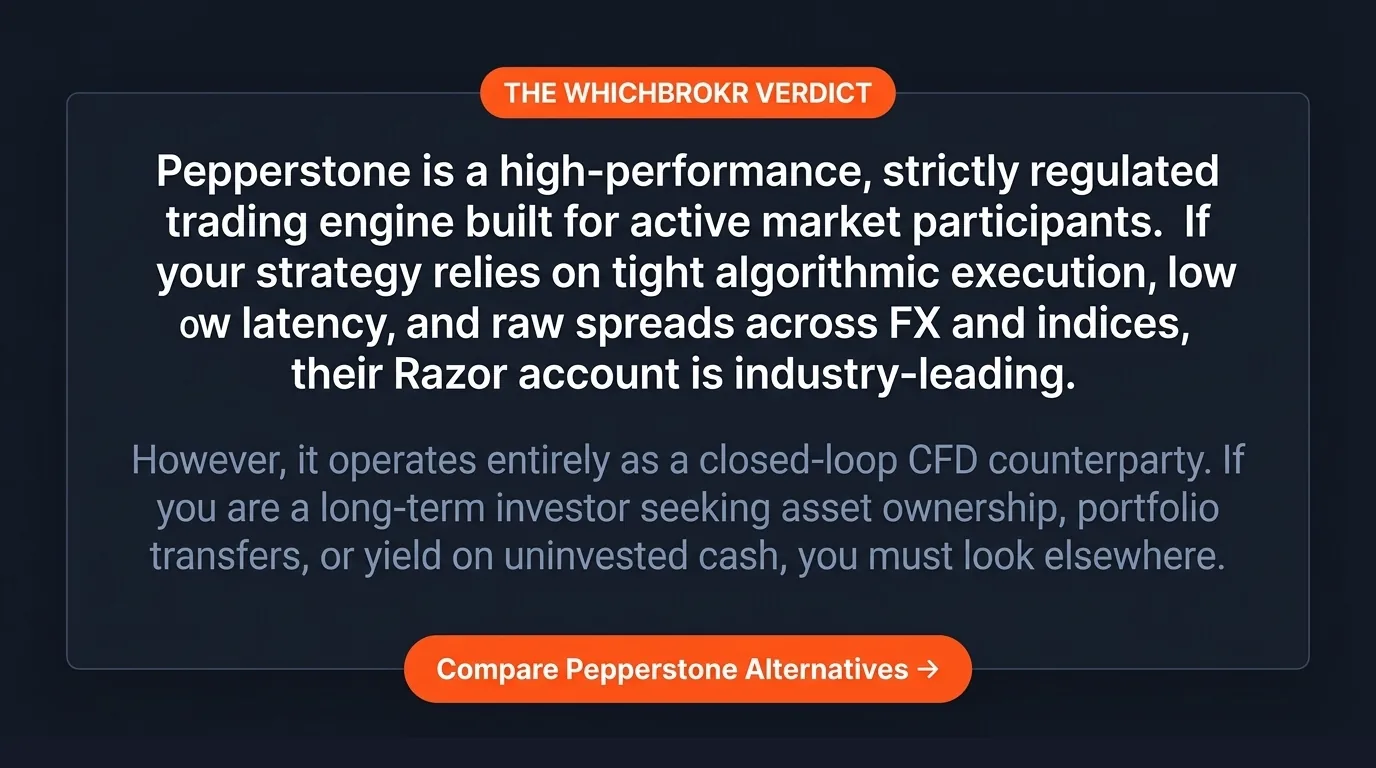
The WhichBrokr verdict
The WhichBrokr verdict
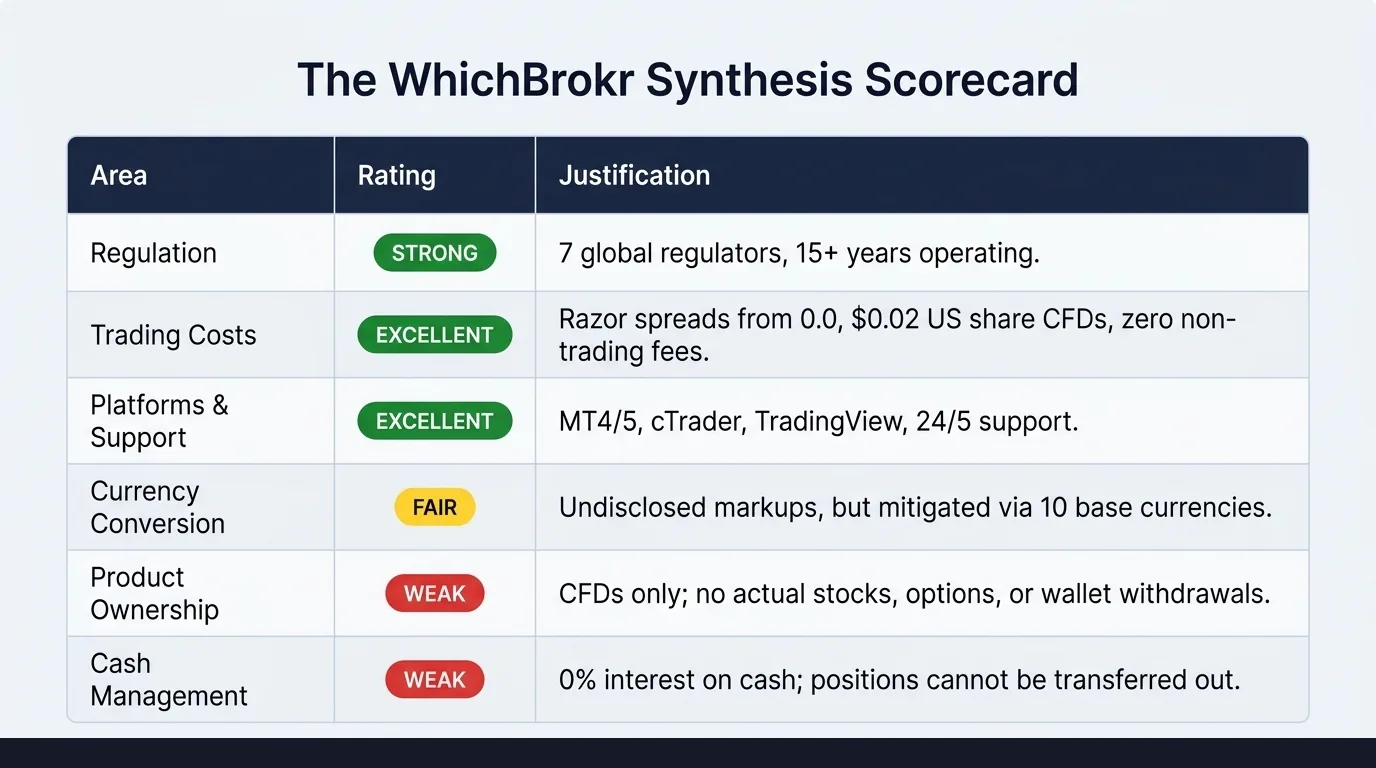
Pepperstone's execution infrastructure is genuinely world-class. The raw spreads are real, the platform choice is excellent, and the fee structure rewards traders who understand it. The costs to watch are the funding differential, the FX conversion markup, and the yield void on uninvested cash.