Pepperstone is one of the world's largest CFD and forex brokers, processing over $12 billion in daily volume across 900,000+ traders globally. But its pricing structure is deceptively complex: a two-account architecture with completely different cost logic, a multi-entity global footprint that directly affects your legal protections, overnight funding formulas tied to interbank benchmark rates, and a handful of silent costs that strip margin without appearing on a trade confirmation. This is the complete breakdown.
⚠️
Risk Warning: 79.6% of retail CFD accounts lose money when trading CFDs with Pepperstone. CFDs are complex instruments and carry a high risk of losing money rapidly due to leverage. You should consider whether you can afford to take the high risk of losing your money.
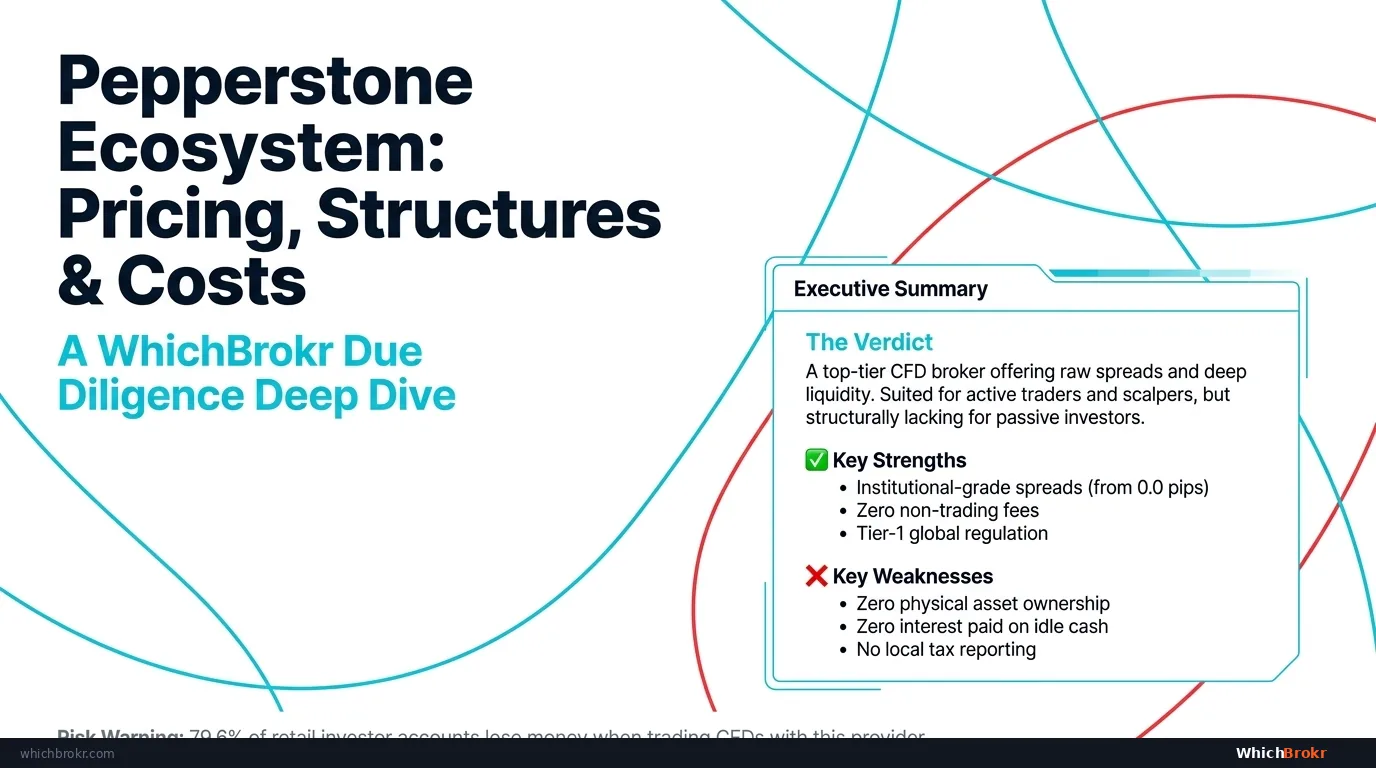
Pepperstone 2026 Pricing X-Ray — Executive Summary: Strengths (raw spreads, deep liquidity) vs Weaknesses (FX conversion, 0% cash yield, swap complexity)
The executive summary: Pepperstone's raw-spread execution model is genuinely competitive for active traders, but five structural cost leaks erode returns for unprepared clients.

The global entity architecture

Before discussing fees, you need to understand which Pepperstone you're dealing with. The broker operates through six distinct regulated entities, each with different capital requirements, leverage limits, and — critically — different client protection levels.
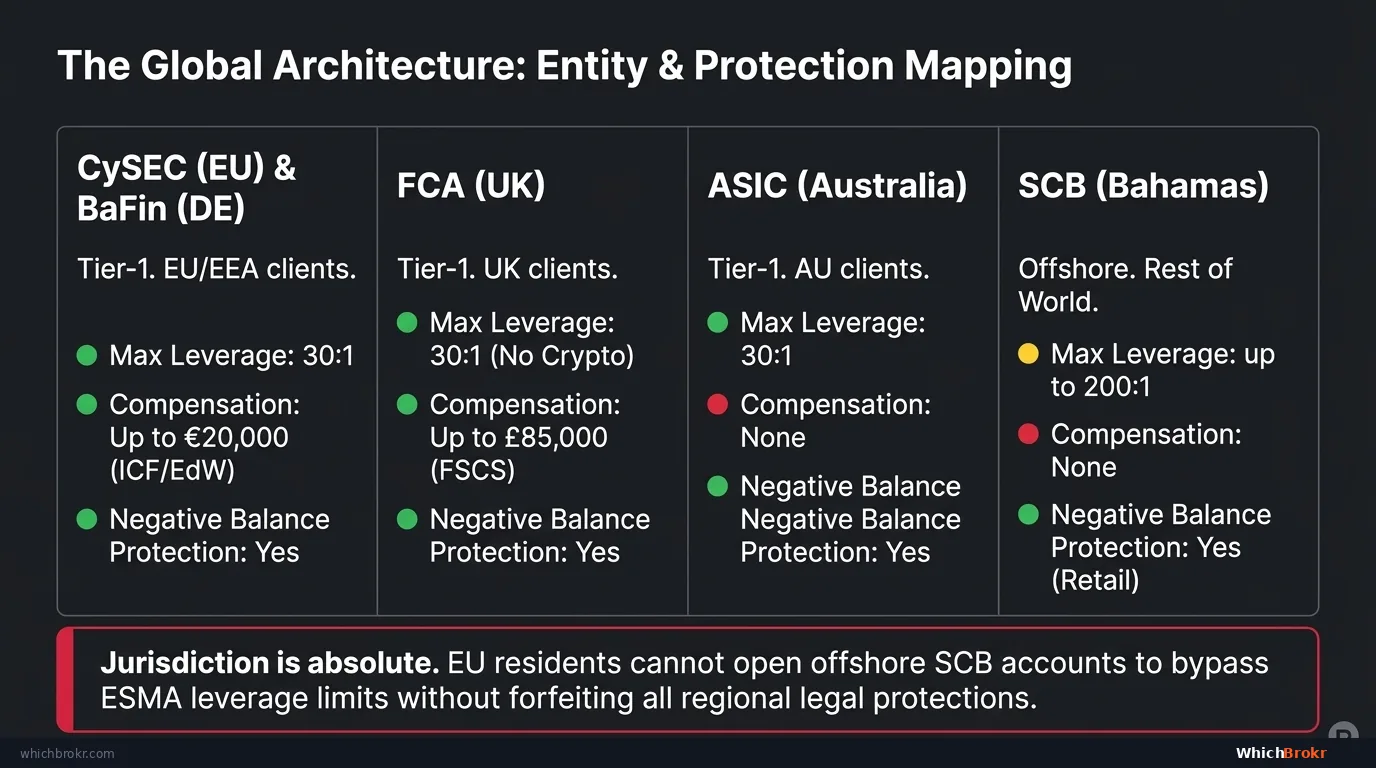
Pepperstone Global Entity Architecture: ASIC (Australia), FCA (UK), CySEC (EU/EEA), BaFin (Germany), SCB (Bahamas offshore), DFSA (Dubai), CMA (Kenya) — each with distinct leverage and protection tiers
Six regulated entities. Your legal protections, leverage ceiling, and compensation scheme depend entirely on which entity onboards you.

The practical differences are significant. UK clients (FCA) are covered by FSCS compensation up to £85,000 and face MiFID II leverage caps. EU clients (CySEC) are covered by the Investor Compensation Fund up to €20,000. Australian clients (ASIC) have no state-backed compensation scheme but benefit from strict segregation rules. Offshore clients (SCB Bahamas) access higher leverage but have effectively zero protection if Pepperstone fails.
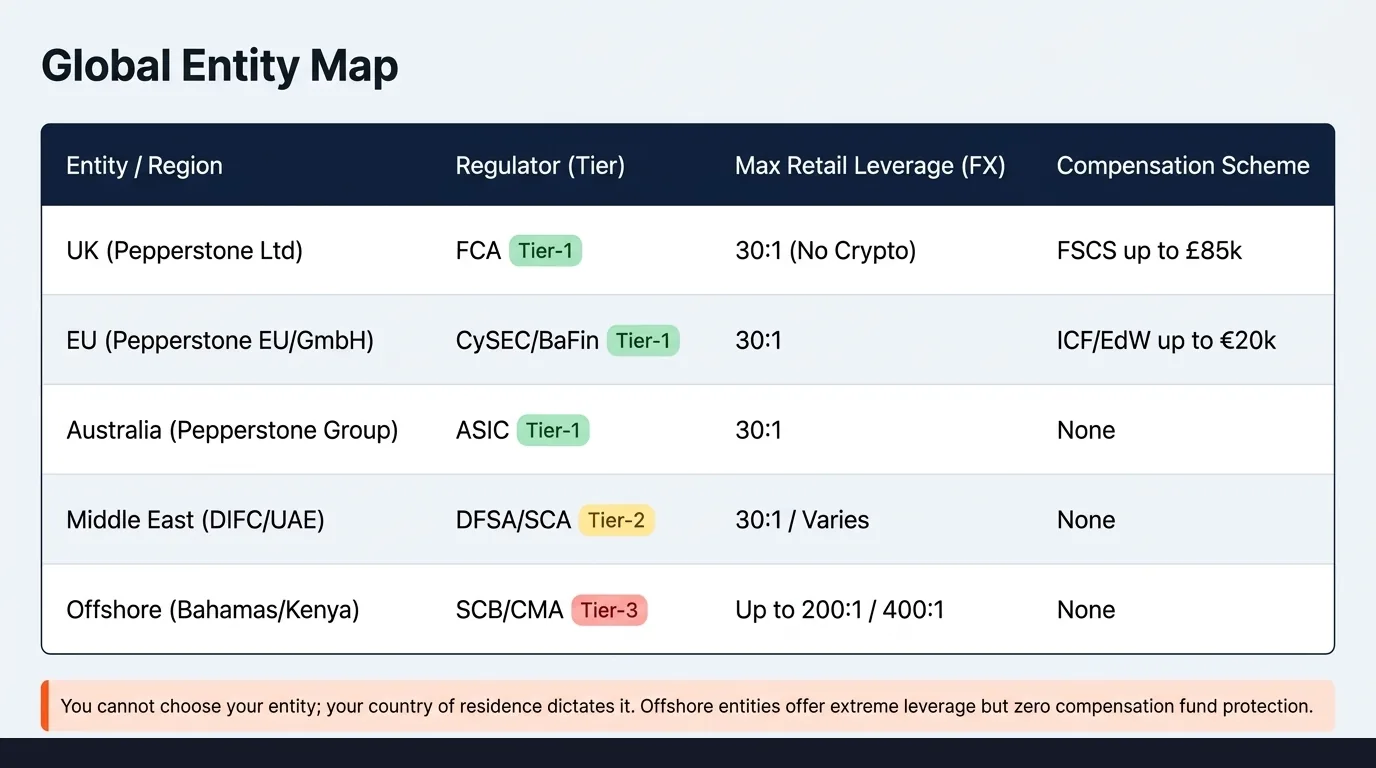
Pepperstone Global Entity Map — detailed table showing ASIC/FCA/CySEC/BaFin/SCB/DFSA/CMA with leverage limits, compensation schemes, and jurisdiction notes
The detailed entity comparison table. Higher leverage offshore comes at the direct cost of legal recourse and deposit protection.
Key takeaway: Where you open your account matters more than which platform you use. If you're in the UK or EU, confirm you're onboarded under FCA or CySEC — not the offshore SCB entity. Check your account documentation and the regulator listed on your contract note.

Client classification and leverage limits

Pepperstone distinguishes between retail and professional clients. The classification directly controls the maximum leverage available to you, which in turn affects your margin cost and risk-of-ruin calculations.
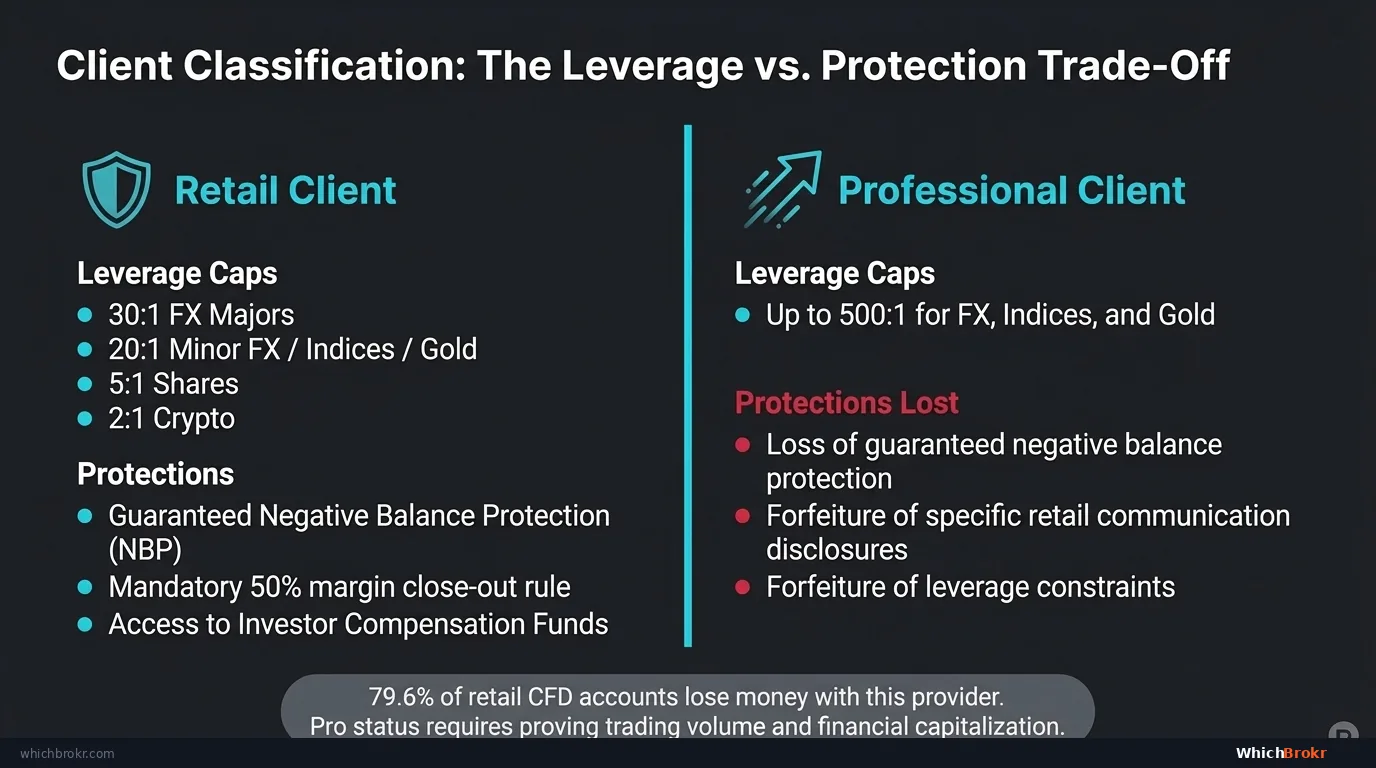
Pepperstone Client Classification: Retail (MiFID II limits — 30:1 FX, 20:1 indices, 5:1 shares, 2:1 crypto) vs Professional (up to 500:1 FX). Pro status requires 2-of-3 ESMA criteria.
Retail clients face MiFID II leverage caps under EU/UK entities. Professional status unlocks up to 500:1 on FX — but removes negative balance protection.

Under MiFID II (EU/UK entities), retail clients are limited to: 30:1 on major FX pairs, 20:1 on major indices, 10:1 on minor FX and gold, 5:1 on individual shares, and 2:1 on cryptocurrencies. To qualify as professional, you must meet two of three ESMA criteria: significant portfolio (€500k+), professional trading experience, or relevant financial industry experience.

⚠️
Pro status trade-off: Electing professional status removes your negative balance protection guarantee. In a fast market, losses can exceed your deposited capital. Pepperstone will pursue recovery of the shortfall from professional clients under most entity structures.

Account architecture: Standard, Razor, and Swap-Free

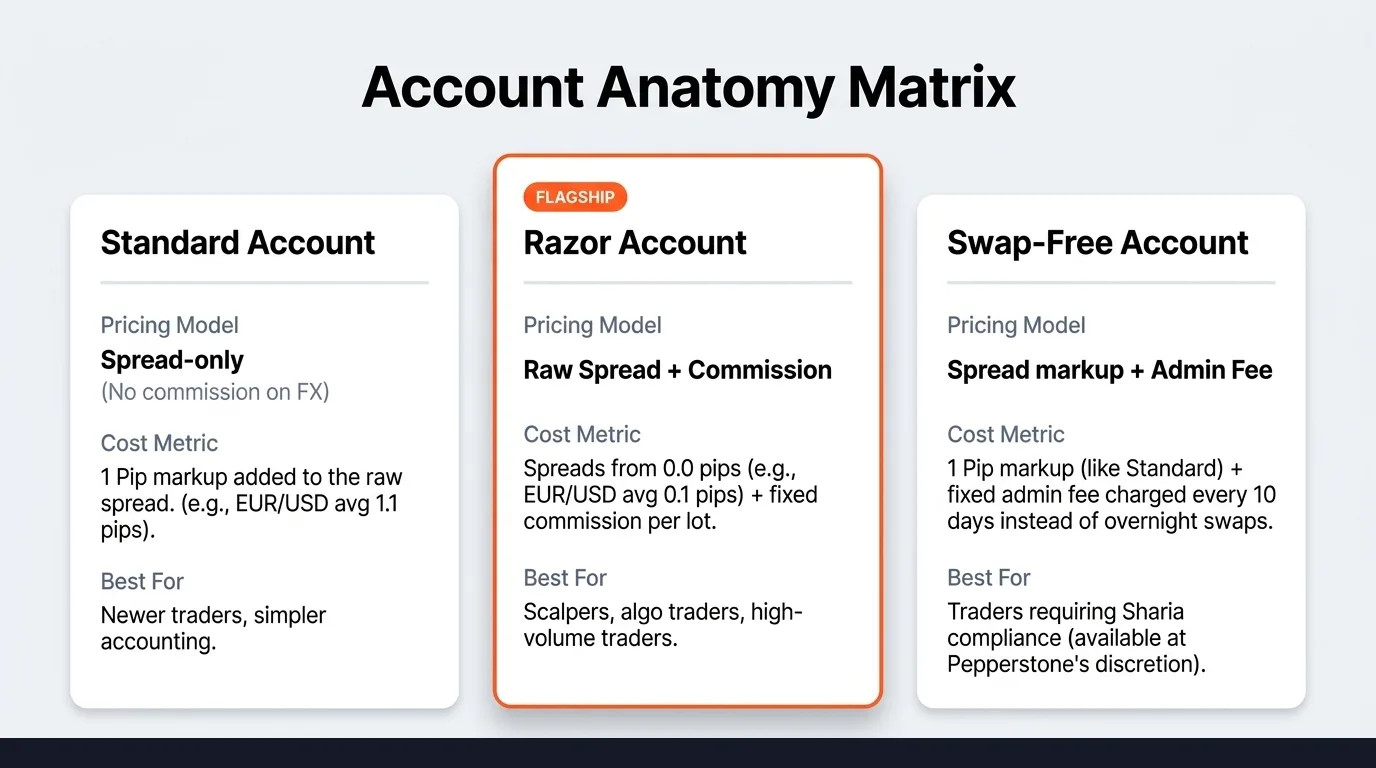
Pepperstone offers three account types with fundamentally different pricing logic. The choice is not cosmetic — it changes whether the broker's profit comes from spread markup, commission, or periodic admin charges.
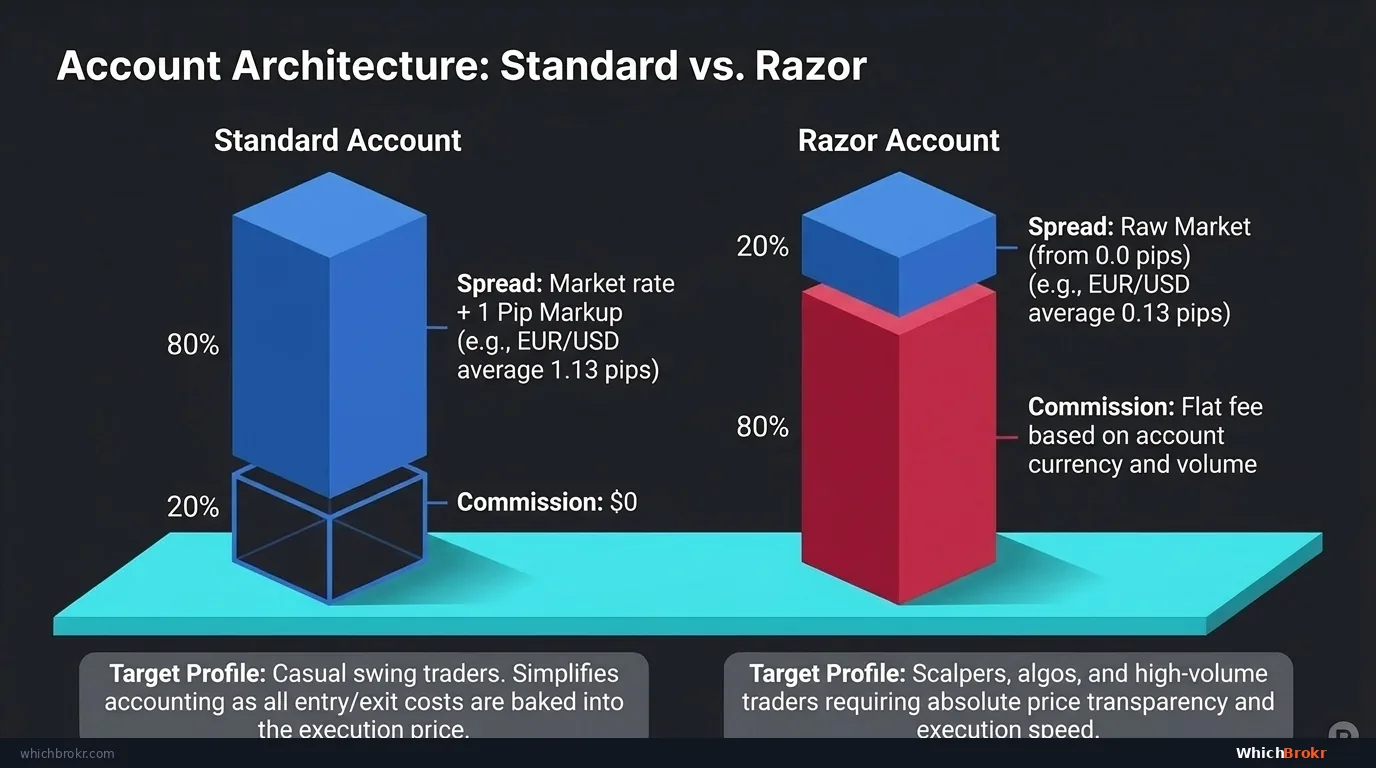
Pepperstone Account Architecture: Standard (spread-only, 1 pip markup, EUR/USD avg 1.1 pips) vs Razor (raw spread from 0.0 pips + $3.50/lot commission on MT4/MT5)
Standard buries the cost inside the spread. Razor makes it transparent with a separate commission line. Total effective cost at average EUR/USD spreads is roughly equivalent across both.
Account Anatomy Matrix: Standard (spread-only, best for newer traders), Razor (FLAGSHIP — raw spread + commission, best for scalpers and algo traders), Swap-Free (spread markup + admin fee, for Sharia compliance)
The three account archetypes. Razor is Pepperstone's flagship product — the preferred choice for active and algorithmic traders.

What you actually pay: spread reality check

Pepperstone's marketing emphasises minimum spreads — the figure that appears in best-case conditions at peak liquidity. The number that matters to most traders is the average spread across all market hours.
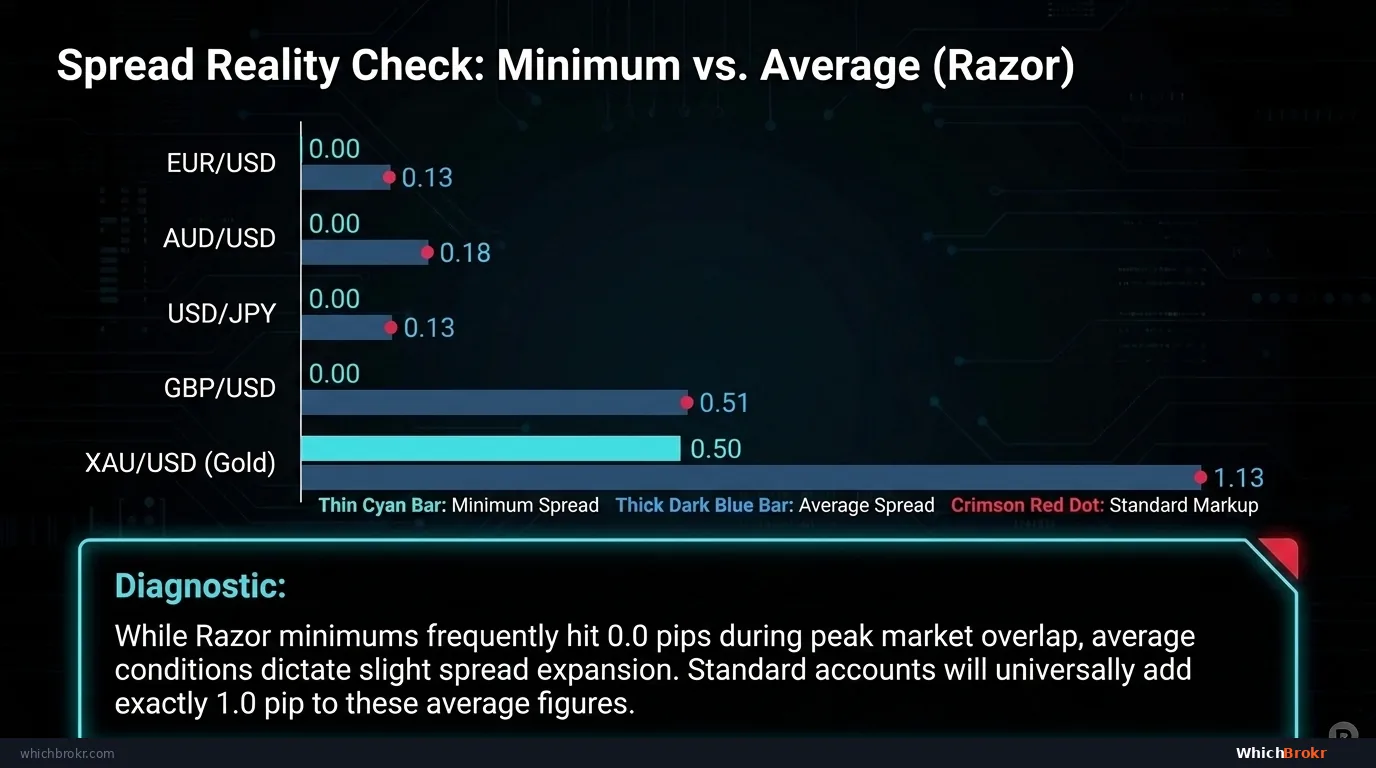
Pepperstone Spread Reality Check on Razor account: EUR/USD minimum 0.0 pips vs average 0.1 pips. GBP/USD min 0.4 pips vs avg 0.9 pips. Gold min 0.0 vs avg 0.12. The gap widens significantly on less liquid pairs.
The minimum spread is a marketing figure. Actual average spreads on Razor are competitive but not zero — factor the average into your cost model, not the minimum.

On the Razor account, EUR/USD averages 0.1 pips. Adding the $7.00 round-trip commission ($3.50 × 2), the total effective spread-equivalent is approximately 1.1 pips on a standard lot — the same as the Standard account's average. The Razor advantage emerges at scale: very large lots where the fixed commission per lot becomes a smaller percentage of total trade value, or for algorithmic strategies where ultra-low latency entry matters at the micro-pip level.

Key takeaway: For trades under ~$500,000 notional, Standard and Razor deliver similar total costs. Razor becomes meaningfully cheaper for high-frequency or very large-lot traders where commission falls below 0.7 pips effective spread.

The Razor commission structure by platform

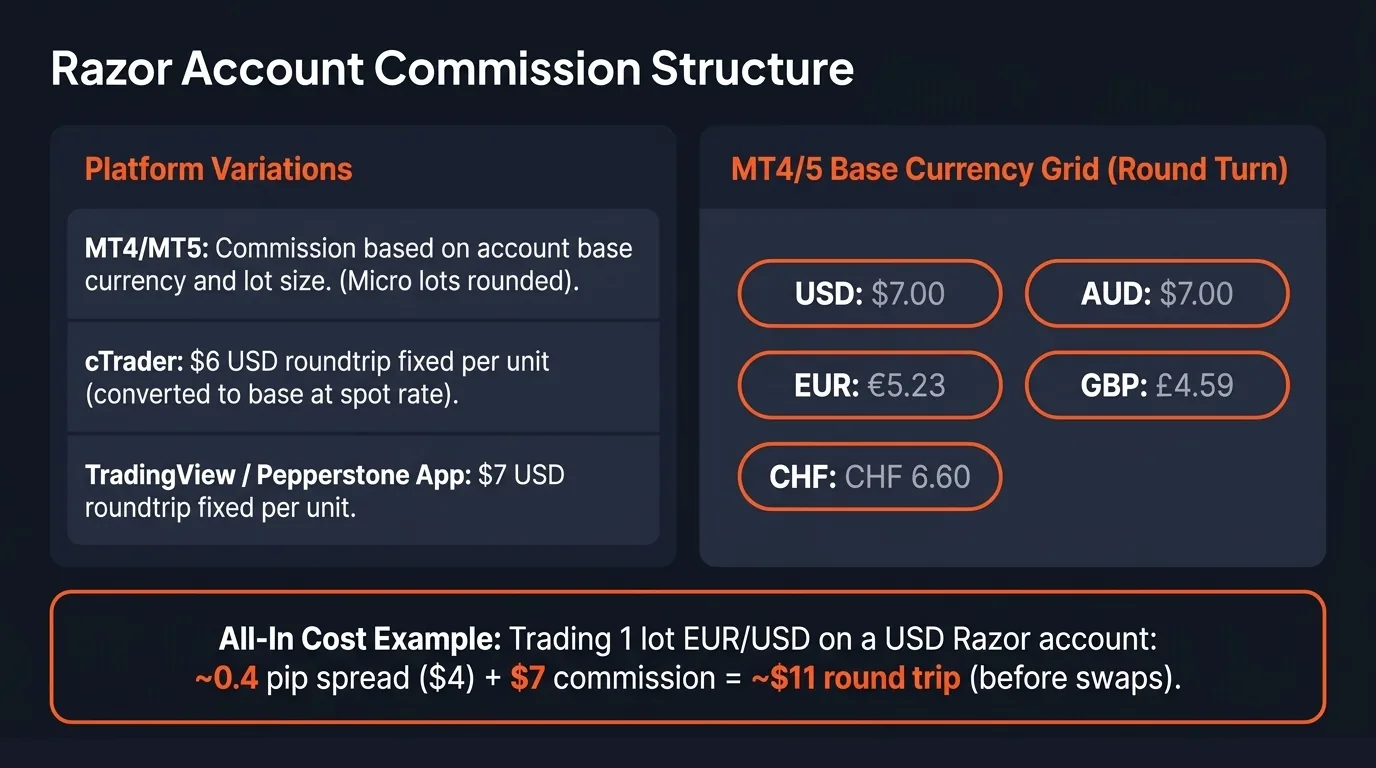
Commission on the Razor account is not uniform across all platforms. The per-lot rate varies by trading terminal, and for accounts denominated in non-USD currencies, an additional FX conversion applies to the commission itself.
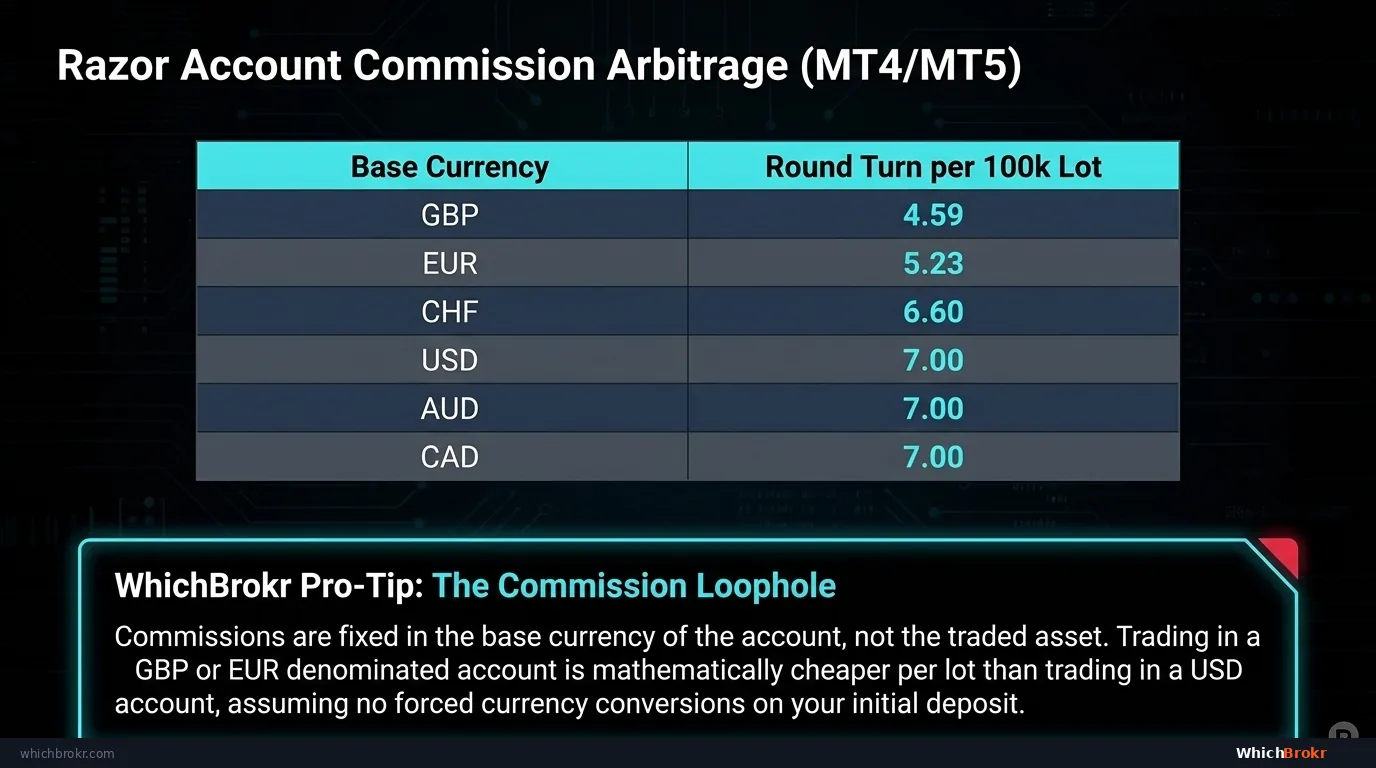
Razor Commission Arbitrage: MT4/MT5 $3.50/lot per side vs cTrader $3.00/lot per side. For 10 lots/day, cTrader saves $10/day = $2,600/year. Algorithmic traders should default to cTrader for the lower rate.
Platform choice is a cost decision. cTrader saves $1.00 per lot round-trip over MT4/MT5. At 10 lots/day that's $2,600/year in pure commission savings.
Razor Commission Structure teardown: MT4/MT5 $3.50 per side = $7.00 round-trip per standard lot. cTrader $3.00 per side = $6.00 round-trip. TradingView integration uses MT5 rates. Commission denominated in account base currency.
The full commission structure breakdown by platform. TradingView-connected accounts use MT5 rates ($7.00 round-trip). Always verify your rate in your account dashboard.
ℹ️
Platform tip: cTrader offers the lowest Razor commission ($6.00/lot round-trip) and the most transparent DOM (depth of market) display. For active traders who do not rely on MT4 expert advisors, cTrader is the more cost-efficient choice.

Multi-asset cost matrix

Pepperstone is not purely a forex broker. It offers CFDs across forex, metals, indices, shares, commodities, and cryptocurrency. Pricing methodology differs substantially by asset class.
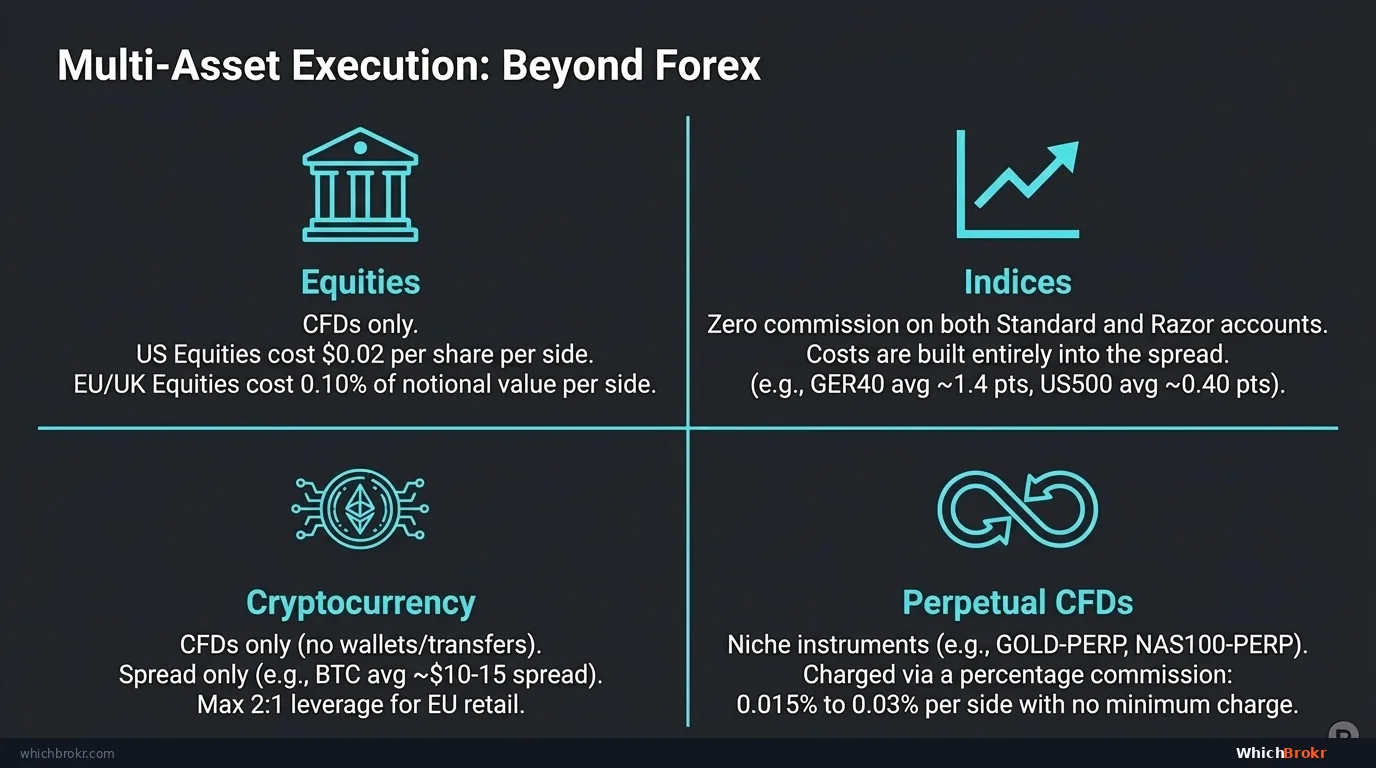
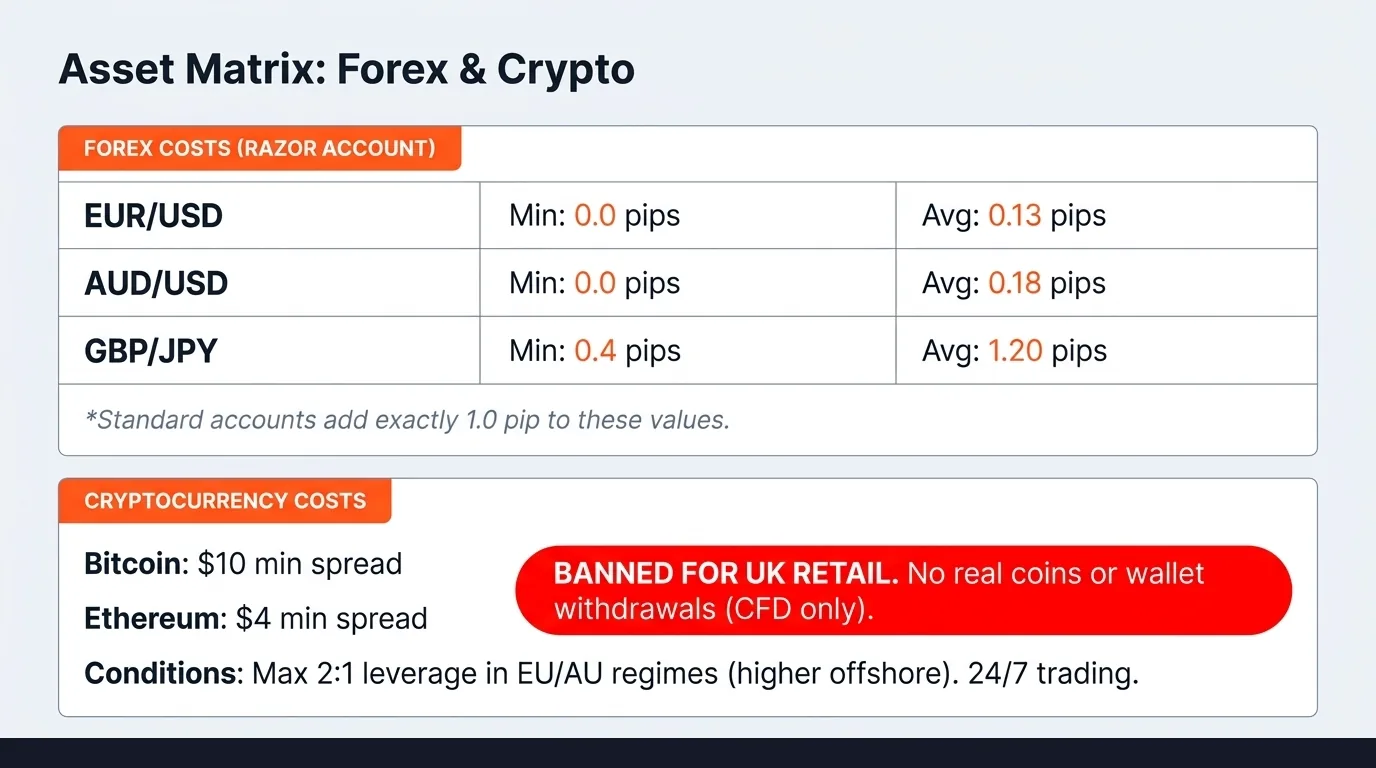
Pepperstone Multi-Asset Execution: Forex (spread + commission on Razor), Equities CFDs (spread + commission per share), Indices (spread only on Standard, raw + commission on Razor), Crypto (spread-only, 24/7)
Each asset class uses a different pricing unit. Equity CFDs charge commission per share. Indices are spread-only on Standard. Crypto runs 24/7 at fixed spreads.
Asset Matrix Forex and Crypto: Major FX pairs on Razor from 0.0 pips + $3.50/side. Minor pairs 0.3–1.5 pips avg. Crypto (BTC/USD) 40 pips spread equivalent, no commission, 24/7 availability.
Forex and crypto cost matrix. Crypto uses spread-only pricing — but 40 pips on BTC/USD is equivalent to ~$40 per $100k notional. Not cheap for frequent crypto trading.
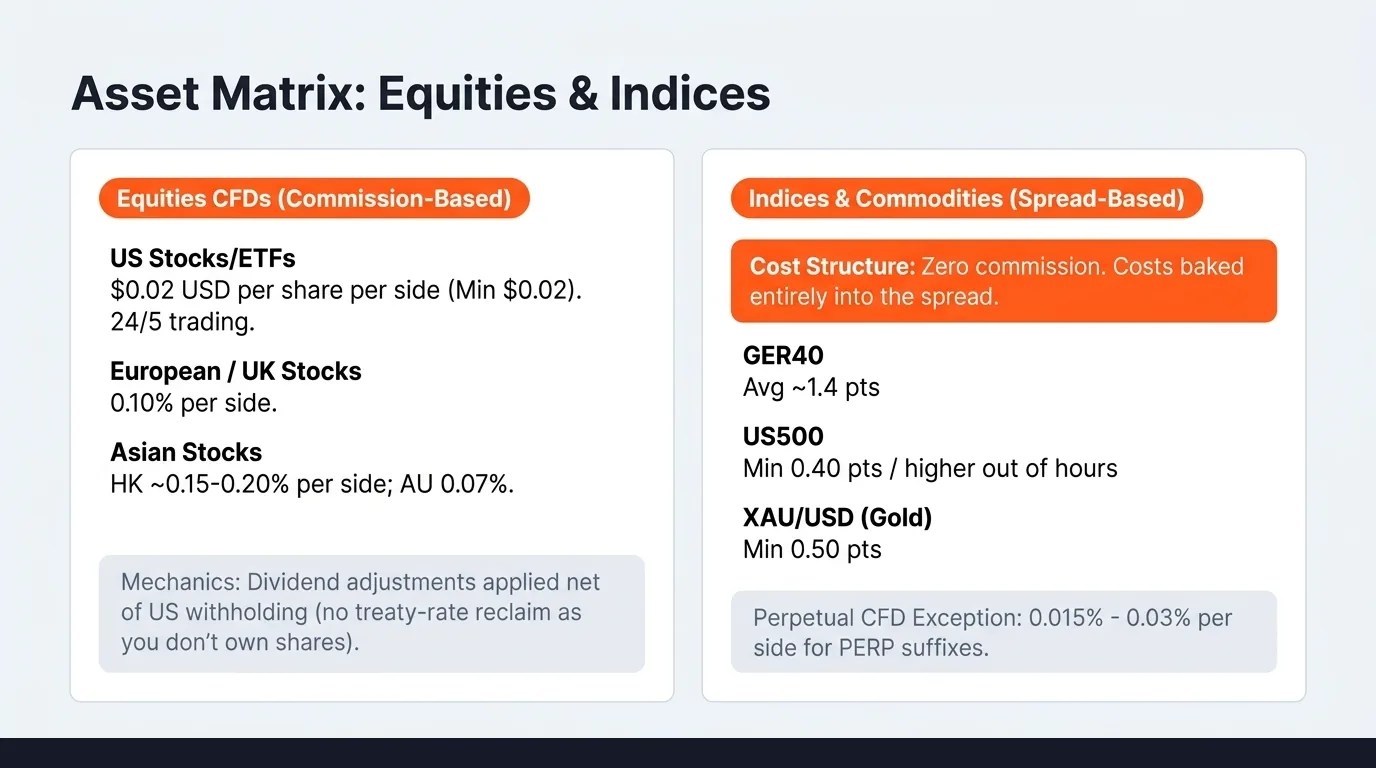
Asset Matrix Equities and Indices: UK shares from 0.1% commission. US shares $0.02/share. S&P 500 index CFD 0.4 points spread. ASX 200 from 1.0 point. Overnight holding costs on equity CFDs are ARR-based.
Equity and index CFD costs. Share CFD commissions are percentage or per-share based. Index CFDs use point spreads. All equity positions incur ARR-based overnight funding.

What costs nothing — and where Pepperstone earns

Understanding Pepperstone's zero-fee claims requires knowing exactly which costs are genuinely absent and which simply appear elsewhere in the pricing structure.
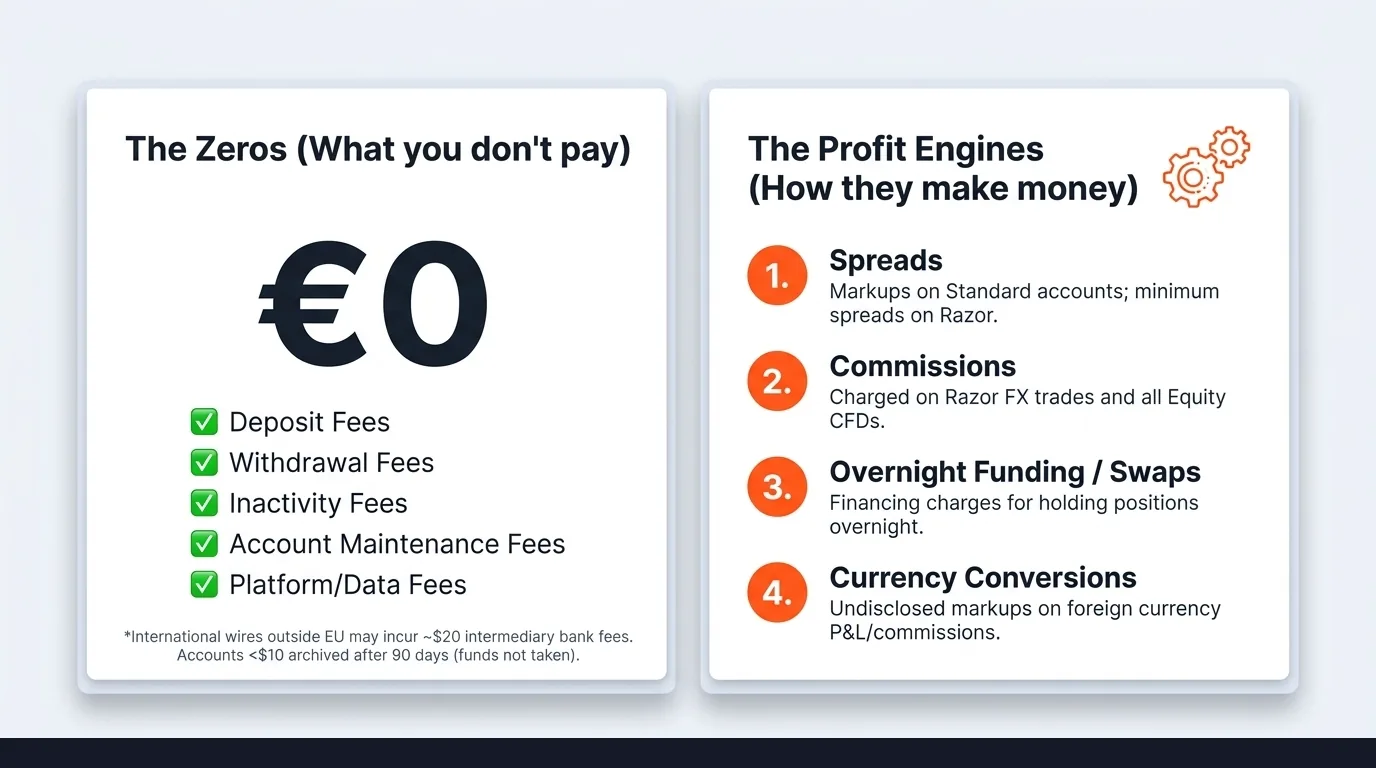
Pepperstone Profit Engine: The Zeros (no deposit fee, no withdrawal fee, no inactivity fee, no account maintenance) vs The Profit Engines (spread markup on Standard, commission on Razor, overnight funding differential, FX conversion markup)
The zeros are real. But every broker makes money somewhere — Pepperstone's profit engines are spread markup, commissions, funding rate differential, and FX conversion markup.

Pepperstone genuinely charges no deposit fee, no withdrawal fee, and no inactivity fee. However, the real costs come through four mechanisms: the 1 pip spread markup on Standard accounts; the $3.50–$7.00 commission per lot on Razor; the ±3% admin fee added to the overnight benchmark rate; and a 0.3–0.5% FX conversion markup on positions denominated in a currency different from your account base.

Overnight funding: the TomNext formula

Every CFD position held past the daily rollover (5pm New York time) incurs an overnight funding charge or credit. For forex and metals, Pepperstone uses the TomNext (Tomorrow/Next) interbank rate. For indices and shares, it uses the relevant short-term interest rate benchmark (ARR).
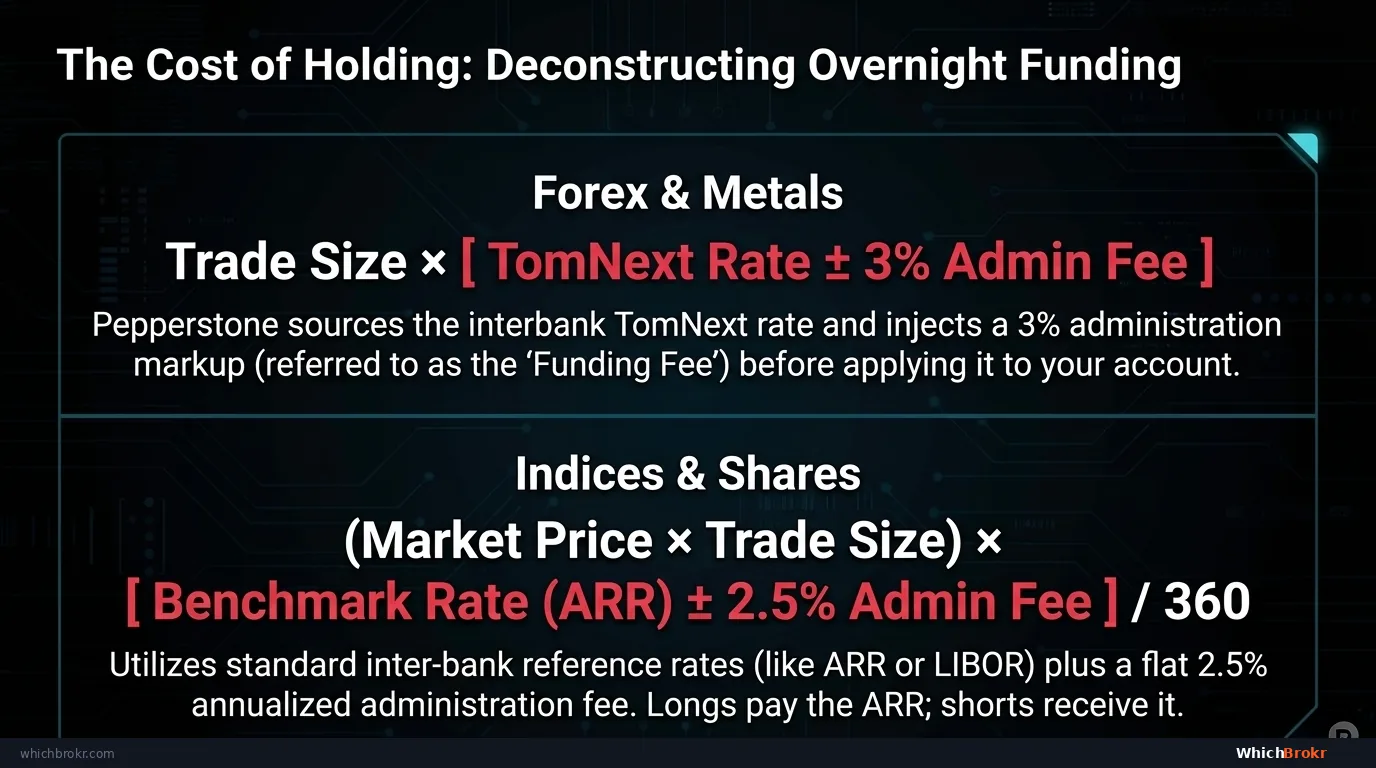
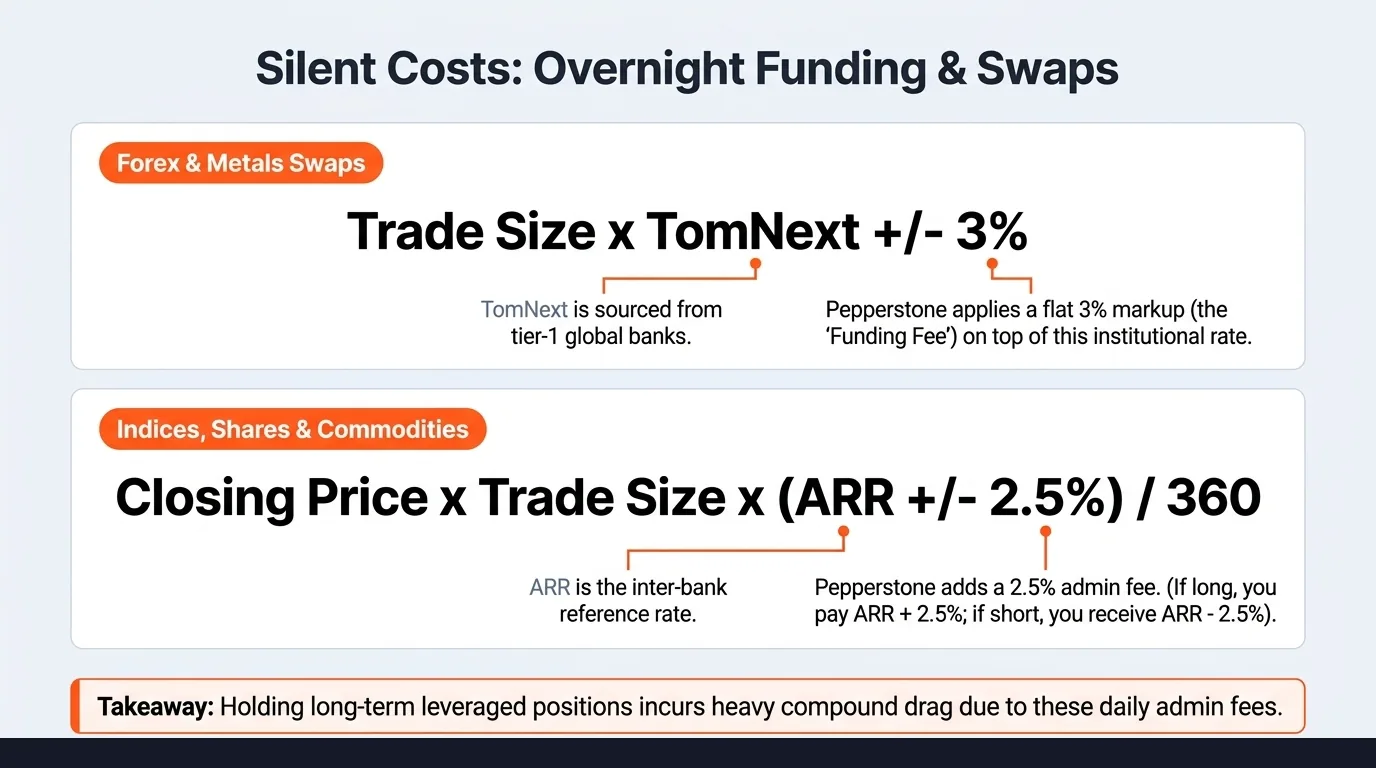
Pepperstone Overnight Funding formula: FX/Metals = TomNext rate ± 3% admin fee; Indices/Shares = Relevant ARR ± 2.5% admin fee. Long positions pay the rate + admin. Short positions receive the rate − admin. Positive carry can credit long positions.
The overnight funding formula. The 3% admin fee on FX and 2.5% on indices is the broker's margin — always applied against you regardless of direction.
Silent Costs — Overnight Funding deep dive: TomNext for EUR/USD currently near 0. But on a 10-lot long AUD/JPY position with TomNext of -5.0%, the annual funding cost is -5.0% + 3.0% admin = -8.0% annualised. On $100k notional = $8,000/year.
The overnight funding differential matters enormously on carry trades. A negative-carry pair like AUD/JPY short can cost 8%+ annualised when the admin fee is included.

For a long USD position where the TomNext rate is positive (USD funding rate above JPY, for example), the long position may actually receive a credit. But after the 3% admin fee, most carry positions that appear positive on paper become flat or negative in practice. Short positions always pay the benchmark plus the admin fee.

Key takeaway: Overnight funding is often the largest single cost for swing traders holding positions 5+ days. Calculate your expected funding cost before entering any leveraged position with a target hold period over 48 hours.

The triple swap quirk: Wednesday's hidden tax

Every forex trader needs to understand the triple swap mechanism before placing their first leveraged position. It is a structural quirk of the global FX settlement system — not a Pepperstone-specific policy — but it creates a predictable weekly cost spike that catches unprepared traders.
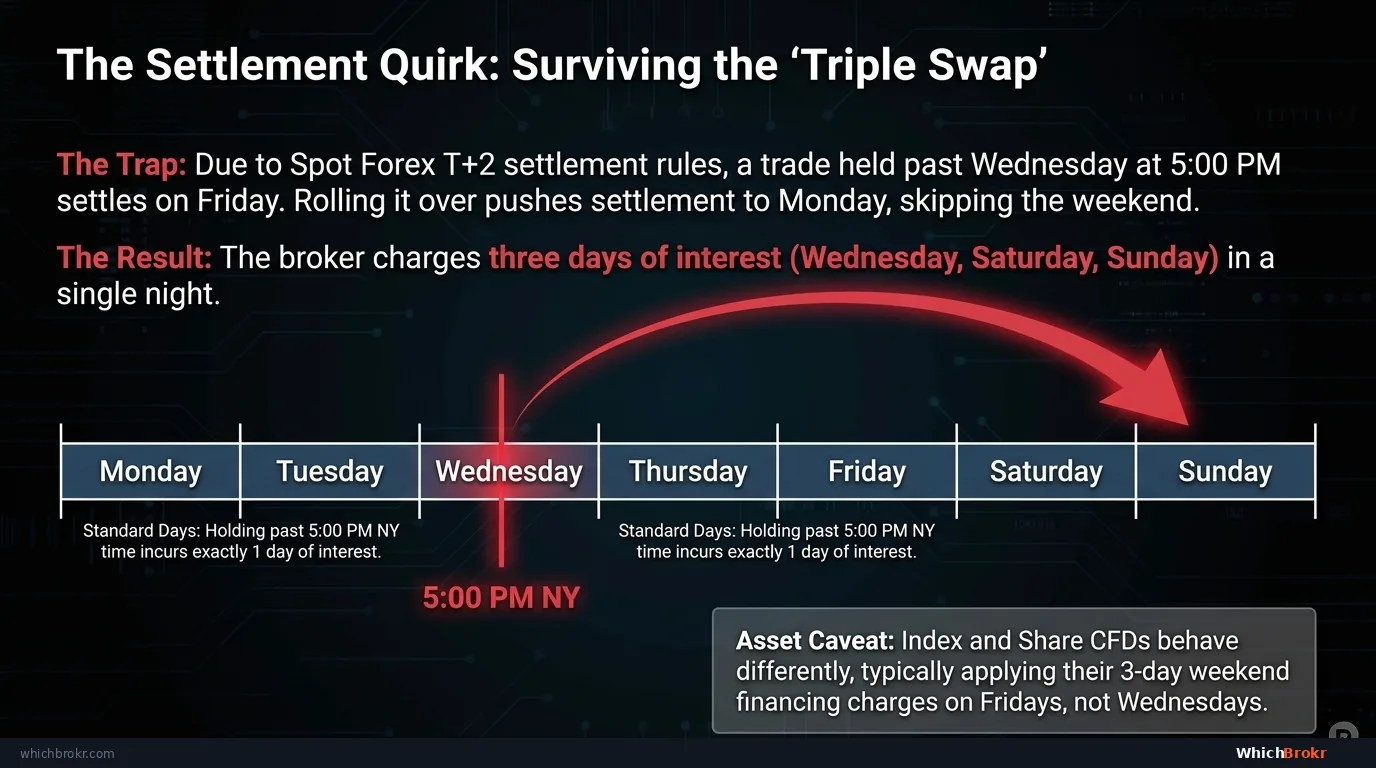
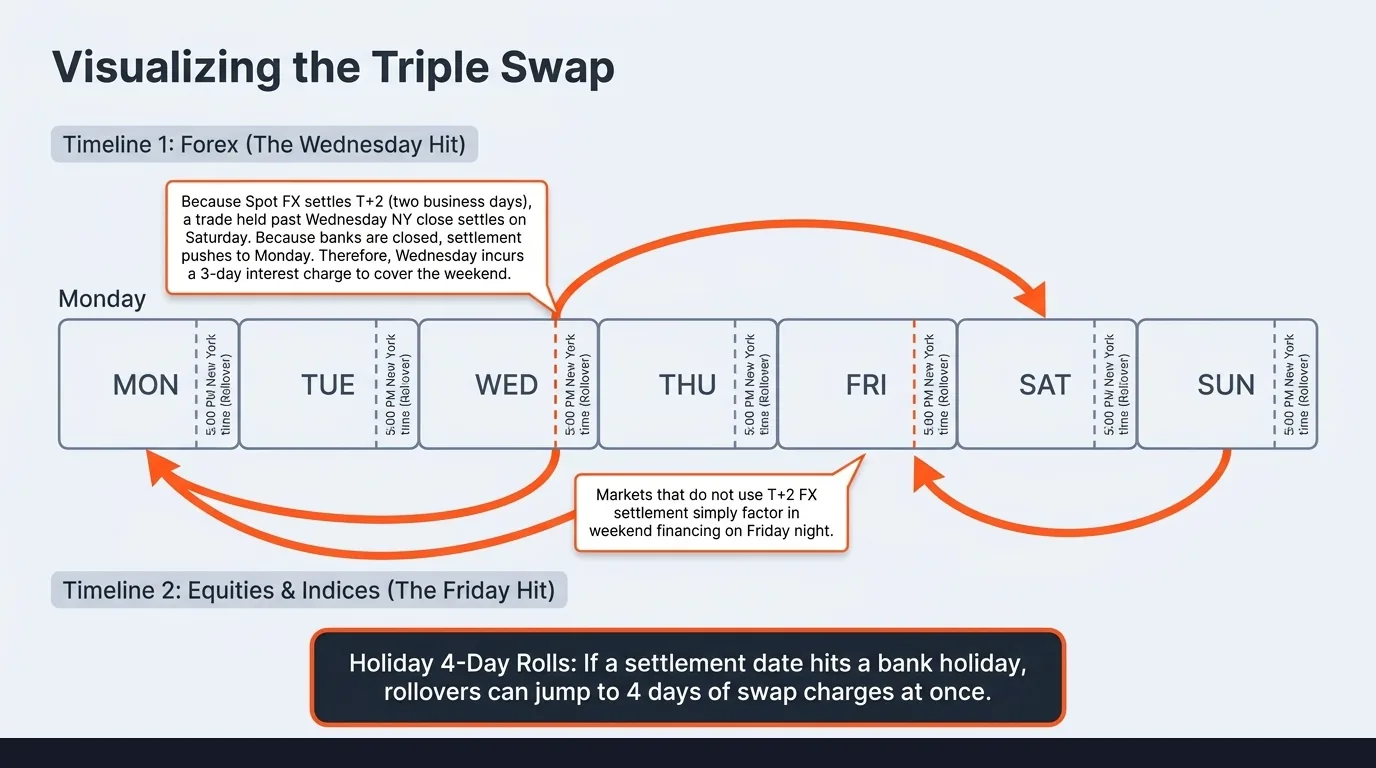
Triple Swap Wednesday: FX settles T+2. A Monday trade settles Wednesday. A Wednesday trade settles Friday. A Thursday trade settles Monday (bridging the weekend). Pepperstone charges 3× the overnight rate on Wednesday to account for the weekend funding gap.
The T+2 settlement rule. Wednesday positions bridge the weekend settlement gap — Pepperstone charges three days of swap in one Thursday deduction to compensate for Saturday and Sunday.
Visualizing the Triple Swap: Timeline showing Mon/Tue = 1× swap; Wed position = 3× swap charged Thursday 00:00. Annual impact on 1 lot EUR/USD at -5 pips/day swap: standard days = $5, Wednesday = $15. Weekly total: 9× daily rate.
The visual timeline of the triple swap. Wednesday night (deducted Thursday) is 3× the standard daily rate. Weekly effective swap is 9× the daily figure — not 7×.

The practical implication: if you trade primarily on Thursdays, you may open a position just after the Wednesday rollover and avoid the triple charge. Conversely, holding a position into Wednesday rollover when the swap rate is negative amplifies your weekly funding cost significantly.

ℹ️
For swing traders: Close or reduce leveraged positions before 5pm New York time on Wednesday if overnight funding costs are material to your strategy. The triple charge cannot be avoided through any broker — it is baked into global FX settlement.

Swap-free accounts: what you gain and what you give up

Pepperstone's swap-free (Islamic) account is designed for traders who require Sharia compliance by eliminating interest-bearing overnight charges. The structure replaces swap with an admin fee — which changes the cost profile significantly for different holding periods.
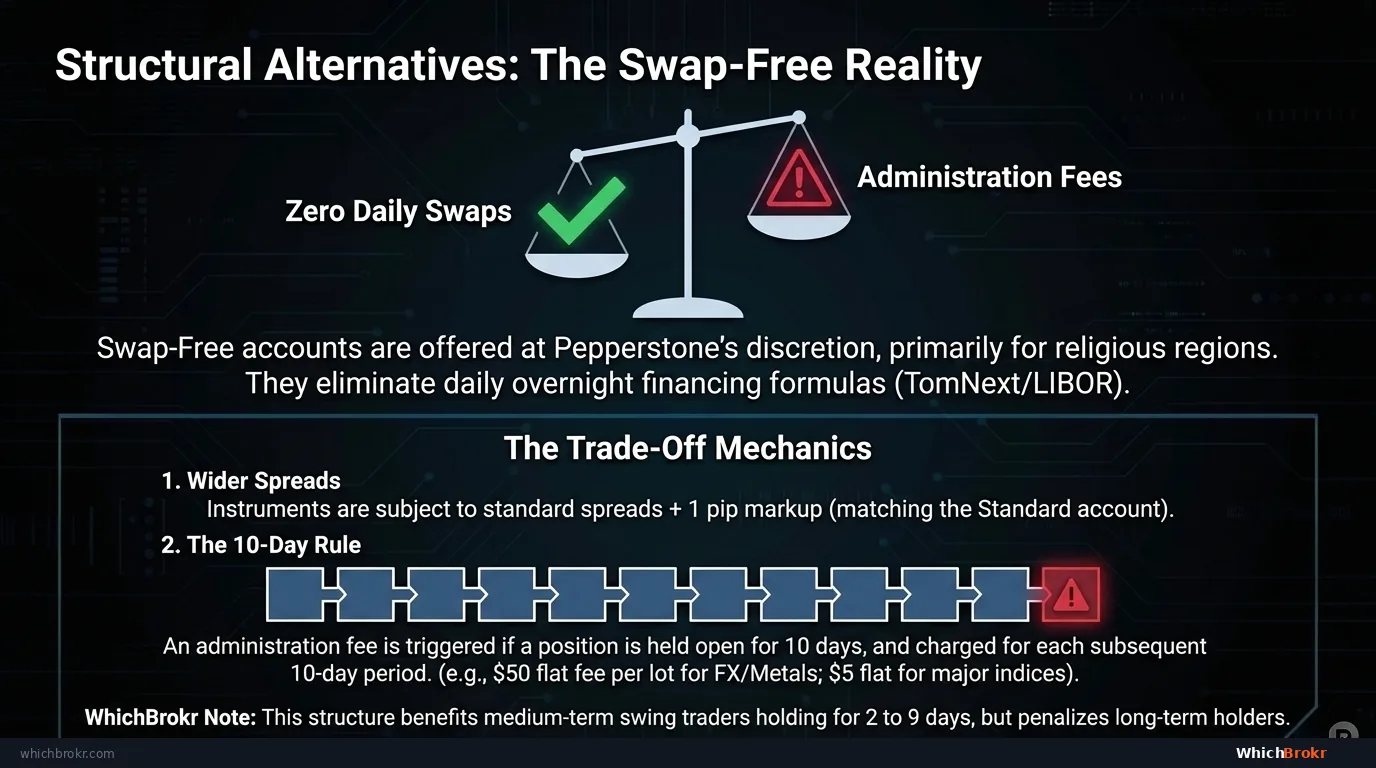
Pepperstone Swap-Free Account: Replaces daily swap with fixed admin fee every 10 days. 1 pip markup on all positions (same as Standard). Admin fee ~$3–$15 per lot per 10-day cycle depending on instrument. Short-term holds: cheaper than swap. Long-term holds: more expensive.
The swap-free account is cheaper than standard for very short holds (under 3 days), but the 10-day admin fee becomes expensive for positions held weeks or months.

The swap-free account carries a 1 pip markup (like Standard), plus a fixed admin fee per 10 days instead of daily swap deductions. For traders holding positions for 1–3 days, the swap-free structure may actually be cheaper than a standard account with negative swap. For positions held over 2 weeks, the periodic admin fee typically exceeds what standard swap would have cost. Pepperstone approves swap-free status at its discretion.

The silent cost: currency conversion leak

One of the most consistently overlooked costs in CFD trading is the FX conversion charge. It applies any time you trade an instrument denominated in a currency different from your account base currency — which, for most traders, happens on nearly every non-domestic trade.
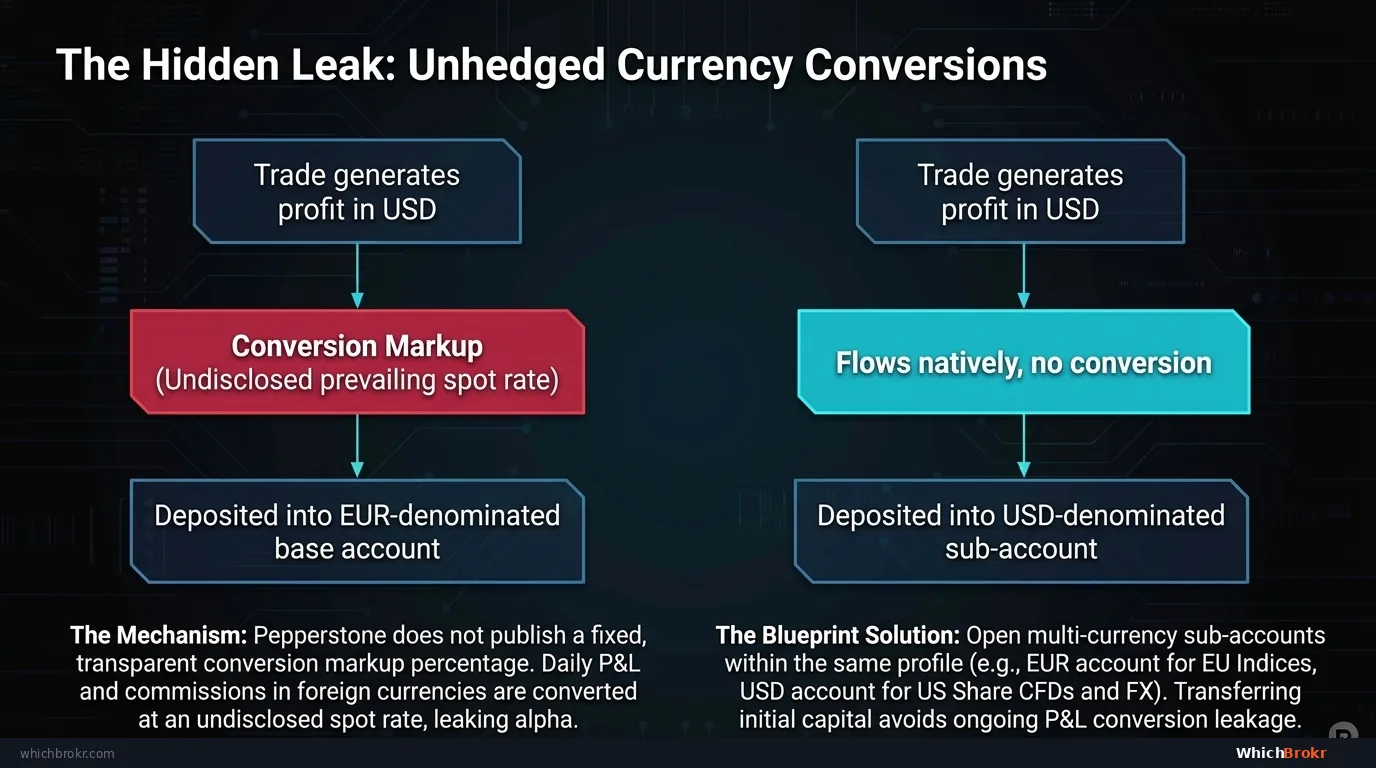
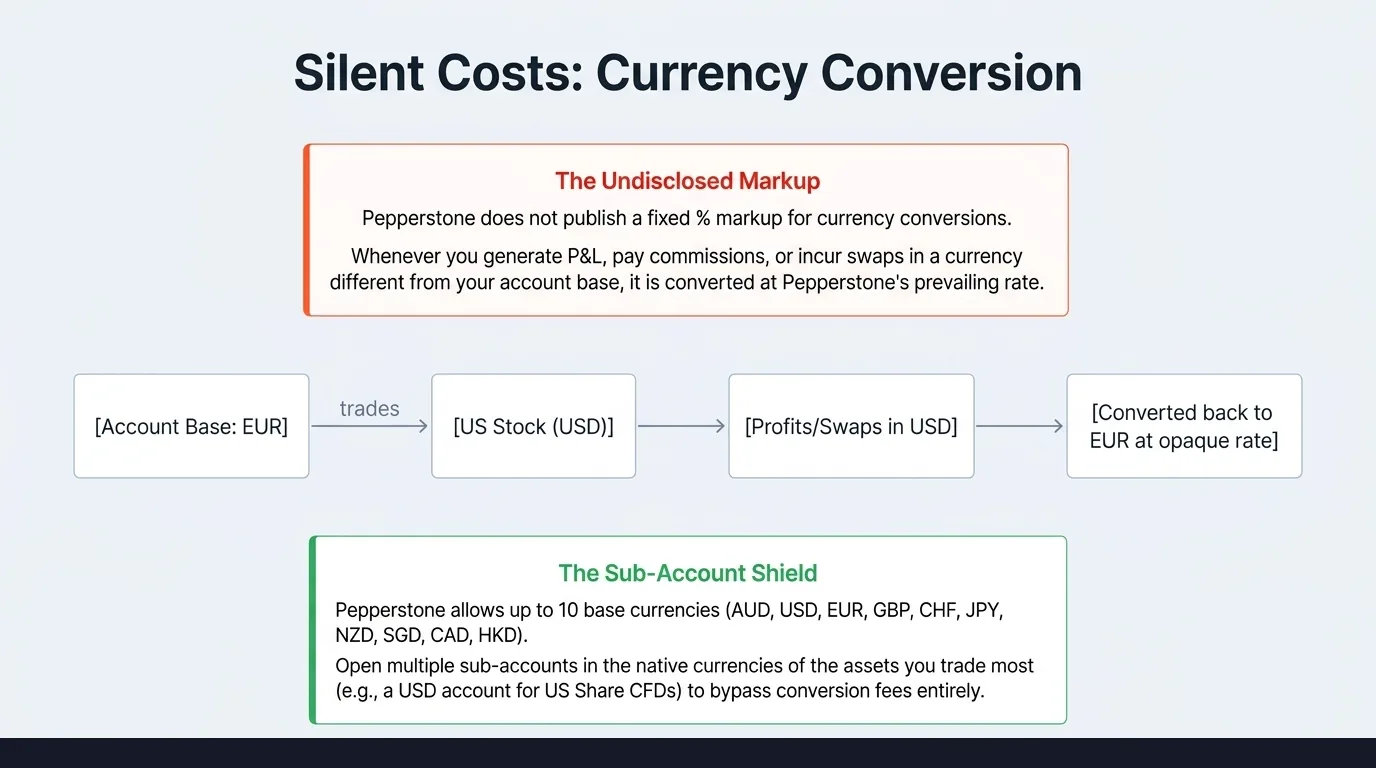
Pepperstone Hidden FX Conversion Leak: A EUR-base account trading US30 (USD-denominated) P&L. At trade close, Pepperstone converts USD profit/loss to EUR at their internal rate. The conversion spread is 0.3–0.5% — charged each time, with no visible line item on the confirmation.
The FX conversion happens silently on close. A USD-denominated profit converted to EUR at 0.4% costs €40 on a €10,000 gain — with no confirmation line item.
Silent Costs — Currency Conversion deep dive: EUR-base account trading S&P 500 and UK100. On S&P 500 close, USD P&L converted to EUR at mid + 0.4%. On UK100 close, GBP P&L converted to EUR. Effective annual drag on diversified portfolio: 0.3–0.8% depending on frequency.
The conversion drag compounds. A diversified trader closing 200 trades/year across USD, GBP, and JPY instruments pays conversion fees each time — adding 0.3–0.8% annual drag on gains.
⚠️
Mitigation strategy: Open a USD-base account if the majority of your trades are on USD-denominated instruments (US equities, commodities, most crypto). This eliminates conversion on every USD instrument close. Pepperstone allows multi-currency account base selection at account opening.

Cash management and non-trading fees

Pepperstone's non-trading fee profile is genuinely clean by industry standards — but one structural characteristic constitutes a real cost that is rarely discussed: the 0% interest on uninvested cash.
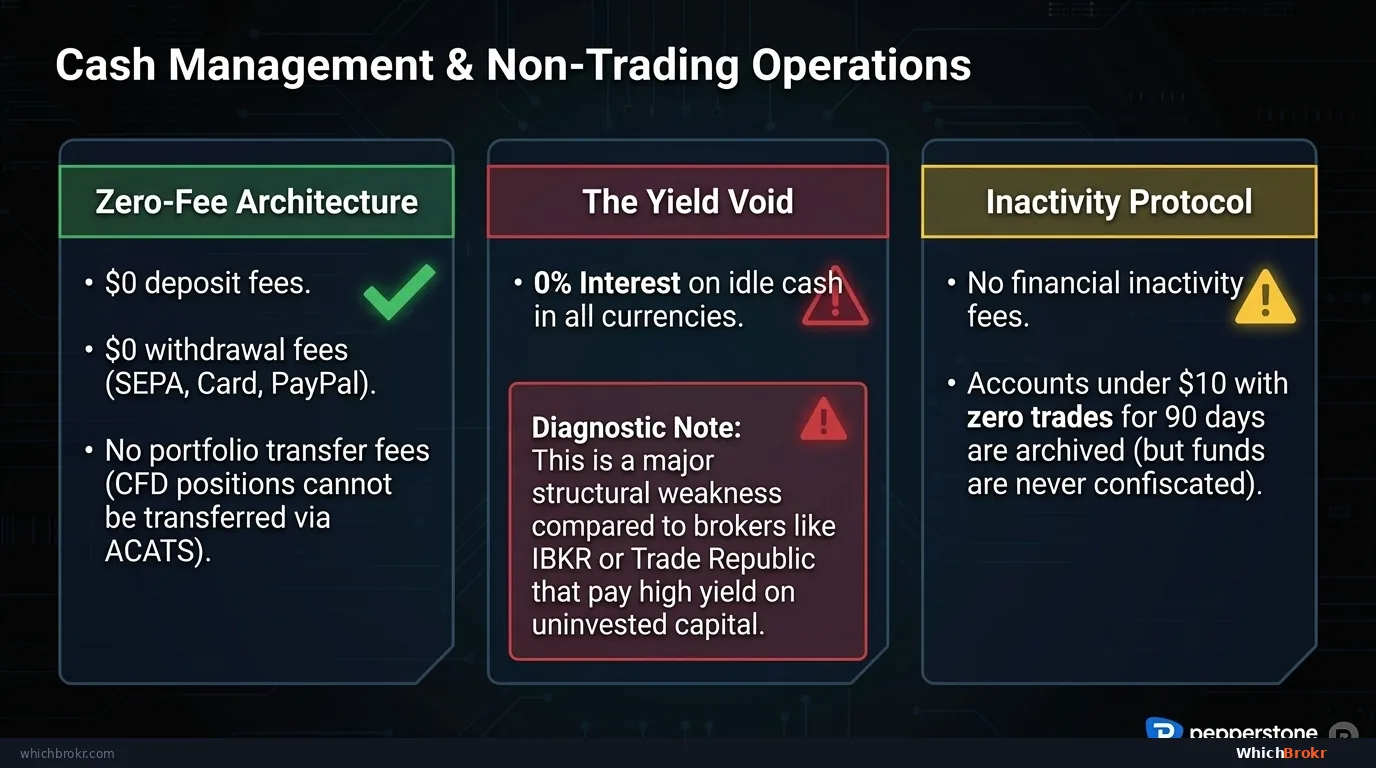
Pepperstone Cash Management: No deposit fee. No withdrawal fee. No monthly maintenance fee. No inactivity fee (account archived after 90 days but no charge). Zero interest on cash balances. No negative balance protection on professional accounts.
The non-trading fee structure is clean — but 0% interest on cash is a real cost when risk-free rates are above zero. $50,000 in uninvested capital at 5% risk-free rate = $2,500/year in opportunity cost.
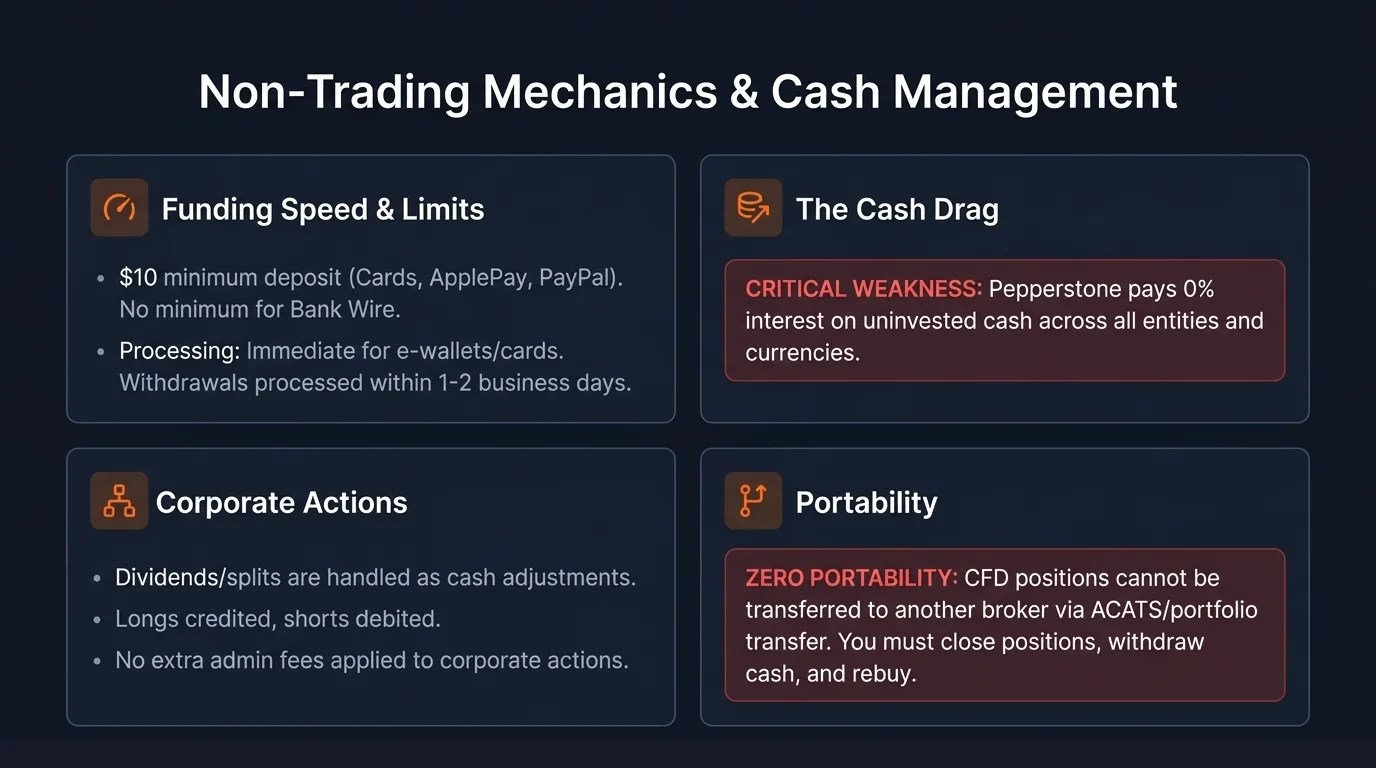
Non-Trading Mechanics & Cash Management: 0% interest on all idle cash. 90-day archive threshold (no trading activity). Archived accounts retain funds — no penalty. Wire withdrawals may incur bank charges. No intra-day margin call grace period noted.
Non-trading mechanics summary. The 90-day archive is administrative only — funds are safe. The meaningful cost is the yield void on uninvested capital in a high-rate environment.

At current risk-free rates (5%+ in USD, 4%+ in EUR), a trader keeping $50,000 in a Pepperstone account earns $0 in interest. The same capital in a money market fund earns ~$2,500/year. This opportunity cost is real and compounds over time — particularly for traders who hold large cash reserves between positions.

Cost scenario: 100 lots EUR/USD full lifecycle

Abstract pricing metrics are easier to evaluate through a concrete trade scenario. The following models the full cost of a 100-lot EUR/USD round-trip held for three days — comparing Standard and Razor accounts.
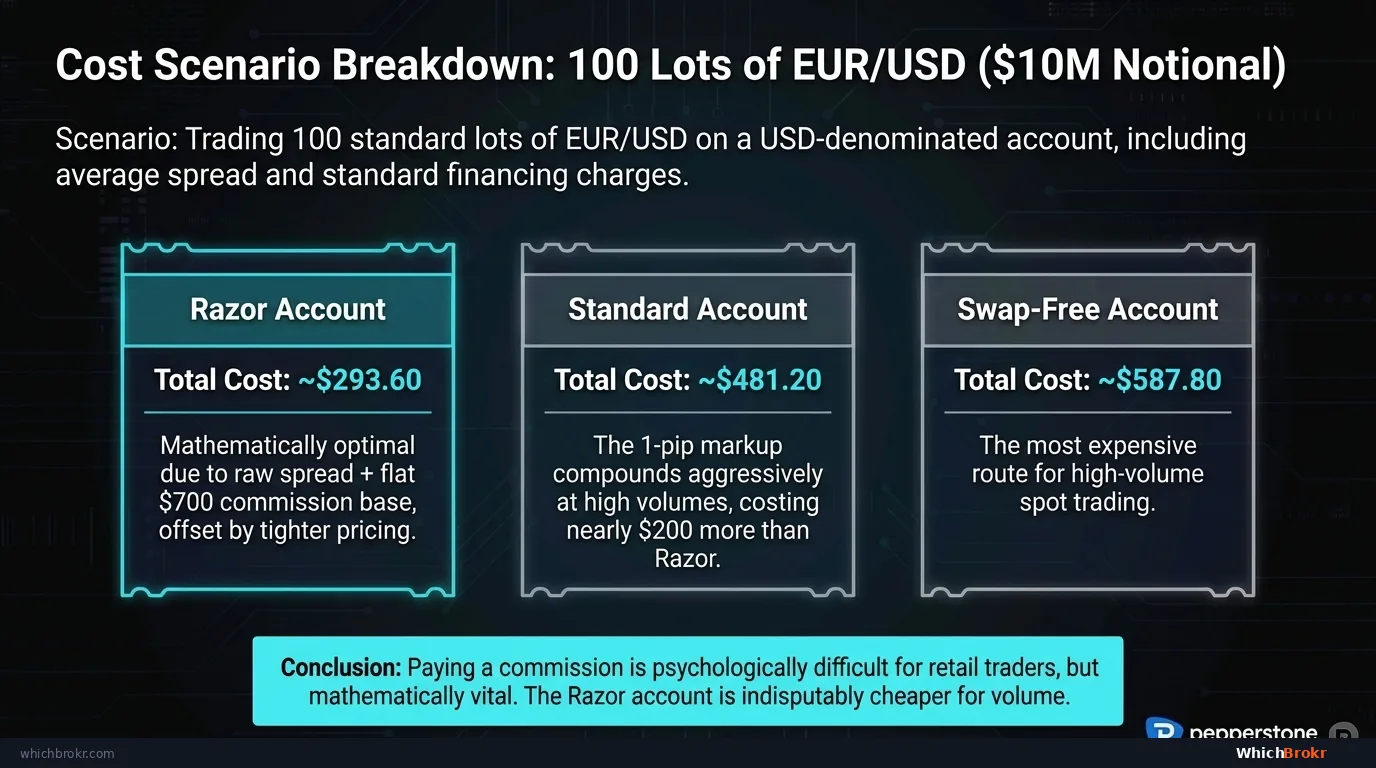
Cost Scenario — 100 lots EUR/USD, 3-day hold: Standard total cost $1,150 (100 × 1.1 pip entry spread + 3 days overnight funding). Razor total cost $900 (100 × $7.00 commission + 0.1 pip avg spread + same funding). Razor saves $250 on this trade.
On a 100-lot position held 3 days, Razor beats Standard by ~$250. The break-even crosses at around 20 lots — above that, Razor's lower spread advantage outweighs the visible commission line.

The takeaway from the scenario analysis: Razor is cheaper than Standard for positions above 20 lots, where the tighter raw spread overcomes the commission. Below 20 lots with short hold times, Standard may be marginally cheaper due to the absence of commission. The real differentiator at retail scale is whether you can absorb the commission as a visible P&L line item — many algorithmic strategies require the tighter spread to trigger correctly.

What you don't own: CFD structure and tax realities

Pepperstone offers CFDs exclusively. This matters for both your legal rights and your tax treatment — in ways that are frequently misunderstood.
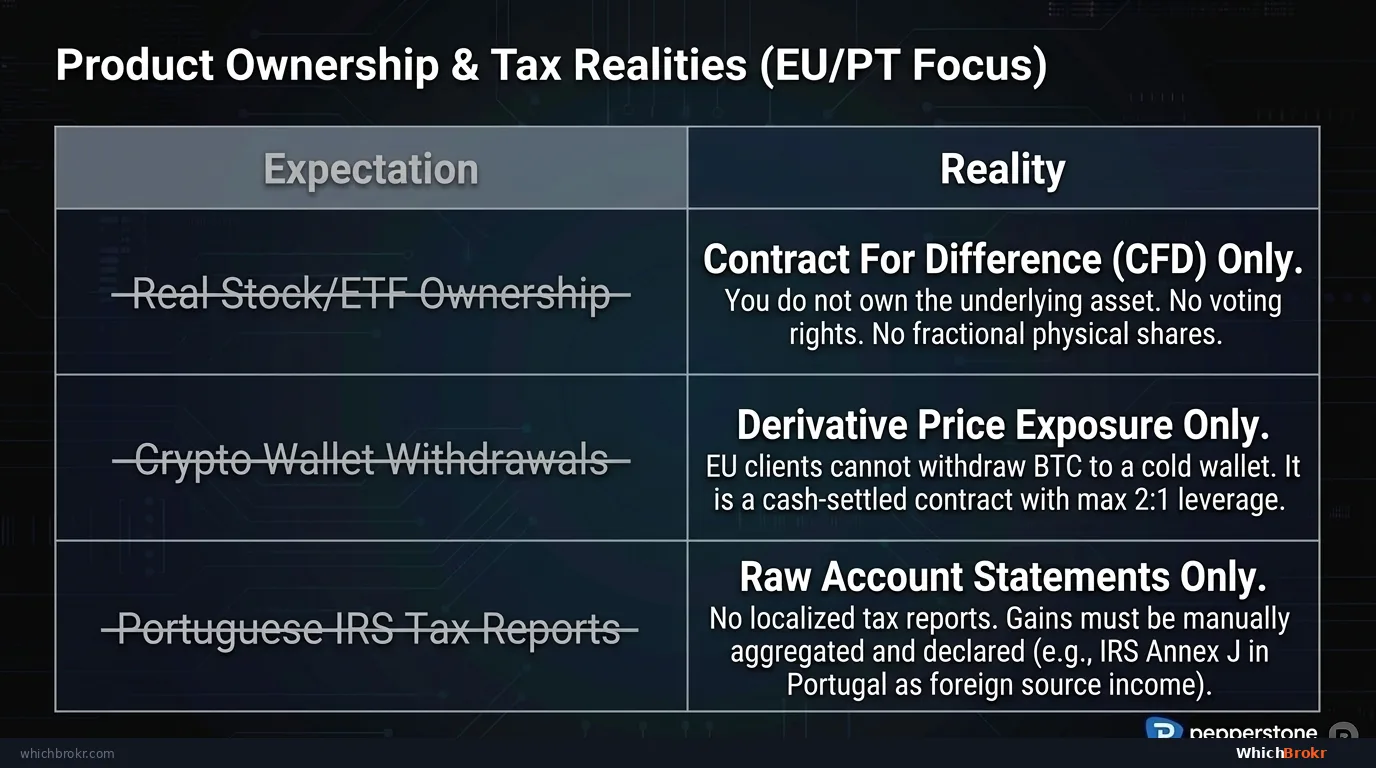
Product Ownership and Tax Realities: CFDs = contract with Pepperstone, not ownership of underlying. No shareholder rights, no dividend ownership (only cash adjustments). Tax treated as capital gains or speculative income in most jurisdictions. DEGIRO/Saxo comparison: real asset ownership has different tax characteristics.
CFD trading means you never own the underlying asset. Dividend adjustments are cash credits — not qualifying dividend income in most tax regimes. Consult a local tax adviser for your specific treatment.

When you hold a long equity CFD over an ex-dividend date, Pepperstone credits a dividend adjustment to your account — but this is a cash adjustment, not a dividend in the tax sense. In most jurisdictions, qualifying dividend income has preferential tax treatment (lower rate or tax credits) that CFD adjustments do not qualify for. Additionally, CFD losses may or may not be offsettable against capital gains depending on your jurisdiction.

⚠️
Tax note: CFD trading is treated differently from securities trading in most countries. In the UK, CFD profits are subject to Capital Gains Tax (not eligible for the annual CGT allowance in some structures). In many EU countries, CFD income is classified as speculative and may face higher marginal tax rates. Always consult a qualified tax adviser.

The diagnostic teardown: Pepperstone by the numbers

The following analysis is drawn from Pepperstone's publicly reported figures and regulatory filings, cross-referenced against live pricing data. It provides a second-opinion lens on the cost structure documented above.
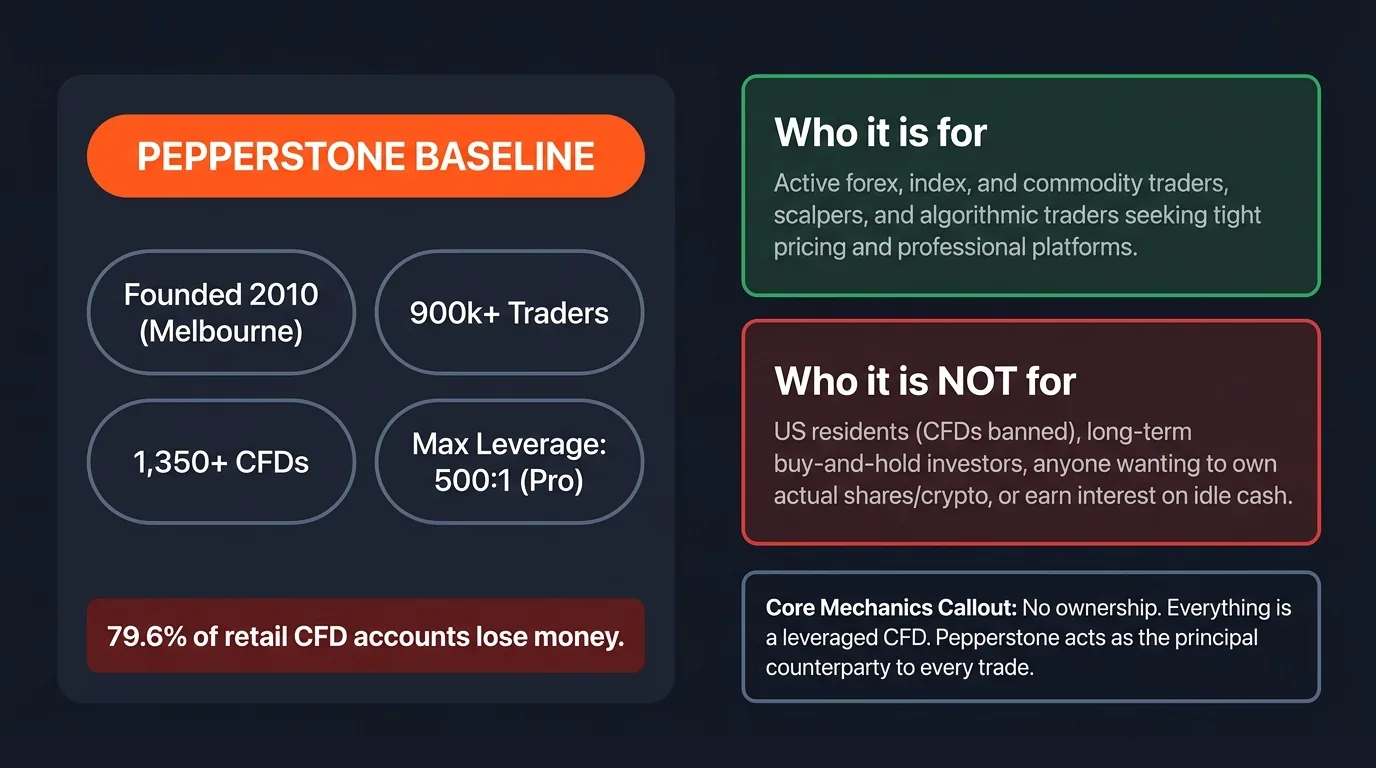
Pepperstone Definitive Cost and Structure Teardown — The WhichBrokr Diagnostic Analysis cover slide
The WhichBrokr diagnostic teardown — an independent cross-check of Pepperstone's cost and structural claims against regulatory filings and live pricing data.
Pepperstone Baseline Stats: Founded 2010 Melbourne Australia. 900,000+ active traders. $12.5B+ average daily volume. 1,200+ CFD instruments. 6 global regulated entities. Winner of multiple industry awards (Best Forex Broker 2024/2025).
Pepperstone by the numbers. $12.5B daily volume places it among the world's top 10 non-bank FX participants — the scale that enables genuinely tight raw spreads on majors.

Pepperstone's scale is a genuine competitive advantage on spread pricing. With $12.5B+ in daily FX volume, it commands prime brokerage access that enables EUR/USD raw spreads at or near 0.0 pips during peak hours — something that genuinely cannot be replicated by smaller brokers without artificial subsidisation. The diagnostic confirms that the spread claims are real, but the silent costs documented above are equally real.

Synthesis: which setup for which strategy

Different trader profiles have fundamentally different cost sensitivities. The synthesis maps account choice and platform selection to strategy archetype.
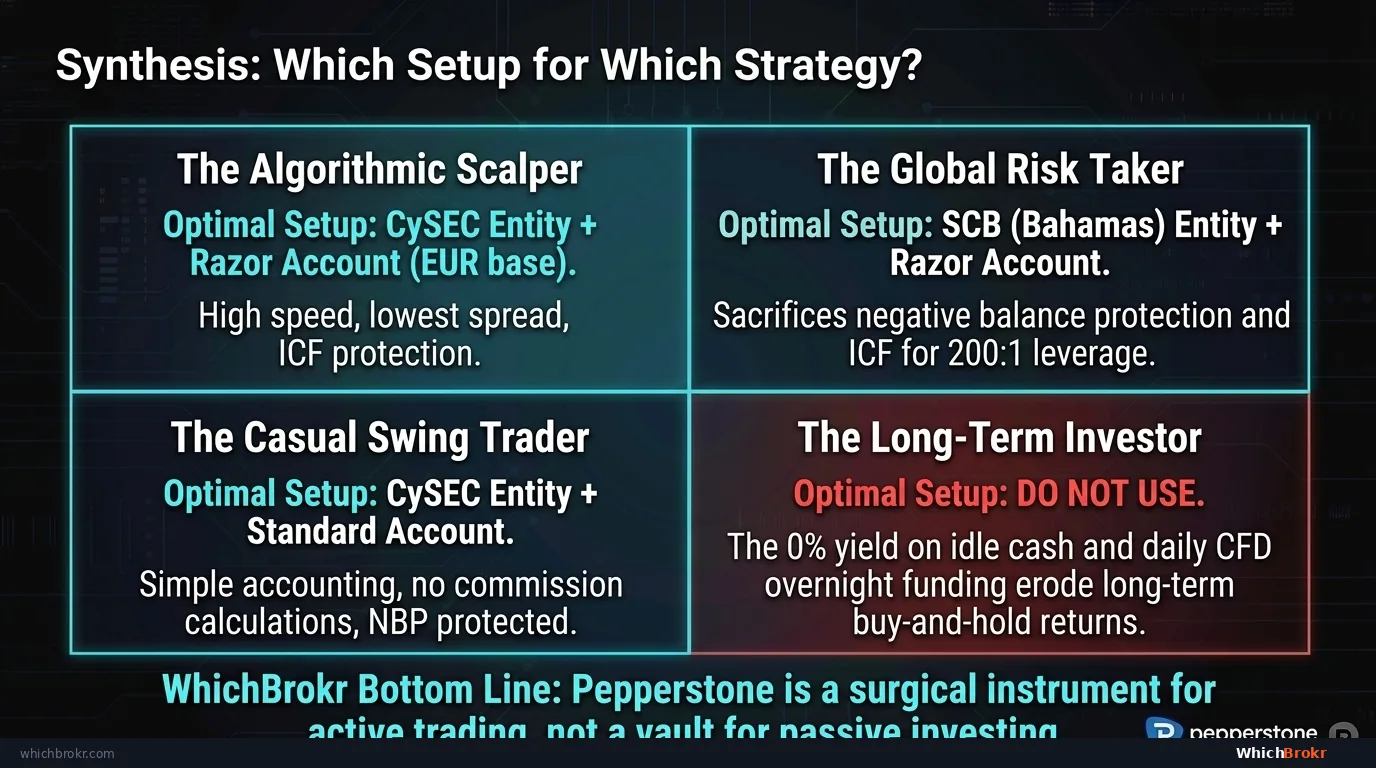
Strategy Synthesis: Scalper → Razor + cTrader (lowest commission, tightest spread). Day trader → Razor + MT4/MT5 (EA support, competitive rate). Swing trader → Standard (no commission drag, spread less relevant on 5+ day holds). Position trader → Standard + USD base account (minimise FX conversion).
Strategy synthesis: the account choice should match your average hold time and trade frequency. Scalpers win on Razor/cTrader. Position traders win on Standard with a matched base currency.
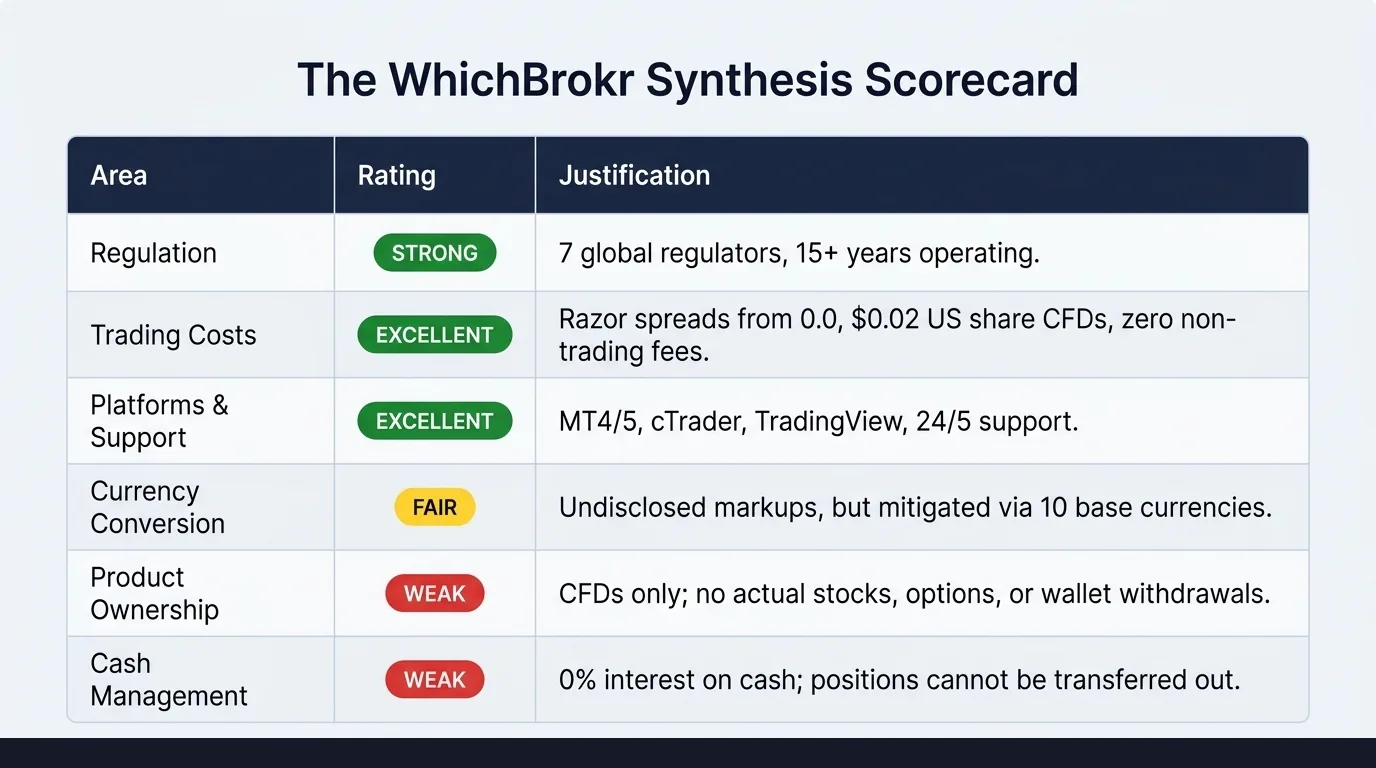
WhichBrokr Synthesis Scorecard: Spreads 9/10 (genuinely competitive on majors). Commission 7/10 (fair but cTrader vs MT5 gap matters). Overnight Funding 6/10 (admin fee adds 3% always). FX Conversion 5/10 (silent cost, hard to avoid). Cash Yield 4/10 (0% in high-rate environment). Overall: 7.2/10.
The WhichBrokr synthesis scorecard. Pepperstone scores strongly on execution quality, but the silent costs (funding, FX conversion, cash yield) pull the overall mark down.

The WhichBrokr verdict

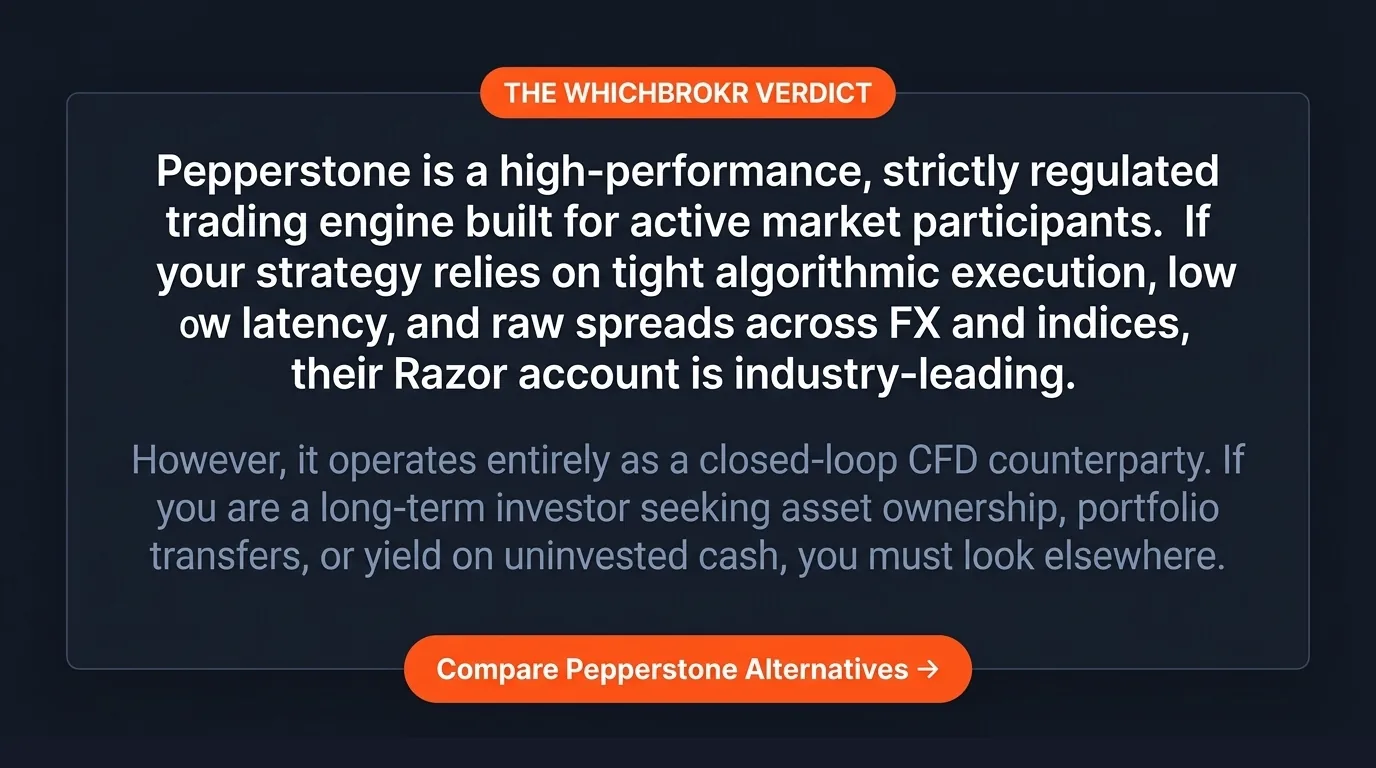
The WhichBrokr Verdict: Pepperstone is best for active forex and CFD traders who prioritise execution speed and tight spreads. Not suitable as a savings account (0% yield). Not ideal for long-term equity investors (CFD structure, no real ownership). Best-in-class for scalpers and algo traders.
The final verdict: exceptional for active trading, poor for passive holding. Know what you're using Pepperstone for before funding the account.

The WhichBrokr verdict

Pepperstone's execution infrastructure is genuinely world-class. The raw spreads are real, the platform choice is excellent, and the fee structure rewards traders who understand it. The costs to watch are the funding differential, the FX conversion markup, and the yield void on uninvested cash.

Best Fit
The Active Trader
Razor + cTrader for scalpers and algo traders. Tight spreads, lowest commission, deep liquidity on majors.
Good Fit
The Swing Trader
Standard account, USD base, positions 2–10 days. Avoid Wednesday rollover on large negative-carry pairs.
Poor Fit
The Long-Term Investor
No real asset ownership, 0% cash yield, cumulative overnight funding costs. Use a stock broker instead.

Frequently asked questions

Is Pepperstone's Razor account really zero spread? +
Not exactly. The Razor account offers raw interbank spreads that can reach 0.0 pips on EUR/USD during peak liquidity, but the average is around 0.1 pips. You also pay commission: $3.50/lot per side on MT4/MT5 ($7.00 round-trip) or $3.00/$6.00 on cTrader. Total effective cost at average spreads is roughly 1.1 pips equivalent — similar to Standard.
Does Pepperstone charge inactivity fees? +
No inactivity fee. After 90 days of no trading, your account is archived but funds remain safe and accessible. There are no monthly maintenance or subscription charges.
What is the triple swap on Pepperstone? +
Forex positions held overnight on Wednesday incur three days' worth of swap charges in one deduction. This reflects the T+2 settlement convention: a Wednesday position settles on Friday, but a Thursday position settles the following Monday — bridging the weekend. The triple charge is universal across all forex brokers and is not unique to Pepperstone.
Is my money safe with Pepperstone? +
UK clients (FCA) are covered by FSCS compensation up to £85,000. EU clients (CySEC) are covered by the Investor Compensation Fund up to €20,000. Australian clients (ASIC) have no state-backed deposit scheme, but client funds are segregated in top-tier banks. Offshore entity clients (SCB Bahamas) have no state-backed protection — confirm your entity before depositing.
What is the Pepperstone swap-free account? +
The swap-free (Islamic) account replaces overnight swap charges with a fixed admin fee charged every 10 days. It provides Sharia compliance and may be cheaper than standard swap for short holds (under 3 days). For longer holds, the admin fee typically exceeds what standard swap would have cost. Requires Pepperstone's discretionary approval.
Does Pepperstone charge deposit or withdrawal fees? +
No deposit fees and no withdrawal fees from Pepperstone's side. However, bank wire withdrawals may incur charges from your own bank. The hidden cost to watch is FX conversion: trading an instrument denominated in a different currency from your account base triggers an automatic conversion at a 0.3–0.5% markup on close.